Oz recalls its glorious past April 19, 2013
Posted by intellectualgridiron in Pop Culture.Tags: 1939, Alice in Wonderland, Bad Santa, Beast, Bill Cobbs, C.S. Lewis, classic, Disney, Dorothy, Emerald City, Family Guy, Famke Janssen, Fantasia, First Class, Frank Morgan, Giggity, Great, Indiana Jones, James Bond, James Franco, Kansas, Last Crusade, lion, Margaret Hamilton, Meg, MGM, Michelle Williams, Mike Myers, Mila Kunis, Narnia, Oz, Powerful, prequel, Professor Marvel, Rachel Weisz, recall, scarecrow, sepia, Technicolor, Tony Cox, Walt, witch, Wizard, X-Men, Xenia Onatopp, Yellow Brick Road
add a comment
 (Warning: a few subtle spoilers herein.)
One hallmark of a great prequel is that it shows/explains how something well-known came to be. For example, just how did X-Man Dr. Hank McCoy, a.k.a., “Beast,” become, well, so blue? You find out in “X-Men: First Class.” Just how did Indiana Jones develop a pathological aversion to snakes? You find out during the prequel segment of “Last Crusade.” So it goes for the Oz canon. Just how did this so-called wizard make his way from Kansas in a balloon to this famous, enchanted land? Just how was the relationship between the sister witches? All of that and more is explained in this movie.
By now, “Oz the Great and Powerful” has been released in theaters for over a month, so it’s likely that most readers have seen the film. As a Johnny-come-lately to the party, it’s hard to say anything that has not been said already about this film, but I nevertheless feel strongly compelled to try. The reason I do is simple: there is so much to like about this film that it is hard to know where to begin.
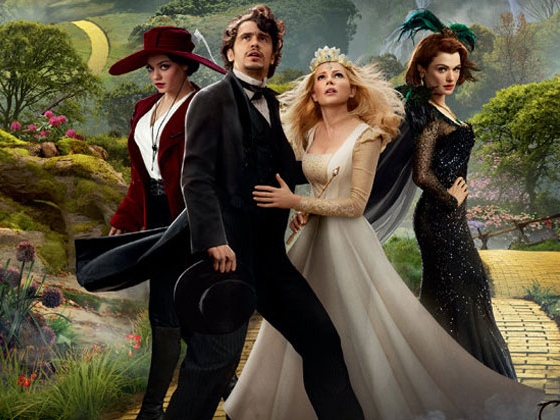
Why not start with the actors’ portrayals of the main characters? James Franco delivers as the protagonist; sure, a number of others could pull it off just as well, but his portrayal of the so-called “Wizard” of Oz — in reality, a traveling circus magician/con man/womanizer — is quite satisfactory, and gives you a plausible origin of how the whole Wizard myth began. When circumstances take him to a place that most certainly is NOT Kansas, he encounters not one, not two, but three witches, and eventually learns that the combined encounter is a family power struggle in which he is now ensnared. Oops! The first witch he meets, Theodora, played by Mila Kunis, ends up taking character development to the extreme. We the audience first meet her as a young, naive, pretty young lady, almost exuding Meg-like innocence (she provides the voice of Meg in “Family Guy”*). Nobody would consider a witch, though she is, and moreover, she later undergoes a metamorphosis, shedding her naive facade and afterwards remains, shall we say, jaded, both inside and out. Soon, though, Oz meets her sister, Evanora, played by Rachel Weisz, who, as the story unfolds, seems to be channeling her inner Famke Janssen-as-Xenia Onatopp (you fellow James Bond aficionados know what I mean!) both in terms of appearance/attractiveness (Giggity!* — although that changes at the end of the film) and in terms of which side of good/evil she truly has chosen. Not until Oz meets the third witch, Glinda, that he becomes enlightened as to who is actually good and who is actually — queue the Mike Myers voice — evil (/puts pinky finger to side of mouth). Speaking of Glinda, her portrayal by Michelle Williams is superbly charming. Any man with a pulse would jump at the chance to make her queen of his kingdom.
The secondary roles are more than ably filled, too. Tony Cox, whose image as the foul-mouthed, sawed-off sidekick in “Bad Santa” is forever humorously etched in my mind, is extremely well-suited for his role as an irascible munchkin. Bill Cobbs as a jack-of-all-trades tinkerer practically brings a smile to your face, too. Other key characters are brought to you via the wonders of modern film-making magic. Indeed, the biggest reason we the movie-going public were never treated to a big-time, big-budget adaptation of, say, C.S. Lewis’ Chronicles of Narnia was that the things described in that story were so fantastical, the special effects technology simply was not there until the middle of the last decade to finally do it justice on the big screen. Same things goes for this film in question in many respects, one being two of the characters that become part of Oz’s group as he finds himself on a mission in a land that coincidentally bears his name. Only the latest in special effects could properly portray a flying monkey dressed like a ritzy hotel bellhop, or a young girl who is a walking, talking china doll. The latter character brings much to the proverbial table, as some of the interactions between her and Oz are the most tender scenes in the whole film.
But what I loved most about the film was all the special efforts made in recalling the original 1939 masterpiece to which this movie is a prequel. Start with the treatment they give to the opening segment of the film. In the 1939 original, everything is in black and white. Only when Dorothy’s house crashes into Oz, thus sending the Wicked Witch of the East to an early albeit timely demise, does the film turn to color. Keep in mind that color films in the late 1930s were few and far between. Color alone would have amazed the audience, but the Technicolor that MGM employed was exceptionally vivid. Same thing goes for this new film. The opening, “real-world” segment of the story is also depicted in sepia, and only after the protagonist survives his ordeal of a journey into the magical land does the eye-popping color open up before the audience’s eyes.
But that is just for starters. The start of the Yellow Brick Road as a spiral directly recalls MGM’s standard-bearing predecessor, as does the physical setting of the Emerald City. One can see its sparkling skyline in the distance behind fields of ultra-colorful poppies, which in turn run up to the edge of a dark forest. Speaking of the city’s skyline, it also recalls the original from ’39; maybe not as art deco, sadly, but it makes up for it with its realistic imagery, not just a large painting on the wall of a sound stage. Even the way the curtains drape in the throne room and in the hallway leading up to it seem to recall the timeless classic. Better yet, Glinda’s memorable arrival in a magical bubble is recalled in fashion more splendid than ever before. Speaking of memorable entrances, one of the witches making a scary entrance with red fire is a fitting nod to how that character did the same thing in the [much] earlier film. Moreover, though the story obviously predates the rest of the dramatis personae (Dorothy et al.), it does well in making oblique references to both the Scarecrow and the Cowardly Lion. Even the turban that Franco’s Oz wears on his head while an illusionist with the traveling circus in Kansas recalls that atop Frank Morgan‘s head as Professor Marvel. Let us also not forget the parallel characters in the protagonist’s life between Kansas and Oz.
Regarding the explanation of how things come to be, not only is the origin of the Wizard’s throne room act of smoke and bombast cleverly explained, what is even more clever is the scenario that first necessitated it. Plenty of other things about the film recommend it, though, in addition to the wonderful references to the 1939 classic. When Oz finds himself in this strange yet beautiful world, part of the incredible scenery he takes in are various exotic plants making music; such is a classic, vintage Disney touch, right out of “Fantasia” or “Alice in Wonderland.” Ol’ Walt would have been proud of these touches, and indeed of the whole film.
*See? Even when talking about the Wizard of Oz and Disney, we can still make Family Guy references! And who’da thought that Meg could so effectively channel her inner Margaret Hamilton?
The Dinosaur Football Roster April 3, 2013
Posted by intellectualgridiron in Science, Sports.Tags: Brett Favre, dino, dinosaur, Dromiceiomimus, football, linebacker, Ornithomimus, position, roster, T-rex, wide receiver
add a comment
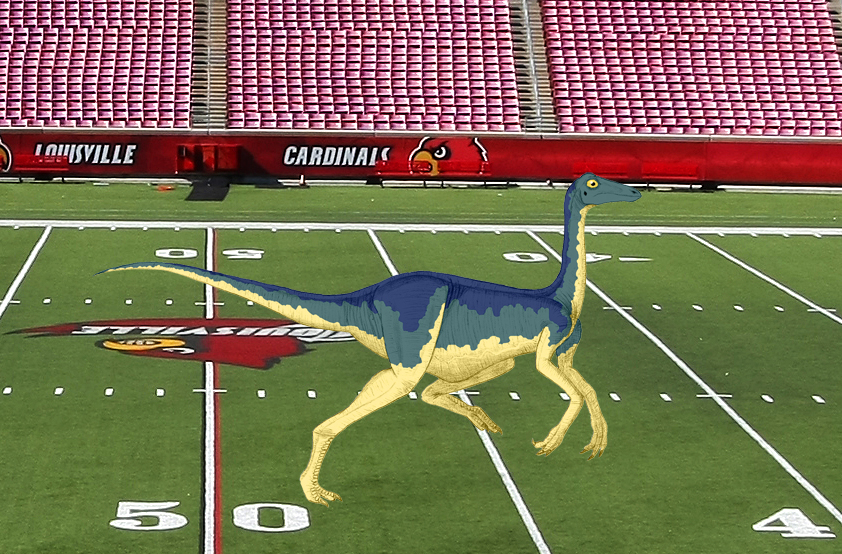
Ornithomimus/Dromiceiomimus (depending on your nomenclatural school of thought) would make an ideal wide receiver within the world of dinos, according to a paleontologist. Photo and drawing by author.
Holy cow is this awesome! Spencer Hall of Every Day Should Be Saturday interviewed a vertebrate paleontologist who gave him the break-down on what dinosaur species would be the best football players at different positions. In yet another cool instance of where science meets sports, it doesn’t get much better than this!
The only flaw I could discern in the blog article is with one of the photo montages. The scientist explicitly said that T-rex would make the best middle linebacker (and I concur!), but they superimposed a Raptor head from Jurassic Park on Ray Lewis instead of that of a Tyrannosaurus head like they should have. True, both were carnivorous Theropods, but T-rex was much larger, robust species, whereas the Raptors, like the other Dromaeosaurids, were smaller and more nimble, thought arguably pound-for-pound, even more ferocious than the King Tyrant Lizard (whose head they stuck on Brett Favre instead!). Spoiler alert: in the article, Dromaeosaurids are, not surprisingly, given a place on the roster, too!
Buicks and Dinosaurs March 28, 2013
Posted by intellectualgridiron in Pop Culture, Science.Tags: ad, Apatosaurus, Argentinosaurs, Buick, Cadillac, Carnosaur, Ceratopsian, Chasmosaurus, cold-blooded, commericial, dino, dinosaur, Diplodocus, Encore, General Motors, Giganotosaurus, GM, homeothermic, hot-blooded, Stego, Stegosaur, Stegosaurs, T-rex, Theropod, Triceratops
add a comment
As a life-long Paleontology enthusiast, I feel compelled to give General Motors lots of credit for this creative commercial. Remember that comic book and cartoon series “Cadillacs and Dinosaurs”? Well, feast your eyes on the next-best thing: Buicks and dinosaurs!
What caught my eye the first time I saw this commercial was not just the dinosaurs, but their species and size. Yeah, they were big – really big, but just how big? It obviously varies from genus/species to genus/species, but what interested yours truly was their depicted size in the commercial. We science/engineering geeks are sticklers for accuracy, after all!
Start with the beginning. The Stegosaurs parked next to the fire hydrant are accurate. Stegosaurus armatus, for example, reached about 30 feet in maximum length, meaning that its likeness regarding shape and size in the commercial is well portrayed (S. stenops was not quite as long at 23 feet in max. length). So far, so good!
At seconds 6 through 13, we feast our eyes on a massive Sauropod, massive even by the standards of the already-large species found within the infraorder. My first guess was this was an outsized specimen of Apatosaurus (known by many as “Brontosaurus,”) which was indeed large at an average length of 75 feet. But as big as it was, it is doubtful that its feet were almost as wide as the car itself, even if the Buick Encore is relatively small. The photo below of a Apatosaur skeleton right next to a Diplodocus skeleton might give the reader a better reference of its average size, as one can see a couple of people standing behind it.
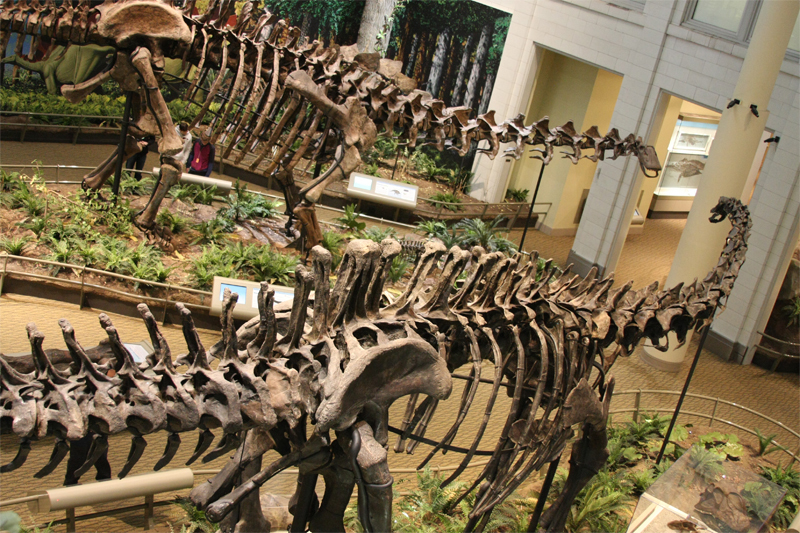
Apatosaurus in the near background, and Diplodocus in the foreground at the Carnegie Museum of Natural History in Pittsburgh; photo by author, Dec., 2010.
My guess regarding the large Sauropod depicted in the commercial in question is either an outsized specimen of Apatosaur (it was the overall shape of one, if not oversized), or, more plausibly, an Argentinosaurus, one of the largest dino species currently known to man. This compilation of photos I snapped at the Fernbank Museum in Atlanta back in early 2009 should back up the validity of this educated guess. The man ascending the staircase gives the reader an idea of its huge size.
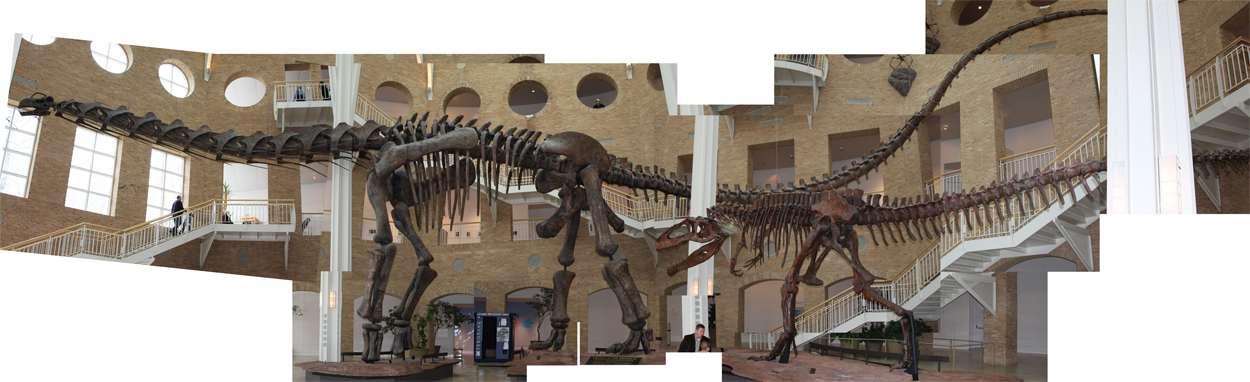
Argentinosaurus reconstructed as being pursued by a Giganotosaurus, a Carnosaur/Theropod even longer than T-rex! Photo by author, Fernbank Museum, Atlanta, Mar. 1, 2009.
Next up at seconds 14 through 16, the couple in the Encore are passing up a couple of Ceratopsians. The initial impulse is to say “Triceratops,” which is entirely understood, given that he was the biggest and most famous of that suborder. But the frills of these two fellows are way too squared for that to be Triceratops, so my educated guess is that these are slightly outsized Chasmosaurs, who also had three horns like their slightly larger cousin (most Ceratopsians just had one, on the nose), even though theirs were not as long as the larger species.
Meanwhile (“…back in the jungle!”), as the camera gives us the vantage point of seeing through the windshield from the backseat, we see more Stegosaurs and Sauropods moving along the boulevard during seconds 17 through 19, and then the car has to maneuver around another large Sauropod (possibly a slightly-outsized Apatosaur, if not another Argentinosaur), before eventually pulling into a hotel entrance next to another Stegosaur to cap off the commercial. Here the Stegosaurs is depicted a bit larger than its maximum size, unless the roof in front of the hotel desk had a very low clearance of 13 feet or less, as that was S. armatus’ maximum height, plates included. The Stego tail and spikes in the background during seconds 27 through 29, however, are sadly way oversized. The spikes in question would reach about three feet at the most.
Something else that gave cause for notice is that all the dino species depicted in this GM commercial are plant eaters. So what, right? The significance of this selection of species was that these are thought by many – though by no means all – scientists to be cold-blooded, or at least homoethermic, whereby they were big enough to maintain their own temperatures. But put these two things together, and these species would be, on average, on the slower scale of dino agility, particularly when compared to their potentially hot-blooded Theropod predators.* What it boils down to is a “big-and-slow” versus “small-and-nimble” comparison that GM implicitly makes in this advertisement.
One must analyze these sizes with the perspective that these are all computer-generated, and as such, when superimposed into a real-world setting, it’s difficult to get the relative size proportions correct, especially when these objects are in constant motions and audience viewing angles are constantly shifting. Still, while most shown sizes are a tad exaggerated, some were dead-on, and overall, the effort is quite laudable, as the commercial certainly piqued my interest, and hopefully those of millions of other viewers!
*The cold-blooded/warm-blooded dinosaur debate has been brought up before in a previous article and shall surely be revisited again.
NCAA Men’s Basketball Awards, post-Round 2 March 25, 2013
Posted by intellectualgridiron in Sports.Tags: Akron, Andy Endfield, award, basketball, bracket, Butler, college, Dr. John Giannini, Duke, Florida, Florida Gulf Coast, Georgetown, Gonzaga, Gregg Marshall, Hades, Illinois, Indiana, Iowa State, IU, John Groce, John Thompson III, Kentucky, LaSalle, Louisville, Mark Few, Marquette, Miami, Michigan State, Minnesota, NCAA, NIT, North Carolina A&T, Oklahoma State, Oregon, Rick Pitino, round, St. Louis, Syracuse, Tom Creen, tournament, tourney, U of L, UCLA, VCU, Wichita State
add a comment
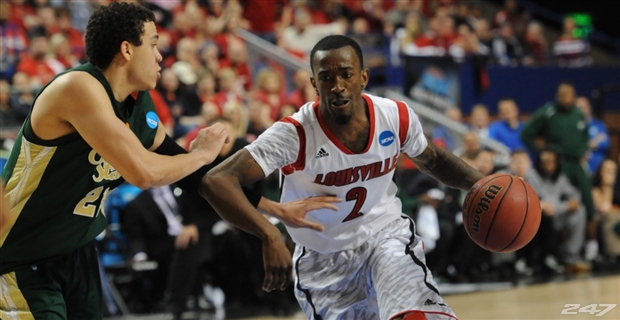 I’m not the most knowledgeable person about college basketball or roundball in general, but the developments over the first two rounds led me to notice that some of the awards I usually bestow at the end of each regular season week of college football might also apply during this, the 2013 NCAA men’s basketball tourney.
It’s been an interesting one thus far, what with some key upsets that have shot many a person’s bracket to Hades. Although, if you went “chalk” in the West region, you’re good for the Sweet Sixteen! Anyhow, Enjoy!
COACHES
Wish I were him: Rick Pitino, Louisville
Glad I’m not him: John Thompson III, Georgetown
Lucky guy: Dr. John Giannini, LaSalle
Poor guy: John Groce, Illinois
Desperately seeking a wake-up call: Tom Creen, Indiana
Desperately seeking a P.R. man: Gregg Marshall, Wichita State (honorable mention: Andy Endfield, Florida Gulf Coast)
Desperately seeking sunglasses and a fake beard: Mark Few, Gonzaga
TEAMS
Thought you’d kick butt, you did: Louisville (both rounds)
Thought you’d kick butt, you didn’t: Indiana (round 2)
Thought you’d get your butt kicked, you did: North Carolina A&T (round 1)
Thought you’d get your butt kicked, you didn’t: Florida Gulf Coast (both rounds)
Thought you wouldn’t kick butt, you did: Iowa State (round 1)
Dang, they’re good: Louisville
Dang, they’re bad: Akron
Can’t Stand Prosperity: Gonzaga
Did the season start? St. Louis
Can the season end? Kentucky (yeah, I know, not even in the tourney, but they were one-and-done in the NIT!)
Can the season never end? Oregon (honorable mention: Florida Gulf Coast)
GAMES
Play this again: Marquette 74, Butler 72
Never play this again: VCU 88, Akron 42
What? Oregon 68, Oklahoma State 55
Huh? Florida Gulf Coast 78, Georgetown 68
Are you kidding me? Oregon 74, St. Louis 57
Oh – my – God: Wichita St. 76, Gonzaga 70
Told you so: Minnesota 83, UCLA 63
NEXT WEEK
Ticket to die for: Indiana vs. Syracuse, also Michigan State vs. Duke
Best non-Big Six vs. Big Six matchup: Florida vs. Florida Gulf Coast
Best non-Big Six matchup: Wichita State vs. LaSalle
Upset alert: Michigan vs. Kansas
Must win: (all of them: duh!)
Great game no one is talking about: Miami vs. Marquette
College Football Drills in Wintertime February 28, 2013
Posted by intellectualgridiron in Sports.Tags: 06:00, 6 A.M., 6 AM, 6 AM's, ball, Clemson, coach, college, conditioning, Cup, directional, drills, football, Fulmer, Georgia, Jim Colletto, Joe Tiller, Mark Richt, mat, Mollenkopf, NCAA, North Texas, practice, puke, Purdue, spring, Sun Belt, winter
add a comment
We are still in the winter season, normally associated with basketball, wrestling (the non-pro kind!) and Winter Olympic-related sports. The Super Bowl has been concluded for almost a month by now, and the college football bowl games have been over for almost two. But do not think that nothing is going on in the world of college football; things are anything but sleepy in that world right now, and I don’t mean the latest developments in the Fulmer Cup, either!
The truth is, college football is very active right now, just not active in the way that ordinary fans, hard-core and casual alike, can readily see or discern. That is because fans do not see the tough conditioning drills that players put themselves through (scratch that, that COACHES put players through) during the week, often at very inconvenient times of day, to get them ready for Spring Ball.
Conditioning is the game, here. The NCAA restricts coaches to 15 spring practice sessions, so there’s no time to waste on gassers or the like when there’s plenty of schematic options to explore to see how they play out and to try to install new offensive stuff for the regular season come Fall.
That means that these boys need to be in shape for all of that. What is truly interesting is all the different approaches that coaching staffs take towards these conditioning sessions, starting with what their nomenclature. One generic, all-purpose term is “winter conditioning drills,” since they last from early February, usually, to early March, though that alone varies from program to program. Another term some teams use is “mat drills,” since some of the conditioning drills take place on wrestling mats or a similar playing surface. At Purdue, we just called them “6 AM’s”, since that’s when these drills officially began.
Six-AM’s are a royal pain in the ass. There, I said it. Some coaches seem to agree, with is why schools of thought differ even on this approach, since some programs WISELY undertake these conditioning sessions in the AFTERNOON (why, what a novel idea!). As disastrous a head coach as Jim Colletto was while at Purdue, one of the few bright spots during an otherwise dark time for the program was that he had said conditioning drills held in the afternoon, when normal people are still, you know, functional. Coach Joe Tiller, however, in a hasty move to — otherwise commendably — change the tone of the program (and goodness knows it needed a change of tone at the time) had them in the morning, hence the term at the beginning of this paragraph.
But Purdue is not the only one; many a program from UConn to USC has had these sessions at 06:00, for whatever reason. Luckily, there are voices of reason at big-time programs that still have them in the afternoon. Take Georgia, for example (this policy alone strengthens my faith in Mark Richt’s adept leadership):
FYI, those human-centipede push-ups are a lot harder than they look! Notice the presence of a red mat in the middle of the indoor practice field, though. We never used a mat for drills on the astroturf playing field of Mollenkopf Athletic Center (field turf was finally installed in there in 2006), which might account for the absence of the mat drill term within our organizational lexicon.
Still, another interesting thing to marvel is what sort of combination of drills the coaches prefer to get their players into shape. We never did the human-centipede push-up drill at Purdue, for example, but one constant one will find from program to program are all sorts of directional drills. Those are simply where the coaches have players run or side-shuffle in one direction then instantly turn to run in a different direction and so on. Players would go to various drill stations throughout the session and about four or five-minute intervals, and variations of directional drills were usually two out of several of said stations. Because two stories of staircases leading to the coaches’ offices were located close to the indoor field, another station was to have players run up and down said stairs — ensuring that endurance and power were covered!
Clemson is considered a big-time program, but sadly they still cling to the out-dated notion of having drills pre-dawn. North Texas, an inconsistent contender in the Sun Belt, also still have their sessions before sunrise.
Notice the good examples of directional drills show in the above video. The tug-of-war drill is no doubt a cool idea! Another constant one sees during these drills from program to program are the puke buckets. Part of the job of the managers are to set up these drills (meaning they must report around 5:30 AM), and part of the setting-up is placing those plastic, dark gray garbage cans in, er, strategic areas for players to conveniently access in the split second before they blow hash. On further review, one advantage to running before dawn is that one needs not to worry about losing one’s breakfast!
At Purdue, after the players were thoroughly worn out from all the drills, to cap things off, the coaches had them run 100-yard wind sprints repeatedly. After all of that, the session would not be completed until all the players on the team did positioning drills (lie on your back, the whistle blows, then you instantly switch to lying on your chest, etc.) to the coaches’ satisfaction. Doing these twice a week to start out seemed manageable. Three times a week and it wears considerably on you; but at four times a week, it pushes you towards the brink of insanity, and makes you jump for joy when it comes time for spring practices to commence. At least we could brag, though, that we practiced while [normal] people slept!
Addendum, 04-03-13: Yes, by now, spring practices are in full-swing all across the land, but I just came across a video of Purdue’s 6 AM drills for 2013, and naturally found that to be a great fit for the article — enjoy!
You too can put together a Top 25 CFB preseason poll! February 17, 2013
Posted by intellectualgridiron in Sports.Tags: ACC, Alabama, AP, Auburn, B1G, Big 10, Big 12, Big East, Big Ten, Big XII, Boise State, Braxton Miller, Cal, Charlie Weis, Cincinnati, Clemson, college, conference, Duke, Florida, Florida State, football, Georgia, Georgia Tech, Kansas, Kansas State, Louisville, LSU, MAC, Manti Te'o, Michigan, Michigan State, Mississippi, NCAA, Nebraska, Northern Illinois, Northwestern, Notre Dame, Ohio State, Oklahoma, Ole Miss, Oregon, Pac-12, preseason, Purdue, ranking, San Jose State, SEC, South Carolina, Stanford, Texas, Texas A&M, Texas Tech, Tim Tebow, Tommy Tuberville, top 25, UC, Urban Meyer, USC, Utah State, Vanderbilt, West Virginia, Will Muschamp
add a comment
Ever wanted to make a college football Top-25 preseason ranking but just didn’t know how? Well, now you do! Thanks to the hilarious writers at SBNation’s Every Day Should Be Saturday, we now have a guide at our disposal to put such a list together and look like prognostication geniuses in so doing! I have taken the liberty of quoting the guiding text to give you reference while we play along. The quoted text from the actual (and funny) guide page is given in italics.
1. Alabama. Look, maybe you have a perfectly strong case for some other school, but if you go off the reservation right away, the readers are going to suspect something is amiss. Stay with the pack here and, if the Tide stumble, you’ll be one of many mistaken scribes, not a distinct and lonesome idiot.
Alabama looks and sounds like a winner to me!
2. Big 12 or Big Ten team. BOOM! Because you started comfortable, those stupid readers didn’t see this knowledge roundhouse coming. Pick a team that didn’t meet expectations in 2012 and talk about how they’ll be “hungry” and “focused” because of it.
Michigan, perhaps?
3. SEC team. Mention how battle tested playing in the conference will leave this team by the end of the season. Then hedge by saying SEC play could eat them alive. SPORTSNIGMA!
Texas A&M; they’re really hot right now. Seriously, so much for them having to get behind Arkansas like we all predicted last year!
4. Ohio State. Emphasize how good the team looked in the first year of a new system. Ignore that they barely beat Cal, Indiana, and Purdue. Clunky suggestion that Braxton Miller could be the next Tim Tebow. Obliquely suggest Urban Meyer could quit at any week for any reason.
Ohio State, and this is why I didn’t put them at the No. 2 spot like I would have otherwise.
5. Oregon or Stanford. Sh-t, you meant to put one of them higher, but that much backspacing seems like a real pain in the ass. Say something here about how you’re being cautious not to put too much stock into a big bowl performance.
Stanford, for reasons of coaching continuity.
6. Team Coming Off A Big Bowl Performance. Clemson-Louisville national championship game ahoy!
Okay, I’ll bite. What the heck; let’s put Louisville in there for the fun of it!
7. SEC team. Which one? Any one THAT’S JUST HOW DAMN GOOD THEY ARE MAN. (Seriously, though, not Auburn.)
Seriously; definitely not Auburn! Already put Texas A&M in there, so let’s have LSU fill this slot, shall we? Or maybe South Carolina; yeah, definitely the Gamecocks. They’re doing quite well right now.
8. Notre Dame. Yes, Irish fans are going to be super pissed at the perceived disrespect, but that’d be true even if you ranked ND numbers one, two, and three simultaneously. Don’t fight a losing battle. Just slot them here and suggest that they could be better off without Manti Te’o.
Notre Dame; and they might not miss Manti Te’o that much if their highly-ranked recruiting class has any teeth to it, unlike “highly-ranked” recruiting classes under Charlie Weis.
9. Oregon or Stanford (whoever you didn’t put at 5). Say something about how they’ve lost a lot of key pieces. Is it true? Players graduate, don’t they?
Oregon, for reasons of lack of coaching continuity.
10. ACC team. You’ll need to construct a paper fortune teller and write the names of four plausibly successful teams twice each. Be sure you only do it twice, because if you write out “Georgia Tech” three times on the same piece of paper Paul Johnson appears out of nowhere and insists on rearranging your pantry.
Well, we already put Louisville at No. 6, so we might as well put Florida State into this one.
11. Team that will likely have three losses before Halloween. Your obligation in preparing this ranking is not simply to come up with a sensible accounting of the top 25 teams heading into the season. It’s also to provide us with teams destined to leave unreasonable expectations unfulfilled. Who will be this year’s Arkansas? THE POWER IS YOURS!
Ole Miss, because expectations are high due to their half-way decent team from last year and No. 7-ranked recruiting class this year.
12. Team with the highest ranked recruiting class that you have not yet included. I mean, all that talent wouldn’t be going to a bad team, would it? And I bet half of them start right away! (note: I do not know how recruiting works)
I want to put Florida here, because they’ve got the No. 4-ranked recruiting class, and I’ve got to stick ‘em somewhere! But, skip down to No 14, and you’ll find out that cannot be done, according to this system. So, we’ll put in Oklahoma.
13. This is exhausting. You really deserve a lemonade, and maybe even an oatmeal cookie. I mean, people bitch about preseason rankings, but then they lap them right up like hungry dogs. Do they not understand how market forces work? Oh, um, Michigan State. Whatever.
Georgia; gotta stick ‘em somewhere.
14. Florida. “Will Muschamp is driving a truck with a great engine and no brake pads. Will Muschamp is eating a sandwich with meat and no bread. Will Muschamp is developing a model that explains how light behaves like a particle but not as a wave.” Metaphor them to death in this middle section.
Okay, NOW we’re allowed to put Florida in there.
15. School that was good six years ago and has stunk since. Because these things are cyclical, or something.
USC, anybody?
16. Team stocked with seniors that have mostly underachieved up to this point. They just want it more, man. That’s why they’re fighting in spring practice. Out of love.
Michigan State, perhaps?
17. Big 12 team with a miserably weak non conference schedule. Basically, this is between Texas Tech, West Virginia, Kansas, and Kansas State. Kansas is out for reasons of being Kansas, so just pick one of the other three and feel like a genius up to, but not beyond, Week 5.
West Virginia is the safest pick out of the three, at least through Week 5. After Week 5, it might be Texas Tech. Just sayin’.
18. Big East team. Start out by noting that the conference had a better bowl winning percentage last year than the every other AQ conference. Pretend you knew that Memphis was joining this year without looking. Realize that the team you pick could join the ACC before this gets published. Shrug, and continue trying to beat Jetpack Joyride.
Cincinnati, because after U of L, UC is the only Big East team that comes to mind, and goodness knows what could happen with Tommy Tuberville at the helm.
19. Team that was terrible but hired a trendy coach. You’ve already won me over, Cal, in spite of me.
Okay, let’s go with Cal. Let me waste another space on something ridiculous, why don’t you!
20. School from a non AQ conference. Again, this is mostly an exercise in antagonizing fans, so just find a Mountain West or MAC team that could plausibly win eight games and put them here. Then say something snide about the Big Ten.
Ah, so THIS is where you put in Boise State!
21. Scandium. Don’t think it belongs here? Check your atomic numbers, clown.
Okay, now they’re being downright silly. Not funny, just silly. Let’s go with LSU.
22. Team with a coach on the hot seat. If you’re not sure who qualifies, just pick any coach that hasn’t won a conference title in the last two years and say he’s on the hot seat.
Texas, because even though I love Mack Brown as a person, he ought to be on the hot seat after three consecutive seasons of underperformance.
23. Almost there! Pick any team, say this is a make-or-break season for the program, and move forward.
Auburn, because after the horrible year they had last season, we’ll now see how quickly they can bounce back.
24. Duke.
Are you kidding me? Alright, we’ll play along for the funny hell of it.
25. Team that barely made a bowl last year. “Trial by fire has made them stronger” sounds way more optimistic than “holy sh– they needed a punt return touchdown to beat Sweet Valley High.”
Heck, Purdue barely made it to a bowl game last year, but I’m certainly not putting them at No. 25! I’d put somebody like Nebraska in there, but I don’t know if it fits the template. Screw it; I’ll put Nebraska in anyway.
Now, let us see how this ranking plays out, according to the above formula:
- Alabama
- Michigan
- Texas A&M
- Ohio State
- Stanford
- Louisville
- South Carolina
- Notre Dame
- Oregon
- Florida State
- Ole Miss
- Oklahoma
- Georgia
- Florida
- USC
- Michigan State
- West Virginia
- Cincinnati
- Cal
- Boise State
- LSU
- Texas
- Auburn
- Duke (groan!)
- Nebraska
I know, I know; LSU is ranked way too low, and it bothers the heck out of me, too. Just for fun, let us compare this with the current 2013 AP preseason Top 25 poll:
- Alabama (no surprise there!)
- Oregon
- Ohio State
- Notre Dame
- Texas A&M
- Georgia
- Stanford
- South Carolina
- Florida
- Florida State
- Clemson
- Kansas State
- Louisville
- LSU (beats not being ranked at all!)
- Oklahoma (I knew they were overvalued!)
- Utah State (there had better be a darn good reason for this!)
- Northwestern (quite plausible, actually)
- Boise State (are you sure you want them that high, AP?)
- Texas
- Oregon State
- San Jose State (huh?)
- Northern Illinois (I guess they felt compelled to stick a MAC team somewhere)
- Vanderbilt (also plausible; have you seen their recruiting class lately?)
- Michigan
- Nebraska
For starters, I’m really regretting sticking Michigan in that No. 2 slot, but the formula called for a Big Ten team, and Ohio State was already locked in to No. 4; what was I to do? The Florida State ranking, though, seems pretty spot-on, and many others (Alabama, Ohio State, Texas A&M, Stanford, South Carolina, and Nebraska are within one or two rankings). Yes, it’s all in fun and jest, to be sure, but it shows that sometimes these whacky formulas work, other times, not so much. And it still sticks in my craw that it compelled me to under-value the Bayou Bengals, and grossly over-value Michigan.
The potentially existential problem at the University of Texas February 10, 2013
Posted by intellectualgridiron in Politics.Tags: 3M, academia, academic, B1G, Berkeley, Big Ten, brand, Cadillac, Cal, Carrier, Chevrolet, Chevy, critical, culture clash, doctorate, DuPont, education, engineering, equity, Evergreen, Florida, G.E., G.M., GE, General Electric, General Motors, GM, Golden, Great Lakes, Harvard, higher ed, Hoosier, Indiana, institution, Ivy League, leftism, Lockheed-Martin, Magnum, marketable, marketing, Marxism, masters, Michigan, Minnesota, Pac-12, Packard, Penn State, prestige, professor, public, Purdue, R&D, research, school, SEC, secondary, state, Texas, UCLA, undergrad, United Technologies, university, USA Today, UT, vocation, Washington, Wisconsin, world-class
add a comment
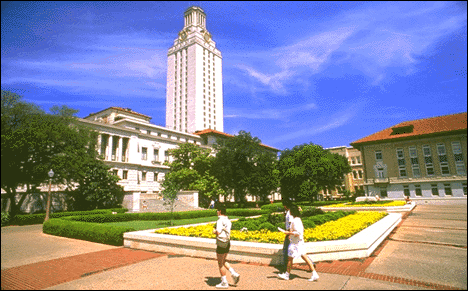 On the surface, it seems there has never been a better time to be a part of a major university, particularly the state-funded type. Education remains in high demand, after all, and those working as full-time academics (extra emphasis on “full-time”) make good money. Individual states take pride in their flagship schools as being centers for world-class research, that some of the most cutting-edge, world-changing advances in technology, from electronics to engineering to chemistry to medicine, have come out of these sorts of universities. Note that I said “some” research, for just as many cutting-edge discoveries have come out of R&D departments in General Electric, General Motors, DuPont, 3M, Magnum Research, Lockheed-Martin, and the like (note that they are all for-profit companies in the private sector!).
But that stipulation aside, these flagship schools are often viewed with some degree of prestige. Pennsylvania, for example, rightly takes pride in the academic excellence at Penn State, as it is regarded as a “public Ivy.” Ditto for the University of Michigan in the Great Lakes State, or for both Indiana and Purdue Universities in the neighboring Hoosier State. The Universities of Wisconsin and Minnesota are also known for quality, world-class research and are thus a source of pride for their respective states. Same can be said for Cal-Berkeley and UCLA in the once-Golden State or for the University of Washington in the Evergreen State. Even the SEC, not necessarily known for its academic prowess overall compared to the Big Ten or even the Pac-12, nevertheless has a good example of a big, state flagship school with good academics (though a recent development, to be sure) in the University of Florida. And yes, the adjective “state” also means “public,” with college tuition being more affordable for in-state students than if said students were to attend private schools for their higher education instead.
So what is the problem? Well, the issue has two large, important dimensions. At the heart of said issue is an existential crisis that seems to be gripping the University of Texas, another great example of a state flagship school that has good academics both at the undergrad level as well as the graduate one. This existential, if not outright identity, crisis is the result of something of a culture clash within the vaunted institution. USA Today reports that opposing factions within the school have very different visions for the direction and purpose of the UT. The conflict basically goes this way: do we focus on the prestigious aspects of the school, or do we make it more accessible? It’s basically a Cadillac vs. Chevy argument. Cadillacs are much nicer and classier, but Chevys will still get you where you need to go without breaking the bank in the process. Both arguments have merit, but which way should the university go?
The prestige/class argument certainly has its place, but has severe limitations. Undergrads usually choose their school based on its academic reputation, yet said reputation comes from research done by faculty and doctoral students. Just because a professor is a leading researcher in his field does not necessarily mean he will be effectively imparting that insight to the undergrads. In fact, in all likelihood, he might farm out that teaching to his teacher’s assistants, themselves concentrating on establishing their own reputations in academia. The only way an undergraduate student would have a course taught be one of these hypothetical leading professors is if they take an arcane course that is directly within the narrow scope of the professor’s arcane research, as Dr. Thomas Sowell points out. Such is often the case at Harvard and the other Ivy League schools, but less so at certain places like Purdue.
This leads us even further into the problem with “prestige.” While some research is very useful in the real world, other research, not so much. If the cutting-edge research is within the fields of engineering, medicine, food science, agriculture, chemistry, computers/electronics, or even business management to an extent, then all those things can translate to useful applications to advance our standard of living in the real world. But if a professor is a leading researcher in sociology, communication, “women’s studies,” or “critical theory” (i.e., Marxism), so what? How does a degree in a field of that sort of related study translate into marketable skills, which, now more than ever, are key to getting a job in a tough economy?
Long gone are the days when just having any old degree will get you a decent-paying job. Employers look for specific skills to make specific contributions to their companies’ productivity. Therefore, if major universities wish to remain relevant, the other argument goes, then they must adapt their teaching curricula to meet these more basic student needs so that said students, once they graduate, can be productive elements of society, and thus truly get their money’s worth.
Specifically, employers are looking for – depending on your industry, and yes, I’m generalizing here – nurses, engineers, chemists (to an extent), I.T. professionals/computer engineers/programmers, and accountants, not to mention HVAC technicians, plumbers, the latter two do not even require a four-year degree insomuch as a vocational certification. Getting a degree in sociology will not help fulfill employers’ needs.
I for one lean towards the latter camp, but coming from an academically-oriented family myself, I fully sympathize with the other side’s point of view. Where I part company with the other side is the blind eye they turn to, if not outright abet, all the side-effects that come with the purely theoretical, no-real-world-application side of academia. To put it bluntly, one does not hear a peep of Marxism, or any other permutation of Leftist philosophy from engineering or medical schools. Perhaps many a chemistry professor might vote for all the local, state and national Democrat lefties du jour, but one hardly hears any of their ideology trickle down into the classroom. Ditto for engineering professors, or even math professors, though one is likely to find some conservatives in those camps and others where part of their profession is making sure that the numbers actually, you know, add up.
That can hardly be said for many courses in communications, English, sociology, “critical theory/studies,” any ethnic study one cares to choose, or even many – though thankfully not all – history courses and pretty else everywhere else within the purview of liberal arts, sadly.
The irony in the existential debate surrounding the University of Texas is that it has the resources to do a mix of both. It has the resources to offer trade-oriented education to the majority of its would-be undergrads, while at the same time offer English, History, Foreign Languages, Math and Science courses to the kids who want to teach in those disciplines at the secondary (i.e., high school level). If kids within the latter category want to continue their studies as actual scholars in those fields, UT ought to have the resources to accommodate that to an extent, as well as continue in the world class research in which the former camp takes so much pride.
A potential problem with this approach is that, yes, it can muddle the brand, and would run the risk trying to make the University of Texas all things to all people, which hardly anybody outside of G.E. and Carrier/United Technologies are capable of doing. Muddying the brand is problematic enough. Packard tried that in the 1930s in order to survive the Great Depression. Rival Cadillac already had the luxury of having the low-priced Chevrolet brand within the larger General Motors conglomerate. As an independent, though, Packard reasoned that it needed to make low-priced models just to survive, but in doing so, it compromised the prestige of the brand. As any marketing professor worth his or her salt will tell you, though, the solution would have been for Packard to come with its own low-priced flanker brand so as to not compromise the brand equity of its famous luxury marque.
Sounds simple in theory, but for higher education, it is not. If UT were to adopt this idea, how could the ‘man on the street’ differentiate the practical vocation-oriented training from the prestigious research that is normally associated with such an institution? Ultimately, it should come down to individual employers’ ability to be able to see how employment candidates from that school can translate the practical knowledge they have learned into applied abilities to benefit the companies, without regard to prestigious research done elsewhere at such a huge school.
This brief exploration of the opposing issues by no means will settle this huge argument in Austin. But approaching market forces might compel the university to adapt some version of this proposed hybrid model, prestige or no prestige. This discussion is surely to be continued.
Dinosaurs were warm-blooded, scientific paper reports January 29, 2013
Posted by intellectualgridiron in Science.Tags: Allosaurus, anapsid, Apatosaurus, Carnegie Museum, Carnosaur, cladistic, Coelurosaur, Deinonychus, diapsid, dinosaurs, ectothermic, endothermic, John Ostrom, journal, Nature, paper, Sauropod, scientific, Theropod, warm-blooded
1 comment so far
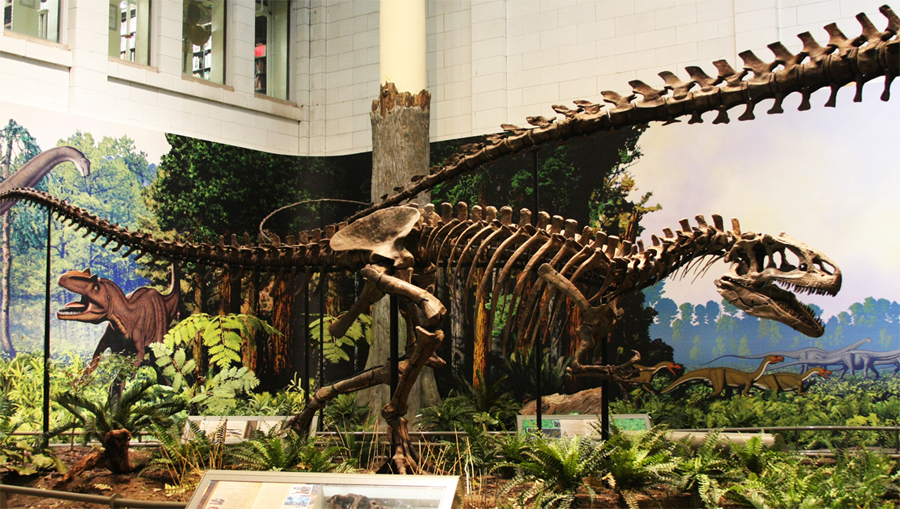
Another scientific paper offers convincing evidence that (at least some) dinosaurs were warm-blooded, such as this Allosaurs, but what of the Apatosaurus whose tail is also visible in this picture? Photo by the author, taken at the Carnegie Museum of Natural History in Pittsburgh.
The dinosaurs were warm-blooded, so reports a recently-published scientific paper. To that, those of us who have paid any serious attention to dinosaurs over the past 25+ years, we reply in one big voice, “well, duh!”
But believe it or not, there has been a four-decade debate as to whether or not dinosaurs were ectothermic (i.e., cold-blooded) like all reptiles today, or endothermic (i.e., warm-blooded) like birds and mammals. It was not always that way; even most of the earliest dinosaur fossils discovered roughly 190 years ago gave scientists clues that the dinosaurs were indeed reptiles. Once complete skulls were discovered in the subsequent decades — particularly the 1840s onward — it because quite clear that not only were they reptiles, but they were diapsids like most reptiles today, save for turtles and tortoises, which are anapsids. The explanation to differentiate those anatomically cladistic terms is for a different article at a different time.
Given that the earliest evidence was that dinos were indeed reptiles, people therefore accepted it as a given that they were ectotherms. After all, every species of reptile today is cold-blooded, why therefore not the dinosaurs from roughly 225 to 65 million years ago? All that thinking changed with John Ostrom‘s discovery of Deinonychus in Montana in 1964. All of a sudden, the bird-like characteristics of some of the feet and parts of the skeleton caused scientists to totally re-think dino metabolism, and eventually kicked off the great debate of warm-blooded — if not outright hot-blooded — vs. cold-blooded schools of thought.
The paper referenced in the linked article announcing its publication will, in all likelihood, not settle the debate, and for a valid reason. It is easy to see the Carnosaurs, or meat-eaters, to be warm-blooded, as well as the less-vicious but very-much bipedal Coelurosaurs, what with their bird-like characteristics — albeit to varying extents — but what about the plant-eaters? If, say, the Sauropods were warm-blooded, can one imagine how much energy it would require — in other words, how much plant matter they would have to eat — in order to sustain themselves? It remains an intriguing question.
This time around, in the latest study, published in the scientific journal Nature, the scientists cite the bone growth rates of dinosaurs, and how they match up to all sorts of different species of modern mammals. In the abstract, it affirms what has stood to reason within part of the paleontological community for roughly forty years. What is left out in the piece, though, is what specific dino species’ bones were examined, and whether or not plant-eaters’ bones were part of this microscopic examination. If they can demonstrate that, say, Sauropods had similar bone growth patterns as the established warm-blooded Theropods, then it shall open up the floodgates for all sorts of speculation about the sustenance behaviors of the vegetarian dinos, if nothing else! Let the fascinating discoveries continue!
Diamond Anniversary of Benny Goodman at Carnegie Hall January 16, 2013
Posted by intellectualgridiron in Pop Culture.Tags: 75, Allan Reuss, anniversary, Art Rollini, Babe Russin, Benny Goodman, Big John's Special, Carnegie Hall, CBS, Chick Webb, Columbia, Count Basie, diamond, Don't Be That Way, Duke Ellington, Edgar Sampson, Gene Krupa, Harry James, historic, Jess Stacey, John Hammond, Lester Young, Let's Dance, Lionel Hampton, Martha Tilton, RCA, Sing Sing Sing, Steve Allen, Stompin' at the Savoy, story, Teddy Wilson
add a comment
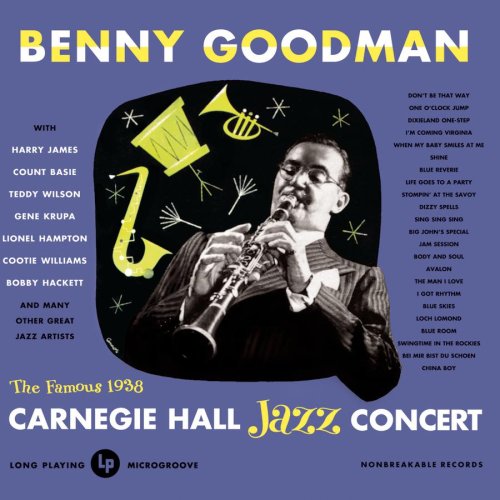 Today, Jan. 16, marks the 75th anniversary of one of the most historic concerts in American history. For it was on this day in 1938 that Big Band, the music that defined American culture for four decades within the 20th Century, officially went Big Time. Benny Goodman and his band performed at world-famous Carnegie Hall on that date, to a sellout crowd, and into the history books. True, Paul Whiteman, the purported “king of jazz” in his day did perform at that historic venue the previous decade, but Big Band, or Swing, was far more refined, more focused, and more definitive a subgenre than the broad category of “jazz,” and it was finally given its big break into the mainstream of American popular culture.
Needless to say, this was no typical Benny Goodman gig. For one, the make-up of the band was different during some of the tunes that were played. Granted, most of the overall performance was by the usual players in the band, and photographic evidence of the concert backs this up. Moreover, some of his bigger names in the band were also present; Gene Krupa on drums and Louisville native Lionel Hampton on vibraphone were both there, as were Teddy Wilson and Jess Stacey alternating at piano. Harry James, then Goodman’s first-chair trumpet, was also on hand to give some memorable solos, and Martha Tilton, arguably the best female vocalist under Goodman’s employ, was present to sing during certain numbers.
But the band makeup was different for some of the numbers in the program in that there were players used to [temporarily] fill in various side-man roles; a talented makeup of musicians from Duke Ellington’s and Count Basie’s bands. The rationale for this unusual move was twofold: for one, this was an historic occasion, and the folks that spearheaded this whole idea in the first place put on the concert under the theme of “celebrating twenty years of jazz.” As such, they wanted to pay some homage to the Duke and do updated versions of jazz tunes from the 1920s and early ‘30s. That explained bringing in the Duke’s boys. Ellington himself was invited, but he politely demurred, which paid off as he would be given his own moment in the sun at Carnegie a couple of years later. Some of Count Basie’s players were brought in at the behest of John Hammond, the A&R man for Columbia Records and a friend of Goodman. Hammond recognized that Basie’s ensemble was up-and-coming throughout 1937, and by including some of his players (including the legendary saxophonist Lester Young), it would give the ensemble for the concert an All-Star band feel.
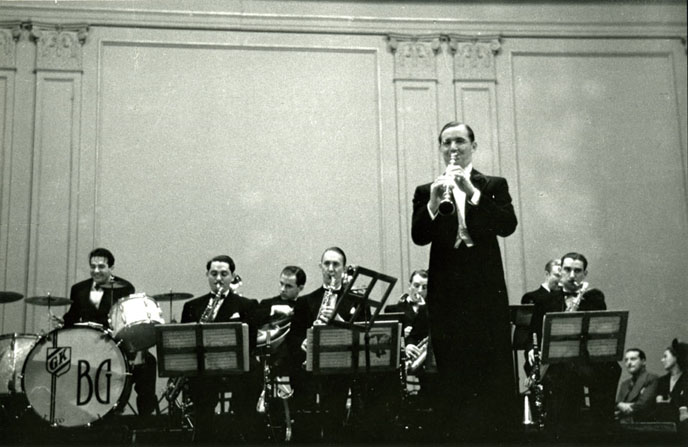
Benny Goodman in the foreground, with Gene Krupa on drums at left, Allan Reuss on rhythm guitar behind the sax section. Babe Russin is to the immediate left and Art Rollini is to the immediate right of Benny. At the far right corner, one can see some of the last-minute concert patrons in the “jury box” on stage!
Another break from precedence was how the show began. Goodman usually opened up his gigs with “Let’s Dance,” which he had used for that purpose since at least 1935 (though he never cut a studio record of it until October of 1939, and by that time he left RCA for Columbia). But instead, for this special show, he opted to kick things off with “Don’t Be That Way” instead. Edgar Sampson wrote the tune. An earlier song of his was “Stompin’ at the Savoy,” with which Goodman had a big hit in early 1936. Moreover, Chick Webb had hits with both tunes as well, in 1936 and 1934, respectively. Goodman, ironically, did not record a studio version for RCA until a week after this historic gig. But irony or no, it did get things started off on the right foot.
Commercially, from the start, the concert was already a success. Tickets sold out very quickly upon announcement of the show, but demand for tickets remained so high right up to Jan. 16 that they had to add some “jury box” seating literally on the stage. For almost two hours, history was made, with the band performing 23 different numbers, including a few by the quartet consisting of Goodman, Wilson, Hampton, and Krupa.
The musical performance line-up for the concert was as follows (note ALL TRACKS have been linked to Youtube clips for your listening pleasure!):
One O’Clock Jump (likewise recorded in studio a month after the concert)
Sing, Sing, Sing, (With A Swing) — see clip below!
Of course, Goodman and his band saved the best for almost-last with a live, 12-minute rendition of Louie Prima’s “Sing, Sing, Sing.” He had a hit with it in the summer of ’37, which took up both sides of a 78 RPM record at about seven and a half minutes. This one was longer thanks to a tongue-twisting trumpet solo by Harry James, extra Goodman clarinet solos, and even a piano solo by Jess Stacey with minimal musical accompaniment. Let us not forget Gene Krupa carrying the whole number with his drumming, either! In fact, he used this as a springboard to start up his own band later that year.
Better yet, though, after such an incredible performance, instead of taking all night to bask in the glow of applause in adulation, he signaled for the band to “cool down” like a horse after a race and break into “Big John’s Special.” Always the professional, Goodman was!
The next day after the concert, while everyone was reading the diversity of reviews in the papers, someone observed to Goodman, “it’s too damned bad somebody didn’t make a record of this whole thing.” Benny smiled back and replied “[S]omebody did.” Indeed, a single microphone hung aloft over the band during the concert, hard-wiring the electric signals (and the music they were carrying) straight to CBS’s recording studios. Two record copies were made. One headed straight to the Library of Congress, while the other was lost into obscurity, until one of Goodman’s daughter’s unearthed it at the family’s house twelve years later. When she showed it to her father, he quickly and wisely transferred the records to tape before listening to — and thus re-living — the concert a dozen years after the fact. The concert was quickly published as an album on Columbia, thus allowing generations of big band/jazz fans to relive it as well over the past 63 years. But 75 years ago, one night showed that a music that helped define American culture had truly come in to its own, which is incidentally another reason we have to thank Benny Goodman and the players in his band for his/their cultural contribution.
Addendum 01-24-13
Here is a clip of a cinematically-recreated scene from Goodman’s concert at Carnegie Hall, from “The Benny Goodman Story” (1955).
The part of Goodman was played by Steve Allen, but Krupa and James actually played themselves and did their own solos in this re-enactment of their historic “Sing, Sing, Sing” rendition during the concert.
2012-2013 Bowl Game Awards January 10, 2013
Posted by intellectualgridiron in Sports.Tags: A.J. McCarron, ACC, Alabama, Arizona, Auburn, Bama, Baylor, BCS, Bill Belichick, Bill Blankenship, Bob Stoops, Bowl, Brian Kelly, championship, Charlie Strong, Chick-Fil-A, Clemson, college, conference, Cotton, Crimson Tide, FBS, FIghting Irish, Florida, football, game, Georgia Tech, Heart of Dallas, Idaho Potato, Lane Kiffin, Louisville, Mack Brown, Mark Dantonio, Michigan, Michigan State, Mississippi State, MSU, national, NCAA, ND, Nebraska, Nevada, NFL, Nick Saban, North Carolina, Northwestern, Notre Dame, Ohio State, Oklahoma, Oklahoma State, Outback, Patrick Higgins, Peach, Pittsburgh, Purdue, SEC, South Carolina, Southeastern, Stanford, Sugar, Sun, Texas, Texas A&M, title, Toledo, Tulsa, U of L, UCLA, USC, Utah, Utah State, West Virginia
2 comments
What, you’d think I’d be lying down on the job just because the regular season is over?
COACHES
Wish I were him: Charlie Strong, Louisville
Wouldn’t be bad to be him, either: Nick Saban, Alabama
Glad I’m not him: Bob Stoops, Oklahoma
Lucky guy: Mark Dantonio, Michigan State
Poor guy: Patrick Higgins, Purdue (interim coach)
Desperately seeking a clue (long-term, notwithstanding the win): Mack Brown, Texas
Desperately seeking a P.R. man: Bill Blankenship, Tulsa
Desperately seeking sunglasses and a fake beard: Lane Kiffin, USC
TEAMS
Thought you’d kick butt, you did: Texas A&M (beat No. 11 Oklahoma in the Cotton Bowl on Jan. 4, 41-13)
Thought you’d kick butt, you didn’t: Florida (see below)
(Dec. 15-31)
Thought you’d get your butt kicked, you did: Purdue (see below)
Thought you’d get your butt kicked, you didn’t: Louisville (see below)
(Jan. 1-7)
Thought you wouldn’t kick butt, you did: Alabama
Thought you wouldn’t get your butt kicked, you did: Notre Dame
Dang, they’re good: Alabama (and Texas A&M!)
Dang, they’re bad: Purdue
They can’t be that good: Oklahoma State
Dang, they’re overrated: Notre Dame
Can’t Stand Prosperity: Mississippi State (lost to Northwestern in the Gator Bowl, Jan. 1, 34-20)
Did the season start? USC
Can the season end? West Virginia
Can the season never end? Louisville (or Clemson, though really, Louisville more so!)
GAMES
Play this again (Jan. 1-7): Outback Bowl – No. 10 South Carolina 33, No. 18 Michigan 28
(Dec. 15-31)
Play this again: Peach, I mean, Chick-Fil-A Bowl — No. 14 Clemson 25, No. 8 LSU 24
Also, play this again: New Mexico Bowl – Arizona 49, Nevada 48
(All Bowls)
Never play this again: Heart of Dallas Bowl – Oklahoma State 58, Purdue 14
Don’t bother with this one again, either: Idaho Potato Bowl – No. 22 Utah State 41, Toledo 15
What? Chick-Fil-A Bowl — No. 14 Clemson 25, No. 8 LSU 24
Huh? Holiday Bowl — Baylor 49, No. 17 UCLA 26
Are you kidding me? Sun Bowl — Georgia Tech 21, USC 7
Oh – my – God: Sugar Bowl – No. 21 Louisville 33, No. 3 Florida 23
Wow, dude: BCS National Championship – erstwhile No. 2 Alabama 42, erstwhile No. 1 Notre Dame 14
Cal Sport Media / AP Images
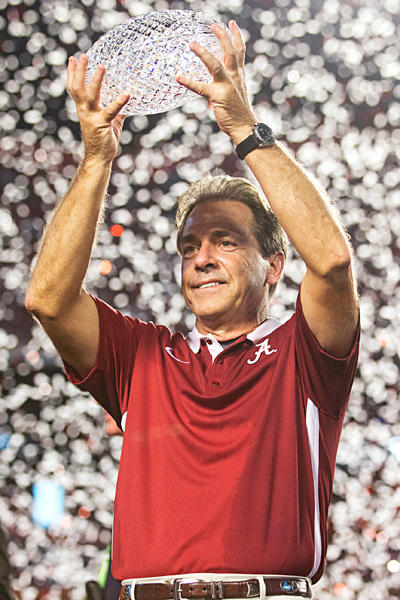
That’s why you line them up and play. My father repeated this mantra to me as I was growing up. Going in to the BCS National Championship game, it seemed as though Notre Dame and Alabama were rather evenly matched on paper. The Fighting Irish had some rather impressive wins on their resume this year, far more impressive than the mediocre schedule they had played in recent years. Beating a tough Stanford squad at home, going on the road to humiliate Oklahoma, and then closing out the regular season on the west coast to beat USC, all in the same year, is no small feat. With such a record, it looked like Notre Dame was back, ready to butt heads with the big boys for national prominence.
Moreover, it was supposed to be a down year for the SEC, remember? Michigan played South Carolina down to the wire (though seriously, the overall outcome was as predicted, if not by a slightly truncated margin of error), and an underachieving Nebraska challenged a, well, underachieving Georgia squad. Mississippi State, for what a great regular season had – by MSU standards, at least – came for naught when they coughed it up to Northwestern in the Gator Bowl. The most striking example of building the case for a SEC down year was the Chick-Fil-A Bowl. No way, under normal circumstances would LSU lose to Clemson, though to be sure, the ACC team has been known to pull one over on the SEC team in that bowl game (remember the 2001 Peach Bowl between Auburn and North Carolina?). No. 3 Florida inexplicably losing to No. 21 Louisville can also add fuel to that fire (not that U of L’s win is something to be rued outside of SEC country!).
Forget that the SEC had three losses going into this game. The conference was 5-3, to be exact; still a winning record. Look at the Bama team itself. They had graduated tons of talent to the NFL. Quarterback A.J. McCarron was not a transcendent player at that position (as one often expects on a team that would be in the running for the national title). The offensive line was young and inexperienced. The Crimson Tide’s defense was not overwhelming, either, especially when compared to the smothering D’s of recent champion squads. When paired up against the other team, one could readily predict some clearly potential mismatches. After all, Notre Dame’s receiving corps was big and talented, and proved to be a game-winning factor throughout the season, as the Irish’s opponents had no answer for that part of their offense.
But there was more. What gave the Irish the strong look of national viability was that Coach Brian Kelly had done an amazing job of massively upgrading the team’s defense. At a school this is much more academically rigid as ND, certain recruiting restrictions tend to put the defensive side of the ball at a disadvantage. One can recruit smart linemen, quarterbacks, tight ends, and receivers, after all, and they are out there. Defense is another issue. Never as well-choreographed as offensive, players on that side of the ball tend to be a bit more reckless, and often have to be to make key stops. Making good grades and doing what defensive players have to do to succeed on the field is oftentimes an incompatibility. Yet Kelly somehow made it work.
So how did things turn out they did? Even yours truly predicted a close game, at least until some time in the 3rd quarter. Turns out, in hindsight, we all made the same mistake we made going into the 2007 BCS game. That year, Ohio State was the undefeated, No.1 team. Florida got in the game almost as an afterthought. Yet despite a touchdown by the Buckeyes on the opening kickoff, the Gators dominated from then on, leaving many viewers in a state of shock and disbelief, and also to ask each other: how did we not see this coming?
The answer comes in two parts. The simplest part is, they are SEC teams. Florida then and Alabama this year played in the most brutal of all college football conferences. Anybody who emerges as the conference champion is battle-hardened, battle tested, and ready and able to go toe-to-toe with anybody else in the country. If one does not believe that the SEC, despite its down year this year, is still not the best conference in the country, you are both blind and detached from reality. For one, SEC teams have won every national title since the 2006-’07 season; that’s seven consecutive years and counting. But even more to the point, the NFL is the ultimate truth serum when it comes to who produces the best players in college football. One NFL team general manager once observed that you could field a competitive team in the pros just by drafting players out of the Southeastern Conference. Lots of money, along with people’s mortgages and livelihoods, rest on making such key decisions – think about that.
So Ohio State then, and Notre Dame this year, were frankly NOT consistently playing the same level of competition that SEC teams face week in and week out. It’s fine for Notre Dame to beat Oklahoma on the road, but to turn right around the struggle at home to Pittsburgh the next game should have raised a few more eyebrows than it did.
The other part to explain how Bama ended up dominating Notre Dame is that Nick Saban is the best college coach in the business. He learned his grinder’s work ethic from his father growing up in West Virginia, and learned how to be detail-oriented as an NFL assistant under Bill Belichick. Being detail-oriented is a transferrable skill that works well at either the college or the pro level. Saban knows how to prepare. Alabama might have seemed relatively weak (compared to recent teams) having to go from one tough game to another (LSU then Texas A&M, for example). But give Saban a full month to prepare, and the team’s true potential shines through. Pay no attention to the Tide getting humiliated to Utah in the 2008 Sugar Bowl; pay attention to Saban’s, and the team’s, more recent body of work, that being three national titles out of the past four years. They say that hindsight is 20-20, and in this case, it most certainly is: Bama played better competition throughout the year, had even better overall athletes, and are guided by the best coach in the business. Sometimes, you have to line them up and play just to be able to see those things with sufficient clarity.
 intellectualgridiron