America’s Greatest Music: You’re a Sweet Little Headache September 12, 2013
Posted by intellectualgridiron in Pop Culture.Tags: 1938, 75, American, Artie Shaw, Benny Goodman, big band, Bing Crosby, Cole Porter, diamond anniversary, Disney, golden age, Helen Forrest, Indiana Jones, Irving Berlin, Last Crusade, Martha Tilton, pop culture, RCA, standard, swing era, The Rocketeer, You're a Sweet Little Headache
add a comment
In a slight change of pace, this particular tune does not merit itself into the Great American Songbook. Nevertheless, it is a lovely little ditty, one that a few bands recorded during the Swing Era. The main reason we highlight this tune right now is because it was recorded on this day (Sept. 12) 75 years ago.
One thing is for certain, and that is that Benny Goodman’s “sound” certainly did the tune justice. An uptempo “businessman’s bounce” — something at which Benny’s band excelled — this record is also a good example of the lilting tone effect heard in Goodman’s woodwind section, something he practically perfected that year.
While Benny Goodman did not have a monopoly on this song, his is arguably the definitive version, what with his aforementioned sound, combined with his gutsy style of play. Martha Tilton’s vocals make for a very nice addition, too. With all that said, other prominent recording stars took their stab at this song around the same time, including RCA stablemate Artie Shaw (who recorded it with Helen Forrest singing the lyrics that same year [1938])*, and even Bing Crosby lent his vocal talents to the ditty in question the following year.
A more modern pop cultural reference to this recording can be heard in the ever-popular film “Indiana Jones and the Last Crusade” during the apartment scene in Venice, where one can hear the Elsa Schneider character play the tune on an acoustic phonograph (making the recording sound 10-15 years older than it actually was!).
So while the lyrics do not rate the song itself as highly as a good Cole Porter or Irving Berlin standard, it nevertheless merits our attention as a solid record during the golden age of American popular culture — enjoy!
*The Artie Shaw version one can briefly heard in the very underrated 1991 Disney Film “The Rocketeer,” which also takes place in 1938.
America’s Greatest Music: You Must Have Been a Beautiful Baby August 15, 2013
Posted by intellectualgridiron in Pop Culture.Tags: 1938, Al Jolson, America, Artie Shaw, Baby, Beautiful, Bing Crosby, Bobby Darin, Bobby Vee, Bunny Berigan, caricature, cartoon, Chick Bullock, Dave Clark Five, Dean Martin, Decca, Der Bingle, Eddie Cantor, Edythe Wright, Elmer Fudd, Frank Sinatra, Greatest, Harry Warren, Johnny Mercer, Joni James, Lee Wiley, Looney Tunes, Merrie Melodies, Michael Buble, music, Perry Como, record, Rosemary Clooney, Russ Morgan, song, Songbook, The Crew Cuts, Tommy Dorsey, Vic Damone, Vocalion, Warner Brothers, What's Up Doc, You Must Have Been
add a comment
Whenever you meet a girl whom you instantly recognize as a cut above the rest, this tune instantly enters your mind. You know that even further when this tune pops up on the radio (assuming you’re tuned in to the SiriusXM 40s on 4 channel) and without hesitation you start singing along to the record. But the question becomes, along with which version do you sing?
Such is a valid question. After all, like many legendary tunes in the Great American Songbook, it has been recorded by many a legendary artist throughout the ages. At different times, Artie Shaw, Lee Wiley, Perry Como (1946), Rosemary Clooney, The Crew Cuts — who made their mark on the business by doing cover versions of early ’50s R&B and doo-wop hits — Vic Damone, Joni James, Dean Martin, and Frank Sinatra have all taken their individual cracks at this song. Let us also not forget Bobby Vee, Bobby Darin (1961), The Dave Clark Five (1967), or Michael Bublé (2001, which, compared to the years of the previous records, might as well be literally yesterday).
But this does not even acknowledge the spate or recordings made of this song when it was written (1938) by Harry Warren (music) and Johnny Mercer (lyrics — figures!). That year, Tommy Dorsey recorded his version with Edythe Wright on the vocals. Chick Bullock — who provided the vocals for some of Bunny Berigan’s small group recordings on the Vocalion label in 1936 — also rendered his version that same year, as did Russ Morgan.
Yet the version that clearly stands out above all others was also recorded the same year the song in question was written (1938, in case you skipped the previous paragraph), and it was sung by none other than Bing Crosby (recorded on the Decca label, of course!). It is this version that sticks out in one’s mind when a guy meets a girl that stands out from all the rest; it is this version that you joyous sing along with in your car when it comes on the radio….and it swings!
For anybody who doubts that Crosby owns the definitive version of this song, take a moment to notice its reference elsewhere in popular culture. In the Looney Tunes cartoon “What’s Up Doc?” (1950) featuring Bugs Bunny and Elmer Fudd, an obvious reference to this record surfaces in the middle of the show.
A scene depicts Elmer Fudd coming across, by happenstance, a down-and-out Bugs. Of the four characters that Fudd passes up before reaching Bugs, the first is a caricature of Al Jolson (“mammy” being a lyric often found in some of his songs), the third is a caricature of Eddie Cantor, and the fourth is obviously a satirical depiction of Der Bingle himself, singing a line of from the featured recording of this very article. Watch for yourself!
Such humorous references to contemporary pop culture were a hallmark, and indeed, a distinctive competency (to borrow a business term) of the Warner Brothers’ Merrie Melodies cartoons! But as hinted previously, this very reference also demonstrates that Crosby’s version stands apart from all others, much like that special lady.
America’s Greatest Music, entry 08-06-13 August 6, 2013
Posted by intellectualgridiron in Pop Culture.Tags: 1937, America, Benny Goodman, Bob Hope, businessman's bounce, Greatest, Martha Tilton, Memory, music, RCA, Shirley Ross, Thanks, Thanks for the Memory, tin pan alley, Victor
add a comment
Yes, no doubt many readers are thinking that of all the outstanding Benny Goodman records that the King of Swing cut in his prime years, I chose “Thanks for the Memory” as the first to highlight on my blog. Suffice it to say, I have my [undisclosed] reasons. Adding further irony to the situation is that Goodman’s take on the tune is not considered its definitive version — Bob Hope is commonly thought to ‘own’ the song, along with Shirley Ross. The two did render, perhaps, the definitive version of the song, and is no doubt closest to the original intent of the songwriters and of the storyline.
What is interesting is the contrast in tones that the two renditions set. Whereas Hope and Ross version strike a very poignant chord of a long-time couple now splitting up, and they reminisce together right before going their separate ways, the Goodman version is far more upbeat. Withholding the later verses about the lamentation of what has come to an end, Martha Tilton’s vocal talent instead concentrates on the fond memory of good times of two apparent travel companions. All this is to say nothing of the contrast in key and tempo. The Hope and Ross version has a strong tinge of melancholy and poignancy throughout the song, making you feel it, and feel for the soon-to-be-ex-couple. All well and good, but that is far from Goodman’s style; thus, the song — recorded on Dec. 2, 1937 — is arranged in typical “businessman’s bounce” fashion, as only the King could deliver.
Moreover, this version does a better job of celebrating those ultra-special moments with very special people.
To all those with whom I’ve had special moments over the years — particularly this past weekend — thanks, for the memory.
Oz recalls its glorious past April 19, 2013
Posted by intellectualgridiron in Pop Culture.Tags: 1939, Alice in Wonderland, Bad Santa, Beast, Bill Cobbs, C.S. Lewis, classic, Disney, Dorothy, Emerald City, Family Guy, Famke Janssen, Fantasia, First Class, Frank Morgan, Giggity, Great, Indiana Jones, James Bond, James Franco, Kansas, Last Crusade, lion, Margaret Hamilton, Meg, MGM, Michelle Williams, Mike Myers, Mila Kunis, Narnia, Oz, Powerful, prequel, Professor Marvel, Rachel Weisz, recall, scarecrow, sepia, Technicolor, Tony Cox, Walt, witch, Wizard, X-Men, Xenia Onatopp, Yellow Brick Road
add a comment
 (Warning: a few subtle spoilers herein.)
One hallmark of a great prequel is that it shows/explains how something well-known came to be. For example, just how did X-Man Dr. Hank McCoy, a.k.a., “Beast,” become, well, so blue? You find out in “X-Men: First Class.” Just how did Indiana Jones develop a pathological aversion to snakes? You find out during the prequel segment of “Last Crusade.” So it goes for the Oz canon. Just how did this so-called wizard make his way from Kansas in a balloon to this famous, enchanted land? Just how was the relationship between the sister witches? All of that and more is explained in this movie.
By now, “Oz the Great and Powerful” has been released in theaters for over a month, so it’s likely that most readers have seen the film. As a Johnny-come-lately to the party, it’s hard to say anything that has not been said already about this film, but I nevertheless feel strongly compelled to try. The reason I do is simple: there is so much to like about this film that it is hard to know where to begin.
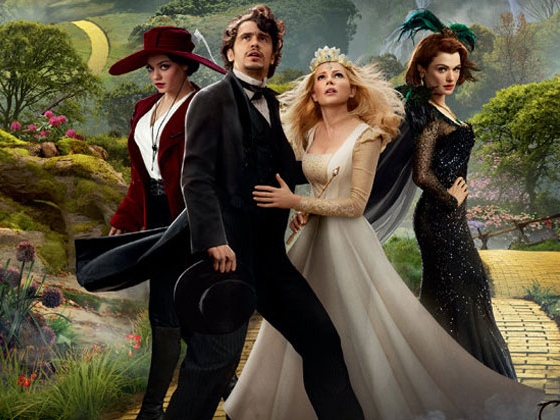
Why not start with the actors’ portrayals of the main characters? James Franco delivers as the protagonist; sure, a number of others could pull it off just as well, but his portrayal of the so-called “Wizard” of Oz — in reality, a traveling circus magician/con man/womanizer — is quite satisfactory, and gives you a plausible origin of how the whole Wizard myth began. When circumstances take him to a place that most certainly is NOT Kansas, he encounters not one, not two, but three witches, and eventually learns that the combined encounter is a family power struggle in which he is now ensnared. Oops! The first witch he meets, Theodora, played by Mila Kunis, ends up taking character development to the extreme. We the audience first meet her as a young, naive, pretty young lady, almost exuding Meg-like innocence (she provides the voice of Meg in “Family Guy”*). Nobody would consider a witch, though she is, and moreover, she later undergoes a metamorphosis, shedding her naive facade and afterwards remains, shall we say, jaded, both inside and out. Soon, though, Oz meets her sister, Evanora, played by Rachel Weisz, who, as the story unfolds, seems to be channeling her inner Famke Janssen-as-Xenia Onatopp (you fellow James Bond aficionados know what I mean!) both in terms of appearance/attractiveness (Giggity!* — although that changes at the end of the film) and in terms of which side of good/evil she truly has chosen. Not until Oz meets the third witch, Glinda, that he becomes enlightened as to who is actually good and who is actually — queue the Mike Myers voice — evil (/puts pinky finger to side of mouth). Speaking of Glinda, her portrayal by Michelle Williams is superbly charming. Any man with a pulse would jump at the chance to make her queen of his kingdom.
The secondary roles are more than ably filled, too. Tony Cox, whose image as the foul-mouthed, sawed-off sidekick in “Bad Santa” is forever humorously etched in my mind, is extremely well-suited for his role as an irascible munchkin. Bill Cobbs as a jack-of-all-trades tinkerer practically brings a smile to your face, too. Other key characters are brought to you via the wonders of modern film-making magic. Indeed, the biggest reason we the movie-going public were never treated to a big-time, big-budget adaptation of, say, C.S. Lewis’ Chronicles of Narnia was that the things described in that story were so fantastical, the special effects technology simply was not there until the middle of the last decade to finally do it justice on the big screen. Same things goes for this film in question in many respects, one being two of the characters that become part of Oz’s group as he finds himself on a mission in a land that coincidentally bears his name. Only the latest in special effects could properly portray a flying monkey dressed like a ritzy hotel bellhop, or a young girl who is a walking, talking china doll. The latter character brings much to the proverbial table, as some of the interactions between her and Oz are the most tender scenes in the whole film.
But what I loved most about the film was all the special efforts made in recalling the original 1939 masterpiece to which this movie is a prequel. Start with the treatment they give to the opening segment of the film. In the 1939 original, everything is in black and white. Only when Dorothy’s house crashes into Oz, thus sending the Wicked Witch of the East to an early albeit timely demise, does the film turn to color. Keep in mind that color films in the late 1930s were few and far between. Color alone would have amazed the audience, but the Technicolor that MGM employed was exceptionally vivid. Same thing goes for this new film. The opening, “real-world” segment of the story is also depicted in sepia, and only after the protagonist survives his ordeal of a journey into the magical land does the eye-popping color open up before the audience’s eyes.
But that is just for starters. The start of the Yellow Brick Road as a spiral directly recalls MGM’s standard-bearing predecessor, as does the physical setting of the Emerald City. One can see its sparkling skyline in the distance behind fields of ultra-colorful poppies, which in turn run up to the edge of a dark forest. Speaking of the city’s skyline, it also recalls the original from ’39; maybe not as art deco, sadly, but it makes up for it with its realistic imagery, not just a large painting on the wall of a sound stage. Even the way the curtains drape in the throne room and in the hallway leading up to it seem to recall the timeless classic. Better yet, Glinda’s memorable arrival in a magical bubble is recalled in fashion more splendid than ever before. Speaking of memorable entrances, one of the witches making a scary entrance with red fire is a fitting nod to how that character did the same thing in the [much] earlier film. Moreover, though the story obviously predates the rest of the dramatis personae (Dorothy et al.), it does well in making oblique references to both the Scarecrow and the Cowardly Lion. Even the turban that Franco’s Oz wears on his head while an illusionist with the traveling circus in Kansas recalls that atop Frank Morgan‘s head as Professor Marvel. Let us also not forget the parallel characters in the protagonist’s life between Kansas and Oz.
Regarding the explanation of how things come to be, not only is the origin of the Wizard’s throne room act of smoke and bombast cleverly explained, what is even more clever is the scenario that first necessitated it. Plenty of other things about the film recommend it, though, in addition to the wonderful references to the 1939 classic. When Oz finds himself in this strange yet beautiful world, part of the incredible scenery he takes in are various exotic plants making music; such is a classic, vintage Disney touch, right out of “Fantasia” or “Alice in Wonderland.” Ol’ Walt would have been proud of these touches, and indeed of the whole film.
*See? Even when talking about the Wizard of Oz and Disney, we can still make Family Guy references! And who’da thought that Meg could so effectively channel her inner Margaret Hamilton?
Buicks and Dinosaurs March 28, 2013
Posted by intellectualgridiron in Pop Culture, Science.Tags: ad, Apatosaurus, Argentinosaurs, Buick, Cadillac, Carnosaur, Ceratopsian, Chasmosaurus, cold-blooded, commericial, dino, dinosaur, Diplodocus, Encore, General Motors, Giganotosaurus, GM, homeothermic, hot-blooded, Stego, Stegosaur, Stegosaurs, T-rex, Theropod, Triceratops
add a comment
As a life-long Paleontology enthusiast, I feel compelled to give General Motors lots of credit for this creative commercial. Remember that comic book and cartoon series “Cadillacs and Dinosaurs”? Well, feast your eyes on the next-best thing: Buicks and dinosaurs!
What caught my eye the first time I saw this commercial was not just the dinosaurs, but their species and size. Yeah, they were big – really big, but just how big? It obviously varies from genus/species to genus/species, but what interested yours truly was their depicted size in the commercial. We science/engineering geeks are sticklers for accuracy, after all!
Start with the beginning. The Stegosaurs parked next to the fire hydrant are accurate. Stegosaurus armatus, for example, reached about 30 feet in maximum length, meaning that its likeness regarding shape and size in the commercial is well portrayed (S. stenops was not quite as long at 23 feet in max. length). So far, so good!
At seconds 6 through 13, we feast our eyes on a massive Sauropod, massive even by the standards of the already-large species found within the infraorder. My first guess was this was an outsized specimen of Apatosaurus (known by many as “Brontosaurus,”) which was indeed large at an average length of 75 feet. But as big as it was, it is doubtful that its feet were almost as wide as the car itself, even if the Buick Encore is relatively small. The photo below of a Apatosaur skeleton right next to a Diplodocus skeleton might give the reader a better reference of its average size, as one can see a couple of people standing behind it.
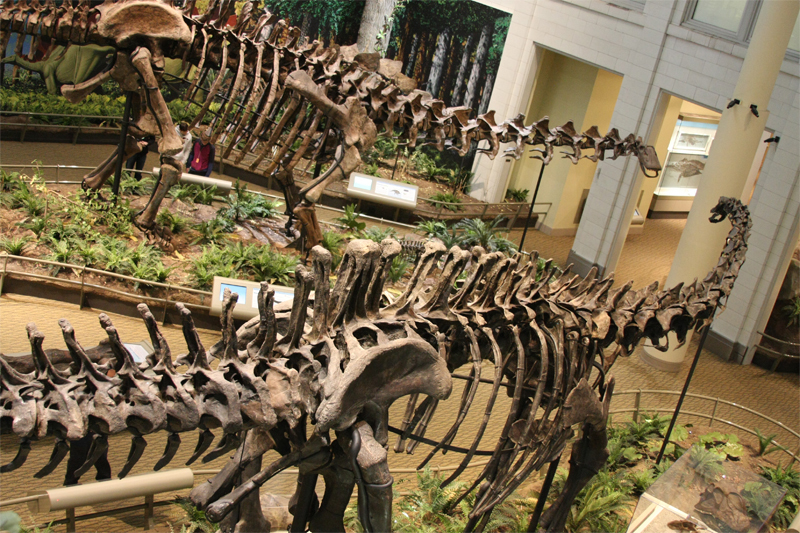
Apatosaurus in the near background, and Diplodocus in the foreground at the Carnegie Museum of Natural History in Pittsburgh; photo by author, Dec., 2010.
My guess regarding the large Sauropod depicted in the commercial in question is either an outsized specimen of Apatosaur (it was the overall shape of one, if not oversized), or, more plausibly, an Argentinosaurus, one of the largest dino species currently known to man. This compilation of photos I snapped at the Fernbank Museum in Atlanta back in early 2009 should back up the validity of this educated guess. The man ascending the staircase gives the reader an idea of its huge size.
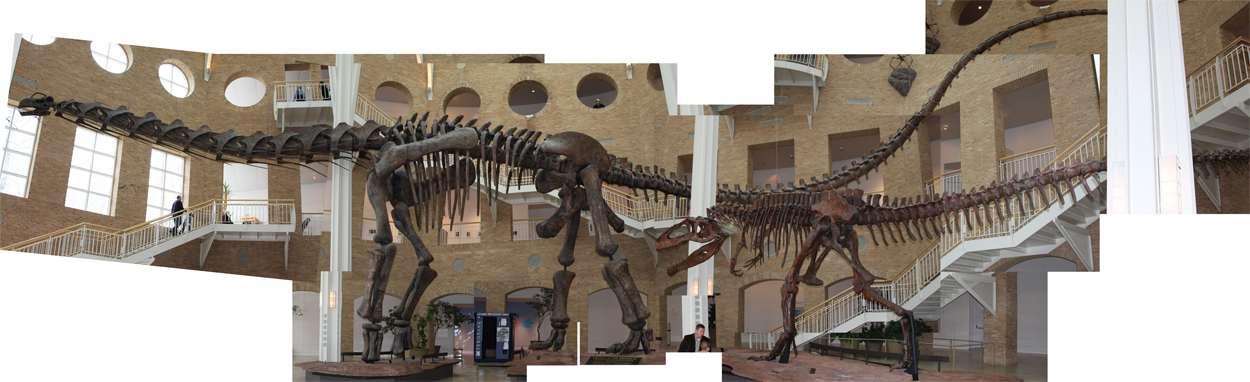
Argentinosaurus reconstructed as being pursued by a Giganotosaurus, a Carnosaur/Theropod even longer than T-rex! Photo by author, Fernbank Museum, Atlanta, Mar. 1, 2009.
Next up at seconds 14 through 16, the couple in the Encore are passing up a couple of Ceratopsians. The initial impulse is to say “Triceratops,” which is entirely understood, given that he was the biggest and most famous of that suborder. But the frills of these two fellows are way too squared for that to be Triceratops, so my educated guess is that these are slightly outsized Chasmosaurs, who also had three horns like their slightly larger cousin (most Ceratopsians just had one, on the nose), even though theirs were not as long as the larger species.
Meanwhile (“…back in the jungle!”), as the camera gives us the vantage point of seeing through the windshield from the backseat, we see more Stegosaurs and Sauropods moving along the boulevard during seconds 17 through 19, and then the car has to maneuver around another large Sauropod (possibly a slightly-outsized Apatosaur, if not another Argentinosaur), before eventually pulling into a hotel entrance next to another Stegosaur to cap off the commercial. Here the Stegosaurs is depicted a bit larger than its maximum size, unless the roof in front of the hotel desk had a very low clearance of 13 feet or less, as that was S. armatus’ maximum height, plates included. The Stego tail and spikes in the background during seconds 27 through 29, however, are sadly way oversized. The spikes in question would reach about three feet at the most.
Something else that gave cause for notice is that all the dino species depicted in this GM commercial are plant eaters. So what, right? The significance of this selection of species was that these are thought by many – though by no means all – scientists to be cold-blooded, or at least homoethermic, whereby they were big enough to maintain their own temperatures. But put these two things together, and these species would be, on average, on the slower scale of dino agility, particularly when compared to their potentially hot-blooded Theropod predators.* What it boils down to is a “big-and-slow” versus “small-and-nimble” comparison that GM implicitly makes in this advertisement.
One must analyze these sizes with the perspective that these are all computer-generated, and as such, when superimposed into a real-world setting, it’s difficult to get the relative size proportions correct, especially when these objects are in constant motions and audience viewing angles are constantly shifting. Still, while most shown sizes are a tad exaggerated, some were dead-on, and overall, the effort is quite laudable, as the commercial certainly piqued my interest, and hopefully those of millions of other viewers!
*The cold-blooded/warm-blooded dinosaur debate has been brought up before in a previous article and shall surely be revisited again.
Diamond Anniversary of Benny Goodman at Carnegie Hall January 16, 2013
Posted by intellectualgridiron in Pop Culture.Tags: 75, Allan Reuss, anniversary, Art Rollini, Babe Russin, Benny Goodman, Big John's Special, Carnegie Hall, CBS, Chick Webb, Columbia, Count Basie, diamond, Don't Be That Way, Duke Ellington, Edgar Sampson, Gene Krupa, Harry James, historic, Jess Stacey, John Hammond, Lester Young, Let's Dance, Lionel Hampton, Martha Tilton, RCA, Sing Sing Sing, Steve Allen, Stompin' at the Savoy, story, Teddy Wilson
add a comment
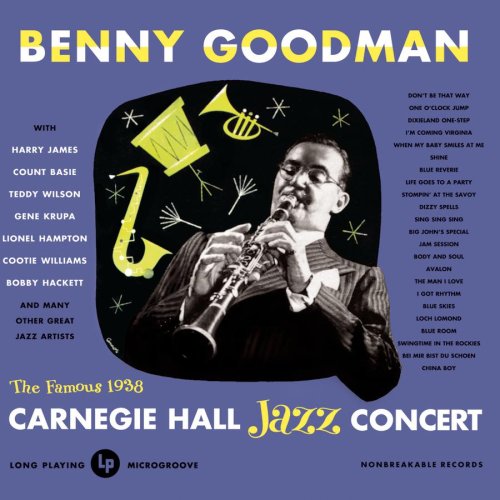 Today, Jan. 16, marks the 75th anniversary of one of the most historic concerts in American history. For it was on this day in 1938 that Big Band, the music that defined American culture for four decades within the 20th Century, officially went Big Time. Benny Goodman and his band performed at world-famous Carnegie Hall on that date, to a sellout crowd, and into the history books. True, Paul Whiteman, the purported “king of jazz” in his day did perform at that historic venue the previous decade, but Big Band, or Swing, was far more refined, more focused, and more definitive a subgenre than the broad category of “jazz,” and it was finally given its big break into the mainstream of American popular culture.
Needless to say, this was no typical Benny Goodman gig. For one, the make-up of the band was different during some of the tunes that were played. Granted, most of the overall performance was by the usual players in the band, and photographic evidence of the concert backs this up. Moreover, some of his bigger names in the band were also present; Gene Krupa on drums and Louisville native Lionel Hampton on vibraphone were both there, as were Teddy Wilson and Jess Stacey alternating at piano. Harry James, then Goodman’s first-chair trumpet, was also on hand to give some memorable solos, and Martha Tilton, arguably the best female vocalist under Goodman’s employ, was present to sing during certain numbers.
But the band makeup was different for some of the numbers in the program in that there were players used to [temporarily] fill in various side-man roles; a talented makeup of musicians from Duke Ellington’s and Count Basie’s bands. The rationale for this unusual move was twofold: for one, this was an historic occasion, and the folks that spearheaded this whole idea in the first place put on the concert under the theme of “celebrating twenty years of jazz.” As such, they wanted to pay some homage to the Duke and do updated versions of jazz tunes from the 1920s and early ‘30s. That explained bringing in the Duke’s boys. Ellington himself was invited, but he politely demurred, which paid off as he would be given his own moment in the sun at Carnegie a couple of years later. Some of Count Basie’s players were brought in at the behest of John Hammond, the A&R man for Columbia Records and a friend of Goodman. Hammond recognized that Basie’s ensemble was up-and-coming throughout 1937, and by including some of his players (including the legendary saxophonist Lester Young), it would give the ensemble for the concert an All-Star band feel.
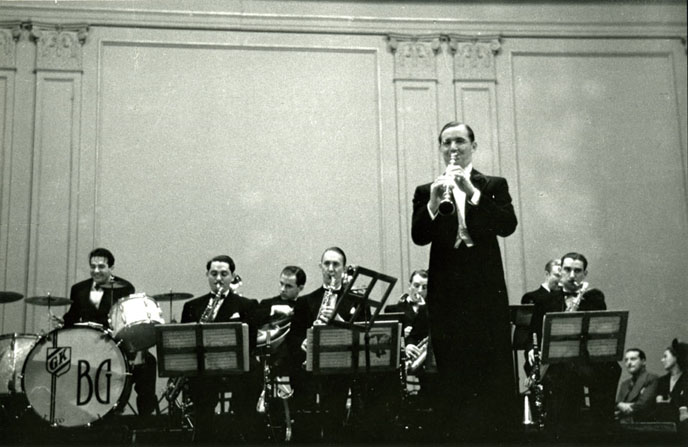
Benny Goodman in the foreground, with Gene Krupa on drums at left, Allan Reuss on rhythm guitar behind the sax section. Babe Russin is to the immediate left and Art Rollini is to the immediate right of Benny. At the far right corner, one can see some of the last-minute concert patrons in the “jury box” on stage!
Another break from precedence was how the show began. Goodman usually opened up his gigs with “Let’s Dance,” which he had used for that purpose since at least 1935 (though he never cut a studio record of it until October of 1939, and by that time he left RCA for Columbia). But instead, for this special show, he opted to kick things off with “Don’t Be That Way” instead. Edgar Sampson wrote the tune. An earlier song of his was “Stompin’ at the Savoy,” with which Goodman had a big hit in early 1936. Moreover, Chick Webb had hits with both tunes as well, in 1936 and 1934, respectively. Goodman, ironically, did not record a studio version for RCA until a week after this historic gig. But irony or no, it did get things started off on the right foot.
Commercially, from the start, the concert was already a success. Tickets sold out very quickly upon announcement of the show, but demand for tickets remained so high right up to Jan. 16 that they had to add some “jury box” seating literally on the stage. For almost two hours, history was made, with the band performing 23 different numbers, including a few by the quartet consisting of Goodman, Wilson, Hampton, and Krupa.
The musical performance line-up for the concert was as follows (note ALL TRACKS have been linked to Youtube clips for your listening pleasure!):
One O’Clock Jump (likewise recorded in studio a month after the concert)
Sing, Sing, Sing, (With A Swing) — see clip below!
Of course, Goodman and his band saved the best for almost-last with a live, 12-minute rendition of Louie Prima’s “Sing, Sing, Sing.” He had a hit with it in the summer of ’37, which took up both sides of a 78 RPM record at about seven and a half minutes. This one was longer thanks to a tongue-twisting trumpet solo by Harry James, extra Goodman clarinet solos, and even a piano solo by Jess Stacey with minimal musical accompaniment. Let us not forget Gene Krupa carrying the whole number with his drumming, either! In fact, he used this as a springboard to start up his own band later that year.
Better yet, though, after such an incredible performance, instead of taking all night to bask in the glow of applause in adulation, he signaled for the band to “cool down” like a horse after a race and break into “Big John’s Special.” Always the professional, Goodman was!
The next day after the concert, while everyone was reading the diversity of reviews in the papers, someone observed to Goodman, “it’s too damned bad somebody didn’t make a record of this whole thing.” Benny smiled back and replied “[S]omebody did.” Indeed, a single microphone hung aloft over the band during the concert, hard-wiring the electric signals (and the music they were carrying) straight to CBS’s recording studios. Two record copies were made. One headed straight to the Library of Congress, while the other was lost into obscurity, until one of Goodman’s daughter’s unearthed it at the family’s house twelve years later. When she showed it to her father, he quickly and wisely transferred the records to tape before listening to — and thus re-living — the concert a dozen years after the fact. The concert was quickly published as an album on Columbia, thus allowing generations of big band/jazz fans to relive it as well over the past 63 years. But 75 years ago, one night showed that a music that helped define American culture had truly come in to its own, which is incidentally another reason we have to thank Benny Goodman and the players in his band for his/their cultural contribution.
Addendum 01-24-13
Here is a clip of a cinematically-recreated scene from Goodman’s concert at Carnegie Hall, from “The Benny Goodman Story” (1955).
The part of Goodman was played by Steve Allen, but Krupa and James actually played themselves and did their own solos in this re-enactment of their historic “Sing, Sing, Sing” rendition during the concert.
The Real King of Rock turns 85 December 5, 2012
Posted by intellectualgridiron in Pop Culture.Tags: 1932, 1945, 1951, 1952, 1953, 1955, 1956, 1957, 1958, 1964, 1987, 80, AC/DC, All Around the World, Arnold Schwarzenegger, Arthur Rupe, boogie woogie, Elvis, Founding Fathers, Geico, George Richards, Get Rich Quick, Good Golly Miss Molly, Hand Jive, Hebby-Jeebies, Hey-Hey-Hey-Hey, Ike Turner, Jenny Jenny, Johnny Otis, Keep A-Knockin, Keith Richards, king, Led Zeppelin, Little Richard, Long Tall Sally, Lucille, Macon, Michael Jackson, Mick Jagger, music, Ooh My Soul, Pat Boone, Paul McCartney, Penniman, piano, Predator, R&B, Ready Teddy, Rhythm & Blues, Rit it Up, rock, Rock and Roll, Rock n Roll, Rocket 88, Roy Brown, saxophone, Send Me Some Lovin', She's Got It, Slippin' and Slidin', Swing, The Girl Can't Help It, True Fine Mama, Tutti Fruitti, Zaxby's
1 comment so far
Editor’s update: This article was originally written in 2012 in honor of Little Richard’s 80th birthday.
Today marks the 85th birthday of Richard Wayne Penniman, a.k.a., Little Richard, one of the most important of Rock n’ Roll’s “Founding Fathers,” and arguably the real king of the genre. “The cat with the ten-inch crew cut” was rocking and rolling at the very beginning of the music, and kept on rocking long after others hung it up or had softened into balladeers. But he was also a great innovator, coming up with rhythms that spoke to the essence of the genre, using the funkiest of saxophone backings than others, played the piano more frantically than others, and combined it all with over-the-top, gospel-style singing, along with wails and moans. It all added up to the hardest rocking and rolling of the era when the music was born.
Born in Macon, Ga., on Dec. 5, 1932, Richard had been performing on stage since his early teens in 1945, but started recording in earnest as early as 1951, the same year that Ike Turner’s band recorded what most historians consider to be the first Rock and Roll song in “Rocket 88.” LR started making an impact in the Rhythm and Blues charts with “Get Rich Quick” that same year. The tune clearly has the influential finger prints of R&B pioneers such as Roy Brown, and Richard seems to be channeling him to an extent on this and other tracks he cut around the same time. The following year, 1952, he showed that he could cut strong, moderate tempo songs with his R&B hit “Rice, Red Beans and Turnip Greens.” He took things to a higher level in 1953 with “Little Richard’s Boogie,” using a percussion instrument that nobody would associate with a Little Richard song, as none other than Johnny Otis (of “Hand Jive” fame, 1958) himself played the vibraphone on that track. Fans who already know Richard’s more familiar tunes can easily sense the direction he was taking in developing his music in terms of the rhythmic pattern.
And what a pattern! Little Richard took inspiration from the sound of trains that he heard thundering by him as a child and molded that idea into a unique 2-2 time, boogie-woogie tempo that helped him drill down to the very essence of Rock ‘n’ Roll itself as the music and its era exploded onto the scene by the middle of the 1950s. Indeed, by September of 1955, he joined Arthur Rupe’s Specialty label, and really began to fully hit his stride. Not even 23 years old yet, he cut a hit in “Tutti Fruitti” that year, and thus helped demonstrate that the new era in youthful music was not just a flash in the pan, and it set the template for many other hard-charging hits to follow. Even today, “Tutti Fruitti” ranks as a great pre-game hit at football stadiums to enliven the crowd, as well as to psyche players up before taking the field of battle.
While it reached #2 on the R&B charts in 1955 (and was also covered by Elvis and Pat Boone[!]), what “Tutti Fruitti” also did was help open the floodgates for many other awesome Little Richard records to soon follow – 17 hits in three years, to be more exact. A good bulk of those hits came the following year in 1956, including “Slippin’ and Slidin’”, “Rip it Up,” “The Girl Can’t Help It,” “She’s Got It,” “Ready Teddy,” “Heeby-Jeebies,” “All Around the World” and even “Lucille.”
But one tune that stands out above all others that year was his inimitable “Long Tall Sally.” That recording exemplified the freight-train effect rhythm that Richard gradually crafted to perfection, and in so doing, achieved the holy grail of Rock ‘n’ Roll. Giving the sax solo an extra eight bars certainly did not hurt, either!
One can hear that defining tune prominently played during the helicopter scene in the Arnold Schwartzenegger movie “Predator” from 1987.
To be sure, Little Richard did not save his recording energies for only “Tutti Fruitti” in 1955. That same year yielded some other gems, including one of the hardest-rocking tunes he ever cut in “Hey-Hey-Hey-Hey,” though that record was not released until 1958. Same thing goes for “True Fine Mama,” a true, hard-core gem, where Little Richard augmented the funkiness level with a call-and-response vocal backing; recorded in ’55, but not released until ’58.
The year 1957 was also a strong one for Richard, in that “Send Me Some Lovin’” (the flip side to Lucille, and a good example of his ballad capabilities) charted, but he also had hits with “Jenny Jenny,” – one his most vocally energetic hits of them all, which is saying something! – “Miss Ann,” and one of the hardest rockers he ever did in “Keep A-Knockin.” Those who doubt the early influence of the swing era on rock ‘n’ roll from later decades clearly overlook that Louis Jordan had a hit with the same song – albeit a more comparatively sedate version! – in 1939. If that were not enough, 1958 also yield two more marvelous, rocking holy grails, such as “Ooh My Soul,” and the ever-timeless “Good Golly Miss Molly”
Richard’s hits on the charts started to wane not because he lost his recording energy, as so many of his contemporaries eventually did, but rather he was making major transitions in his life of the spiritual nature. In 1958, he enrolled in a theological seminary and soon started recording gospel music instead of rock ‘n’ roll, though by 1962 he made the return back to secular music, and even started touring in England that year, where his records were still selling well. A fine example of how he still maintained his energy that decade can be seen in this 1964 live performance of “Lucille” in that county (it is arguably a better version than the original 1956 recording):
Little Richard’s influence and legacy spread far and wide throughout the popular music world. Otis Redding claimed that he entered the music business because of him. The Beatles cited him as an influence in general; Paul McCartney idolized him while still in high school, and wanted to learn to sing like him. Mick Jagger of the Rolling Stones also referred to LR as his “first idol.” Jimi Hendrix actually recorded with Little Richard in 1964 and ’65. George Harrison, Keith Richards, Bob Seger, David Bowie, Elton John, Freddy Mercury, Rod Stewart, band AC/DC, and even Michael Jackson have claimed LR as a primary influence to some varying extent. One can hear his influence in popular recordings of later years on one’s own. Surely one can recognize, for example the direct influence that the opening drum riff on “Keep A-Knockin” has on the ever-famous opening drum riff on Led Zeppelin’s “Rock and Roll.”
Over the past 30 years, Little Richard has appeared on TV and in films as an actor as well as in dozens of soundtracks. Even within the past few years, Richard has still managed to remain in the spotlight, having appeared in a Geico commercial, as well as one for Zaxby’s.
But as good as it is to casually remain in the spotlight, these recent examples must not obscure his real cultural contribution as being one the greatest standard-bearers Rock ‘n’ Roll has even known. His unmatchable energy in his recordings and on the stage, along with his everlasting legacy of some of Rock ‘n’ Rolls greatest, most timeless, most energetic records demonstrate time and again that Little Richard is, and ever shall be, in a class by himself. Happy 80th birthday, your majesty!
Cleve Duncan, R.I.P.: “Earth Angel” shall forever live on. November 22, 2012
Posted by intellectualgridiron in Pop Culture.Tags: 1954, 1955, Back to the Future, Cleve Duncan, doo-wop, Dootone, Earth Angel, Hey Senorita, Kool, Oldie, Oldies
add a comment
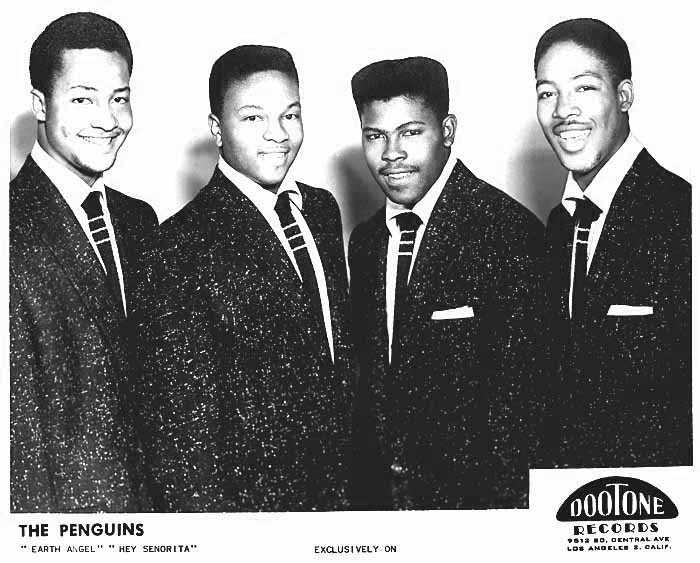
Cleve Duncan, second from the left, was the lead tenor on the Penguins when they recorded “Earth Angel” In 1954, a hit for the ages.
Cleve Duncan, the tenor vocalist who sang the lyrics to the immortal doo-wop hit “Earth Angel” by the Penguins, died earlier this month at age 78. Their huge hit, which to this day has sold 10 Million copies, was recorded in June of 1954 (released later un September of that year) and peaked at No. 1 on the R&B charts at the beginning of 1955. Do the math, and that means that Duncan was only 20 years old when he sang/recorded one for the ages. The New York Times has an excellent obituary/tribute piece on Duncan. Anybody familiar with the well-known film “Back to the Future” would be apt to recall that the band playing at the high school dance sang that song during one of the pivotal scenes of the movie, demonstrating the song’s incredible popularity the year most of the picture took place (1955) as well as the previous year.

A recent copy of the 1954/1955 hit “Earth Angel.” The look of the independent, black-owned label did not change in over 30 years. The label’s original address was 9514 S. Central Avenue in Los Angeles. (from author’s collection)
The song itself is a reminder that it does not necessarily take a gigantic production with sophisticated equipment to have a huge hit. The only instrumentation was a piano, a stand-up, acoustic bass, and drums. Some of the drums covered with pillows so that when struck, their sound would not overwhelm the vocalists. To top it all off, the song was recorded in a garage (!). More interesting history of the song and of others can be found on this great site.
The strength of the record is the sincerity of Duncan’s singing. That sincerity is what touched the nerve of the buying public 58 years ago, and has continued to do so for generations since. The irony is that it was initially the “B” side of the single, with “Hey Senorita,” the “A” side (not a bad recording in and of itself). But DJ’s soon flipped the record over and treated “Earth Angel” as the “A” side.
In a little bit of doo-wop/Oldies trivia, the Penguins started off as four students from Fremont High School in Los Angeles, and when they formed as a group, they first called themselves the Flywheels. But they re-named their group the Penguins after the mascot on a pack of Kool cigarettes, demonstrating, if nothing else, that certain stereotypes are indeed based on truths.
But that aside, Duncan himself thought that the song would have long-term staying power in our national memory. “I never get tired of singing it,” he said, “as long as people never get tired of hearing it.”
Addendum, 12-01-12:
Given that it is now the Christmas season, it is more than behooving to mention that the Penguins, Duncan included, recorded a fantastic d0o-wop Christmas record on the Mercury label in 1955. Enjoy!
 intellectualgridiron