A Possible Replacement for Hazell at Purdue October 17, 2016
Posted by intellectualgridiron in Sports.Tags: ad, athletics, B1G, Big Ten, Brian Kelly, Buffalo, coach, college, Darrell Hazell, Dave Wannstedt, director, FBS, FCS, football, Jim Colletto, Jim Harbaugh, Kansas, Les Miles, Michigan, Mike Bobinski, Morgan Burke, NCAA, Nebraska, Notre Dame, Purdue, Turner Gil, Youngstown State
add a comment
Remember me, Big Ten?
Coach Darrell Hazell has been fired at Purdue. Yes, it was highly commendable how he made lots of friendly gestures in reaching out to the football alums; how well-behaved and polite his kids are; how he preaches morals and good conduct to his players. As a person, Hazell was a very good man. As a coach, he was a charlatan.
We were willing to give him the benefit of the doubt after his first horrible season (2013). The blowout loss at home to then-No. 2 Ohio State on Nov. 2 of that year was an affront to the university, to the Purdue program, to say nothing of all the Purdue football alumni forebears who had to watch such a disgraceful showing. Little did we know that plenty more disgraceful showings were to come in the course of almost four seasons. Those of us who have followed Purdue football for two decades or more know only too well what a disastrous coach Jim Colletto was, but at least the guy could recruit. With Hazell, we have lacked even that silver lining.
It turns out that Hazell was former AD Morgan Burke’s parting “Gift.” The humor is in understanding the double entendre, for the word “Gift” in German – hence the capitalized noun, a constant in that language – means “poison”. In fact, that disastrous hire has permanently tainted Burke’s legacy as an athletics director. Rightfully so, too. This is what happens when you continually hire coaches on the cheap, withhold needed administrative support and resources, then act like you’re going to pay the new head coach real money (actually, not so much, comparatively speaking), only to hire a charlatan who fooled you with one good season at a bottom-feeding MAC program. We saw this scenario before with Turner Gil having one good season at Buffalo, making the gullible think that he was the next Jack Welch. How well did that hire work out of you, Kansas?
To put it another way, Purdue paid Darrell Hazell roughly $1 Million more than they paid Danny Hope per year, even though the former finished with a 9-33 record at that school, while Hope went 22-27 with two bowl appearances. Nothing like paying more for a much worse performance, no?
Thankfully, we now have the prospect of being spared future embarrassments in the seasons to come…provided that new Purdue AD Mike Bobinski makes the right hire. In the college game, hiring the right coach makes all the difference in the world. Just look at Michigan. All of us left that program for dead…or, least for permanent diminished relevance. Then they hired Jim Harbaugh, and in his second year, they are already a national championship contender.
Granted, Purdue is not Michigan, neither in terms of tradition, resources, or recruiting channels. But that is not to say that there is potential to hire a good coach to not just give the program the shot in the arm it needs, but also, immediately give the program the electric shock paddles just to get its heart to beat again.
But who? Several ideas have been tossed out in the comment section of the most recent Hammer and Rails articles. Many of the faithful, for example, seem fixated on Les Miles. Honestly, that would be a pleasing hire to me. He would be effective in shaking up the culture, and would attract lots of eyeballs and thus attract some good recruits. My purpose is to offer an additional idea; not to say it is THE only idea to be considered, but that it is AN idea to be considered. Here it is:
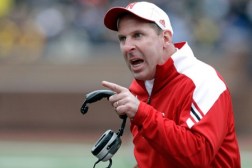
Bo Pelini. There are three major upsides with this possible hire. For one, he is currently coaching at Youngstown State, which is an FCS school. That’s right, he’s not even coaching at an FBS school after Nebraska fired him. It would therefore not be a hard sell for him to come to Purdue for a Power Five FBS job. Indeed, given his current predicament, a salary just slightly higher than Hazell’s might suffice.
Second, Purdue is a Big Ten team, same as his former team Nebraska, who did him dirty. Those idiots fired him for going 9-3. Who in their right mind would do such a thing? Given his reputation for intensity – something Purdue’s program desperately needs, obviously – it would stand to reason that he would not be a “forgive and forget” type. Thus, the opportunity for revenge against those in the conference who wronged him would make Pelini coming to Purdue an even easier sell.
Third, he clearly has recruiting contacts. One would need that in order to be able to win nine games a year in a state that produces zero NFL talent, save for the occasional offensive lineman. His is clearly a name recognized throughout the conference regardless, and that is the most key item.
Indeed, regardless of who becomes the new coach, it is an absolute requirement that he be a recognizable name. We cannot roll the dice with a coach from the MAC again. We already made that mistake. We need a “big name” to show that we truly are committed to not only righting the ship but making sure that it stays on course for the long haul and does not hit a reef again. Bo Pelini would be such a name. If not he, then Les Miles should do just fine, or even Dave Wannstedt, for that matter. If Notre Dame is foolish enough to fire Brian Kelly this year (don’t put it past such a delusional fan base to call for something that monumentally insane, either), then by all means should Purdue empty the bank for him. Morevoer, if such a scenario were to take place, by all means, forget Pelini go all-in on Kelly!
If nothing else, Mike Bobinski ought to heed that last bit of advice, as his young legacy as the new AD at Purdue hangs in the balance with this critical decision. Either Purdue gets a name guy with a proven history, or they will stay in the outhouse forever, reaching for the “flush” handle.
College Football Drills in Wintertime February 28, 2013
Posted by intellectualgridiron in Sports.Tags: 06:00, 6 A.M., 6 AM, 6 AM's, ball, Clemson, coach, college, conditioning, Cup, directional, drills, football, Fulmer, Georgia, Jim Colletto, Joe Tiller, Mark Richt, mat, Mollenkopf, NCAA, North Texas, practice, puke, Purdue, spring, Sun Belt, winter
add a comment
We are still in the winter season, normally associated with basketball, wrestling (the non-pro kind!) and Winter Olympic-related sports. The Super Bowl has been concluded for almost a month by now, and the college football bowl games have been over for almost two. But do not think that nothing is going on in the world of college football; things are anything but sleepy in that world right now, and I don’t mean the latest developments in the Fulmer Cup, either!
The truth is, college football is very active right now, just not active in the way that ordinary fans, hard-core and casual alike, can readily see or discern. That is because fans do not see the tough conditioning drills that players put themselves through (scratch that, that COACHES put players through) during the week, often at very inconvenient times of day, to get them ready for Spring Ball.
Conditioning is the game, here. The NCAA restricts coaches to 15 spring practice sessions, so there’s no time to waste on gassers or the like when there’s plenty of schematic options to explore to see how they play out and to try to install new offensive stuff for the regular season come Fall.
That means that these boys need to be in shape for all of that. What is truly interesting is all the different approaches that coaching staffs take towards these conditioning sessions, starting with what their nomenclature. One generic, all-purpose term is “winter conditioning drills,” since they last from early February, usually, to early March, though that alone varies from program to program. Another term some teams use is “mat drills,” since some of the conditioning drills take place on wrestling mats or a similar playing surface. At Purdue, we just called them “6 AM’s”, since that’s when these drills officially began.
Six-AM’s are a royal pain in the ass. There, I said it. Some coaches seem to agree, with is why schools of thought differ even on this approach, since some programs WISELY undertake these conditioning sessions in the AFTERNOON (why, what a novel idea!). As disastrous a head coach as Jim Colletto was while at Purdue, one of the few bright spots during an otherwise dark time for the program was that he had said conditioning drills held in the afternoon, when normal people are still, you know, functional. Coach Joe Tiller, however, in a hasty move to — otherwise commendably — change the tone of the program (and goodness knows it needed a change of tone at the time) had them in the morning, hence the term at the beginning of this paragraph.
But Purdue is not the only one; many a program from UConn to USC has had these sessions at 06:00, for whatever reason. Luckily, there are voices of reason at big-time programs that still have them in the afternoon. Take Georgia, for example (this policy alone strengthens my faith in Mark Richt’s adept leadership):
FYI, those human-centipede push-ups are a lot harder than they look! Notice the presence of a red mat in the middle of the indoor practice field, though. We never used a mat for drills on the astroturf playing field of Mollenkopf Athletic Center (field turf was finally installed in there in 2006), which might account for the absence of the mat drill term within our organizational lexicon.
Still, another interesting thing to marvel is what sort of combination of drills the coaches prefer to get their players into shape. We never did the human-centipede push-up drill at Purdue, for example, but one constant one will find from program to program are all sorts of directional drills. Those are simply where the coaches have players run or side-shuffle in one direction then instantly turn to run in a different direction and so on. Players would go to various drill stations throughout the session and about four or five-minute intervals, and variations of directional drills were usually two out of several of said stations. Because two stories of staircases leading to the coaches’ offices were located close to the indoor field, another station was to have players run up and down said stairs — ensuring that endurance and power were covered!
Clemson is considered a big-time program, but sadly they still cling to the out-dated notion of having drills pre-dawn. North Texas, an inconsistent contender in the Sun Belt, also still have their sessions before sunrise.
Notice the good examples of directional drills show in the above video. The tug-of-war drill is no doubt a cool idea! Another constant one sees during these drills from program to program are the puke buckets. Part of the job of the managers are to set up these drills (meaning they must report around 5:30 AM), and part of the setting-up is placing those plastic, dark gray garbage cans in, er, strategic areas for players to conveniently access in the split second before they blow hash. On further review, one advantage to running before dawn is that one needs not to worry about losing one’s breakfast!
At Purdue, after the players were thoroughly worn out from all the drills, to cap things off, the coaches had them run 100-yard wind sprints repeatedly. After all of that, the session would not be completed until all the players on the team did positioning drills (lie on your back, the whistle blows, then you instantly switch to lying on your chest, etc.) to the coaches’ satisfaction. Doing these twice a week to start out seemed manageable. Three times a week and it wears considerably on you; but at four times a week, it pushes you towards the brink of insanity, and makes you jump for joy when it comes time for spring practices to commence. At least we could brag, though, that we practiced while [normal] people slept!
Addendum, 04-03-13: Yes, by now, spring practices are in full-swing all across the land, but I just came across a video of Purdue’s 6 AM drills for 2013, and naturally found that to be a great fit for the article — enjoy!
 intellectualgridiron