College Football Week 14 Awards December 3, 2012
Posted by intellectualgridiron in Sports.Tags: ACC, Alabama, Arkansas State, Army, B1G, Baylor, Big 10, Big East, Big Ten, Big XII, Bo Pelini, championship, Charlie Strong, Charlie Weis, college, Florida State, football, Georgia, Georgia Tech, Gus Malzahn, Kansas, Kyle Flood, Louisville, Mack Brown, Mark Richt, Navy, NCAA, Nebraska, New Mexico State, Nicholls, Nick Saban, Oklahoma State, Oregon State, Pac-12, Rutgers, SEC, South Alabama, South Florida, Stanford, Texas, Texas State, UCLA, West Virginia, Wisconsin
add a comment
(Note: All rankings are week 14 AP polls unless otherwise noted.)
COACHES
Wish I were him: Nick Saban, Alabama
Glad I’m not him: Mark Richt, Georgia
Lucky guy: Charlie Strong, Louisville
Poor guy: Kyle Flood, Rutgers
Desperately seeking a clue: Charlie Weis, Kansas
Desperately seeking a P.R. man: Gus Malzahn, Arkansas State
Desperately seeking sunglasses and a fake beard: Bo Pelini, Nebraska
Desperately seeking … anything: Mack Brown, Texas
TEAMS
Thought you’d kick butt, you did: Oregon State (beat Nicholls 77-3)
Thought you’d kick butt, you didn’t: Stanford (beat UCLA 27-24 in the Pac-12 championship)
Thought you’d get your butt kicked, you did: Kansas (lost to West Virginia 59-10)
Thought you’d get your butt kicked, you didn’t: Georgia Tech (lost to Florida State in the ACC championship)
Thought you wouldn’t kick butt, you did: Texas State (beat New Mexico State 66-28)
Dang, they’re good: Alabama
Dang, they’re bad: South Alabama
Can’t Stand Prosperity: Nebraska
Did the season start? Rutgers
Can the season end? South Florida
Can the season never end? Wisconsin
GAMES
Play this again: No. 2 Alabama 32, No. 3 Georgia 28
Never play this again: No. 15 Oregon State 77, Nicholls 3
What? No. 8 Stanford 27, No. 16 UCLA 24
Huh? Louisville 20, Rutgers 17
Are you kidding me? No. 21 Northern Illinois 44, No. 17 Kent State 37
Oh – my – God: Wisconsin 70, No. 12 Nebraska 31
Told you so: Baylor 41, Oklahoma State 34
NEXT WEEK
Only one regular season game is to be played next week, which is the annual Army-Navy game: a cherished American tradition. Go Armed Forces – God bless our troops!
Teams that hit the wall November 29, 2012
Posted by intellectualgridiron in Sports.Tags: 'Canes, ACC, Alabama, Arkansas, Austin, Ball State, Baylor, BCS, Belk Bowl, Big 12, Big East, Big XII, Bobcats, Bowl, Bowling Green, Bulldogs, Butch Jones, Cardinals, Charlie Strong, Cincinnati, Clemson, college, Dan Mullen, Dana Holgorsen, Duke, Egg Bowl, Florida State, football, Frank Solich, game, Hurricanes, Iowa State, Kansas, Kansas State, Kent State, Longhorns, Louisville, LSU, MAC, Miami, Mississippi, Mississippi State, Mountaineers, MSU, NCAA, North Carolina, Ohio U, Oklahoma, Oklahoma State, Ole Miss, Pittsburgh, Rebels, Rutgers, Scarlet Knights, SEC, Southern Miss, Stanford, Syracuse, TCU, Tennessee, Texas, Texas A&M, Texas Tech, U of L, USF, Virginia Tech, West Virginia, WVU, Yeoman
add a comment
 Ohio U: The Bobcats were off to a great start under Frank Solich. They won seven consecutive games, and were even ranked No. 24 going into the Miami (Ohio) game on Oct. 27. After that game, they were undefeated no more. The team lost the next four of five games, including their last one to currently No. 18 Kent State. That loss was understandable, even excusable. Losing to Ball State the previous week? Less understood, even less excusable. But losing to Bowling Green? No excuse at all. Perhaps the Bobcats just ran out of energy, which is one form of hitting the proverbial wall.
Correction: A well-informed, experienced observer brought something else to my attention regarding Ohio U. The biggest reason they hit the proverbial wall was injuries, especially injuries to their offensive line. By season’s end, they were playing third-string linemen without any subs — brutal! Upon further review, that might explain their loss to Bowling Green after all!
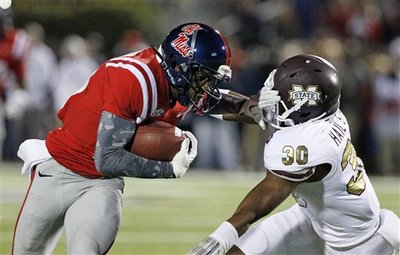 Mississippi State: Poor MSU (the Magnolia State MSU, not the Great Lakes State MSU). They try so hard, but they try to excel in the most brutal of all college football neighborhoods. Dan Mullen has done the Yeoman’s work making the Bulldogs more than respectable, and making their fan base believe in the team’s potential. Seven consecutive games, seven consecutive wins: so far, so good. Then came the game at Alabama: automatic loss. Fair enough. Still ranked No. 16, they were to play Texas A&M at home. That turned out not so well, either. The next game was at LSU; care to guess how that turned out? The thing was, after the big win over Arkansas (45-14), one would think that the worst was behind them. After all, in the Egg Bowl (their traditional rivalry game against Mississippi), they were favored. Ole Miss is mediocre, and Mississippi State has had, all things considered, a great season. But then they inexplicably lost to the Rebels 41-24. What gives? They obviously hit the wall, but how? Was it loss of energy, in clear case of Ohio U, or was it just the more brutal part of their schedule? The latter cannot explain things alone, since, hello, they lost to Ole Miss, and though the Rebels have improved, they have not improved that much. The answer might therefore be, a little of both. Let us hope Dan Mullen can allow for some of the energy in the team to recover for the bowl game.
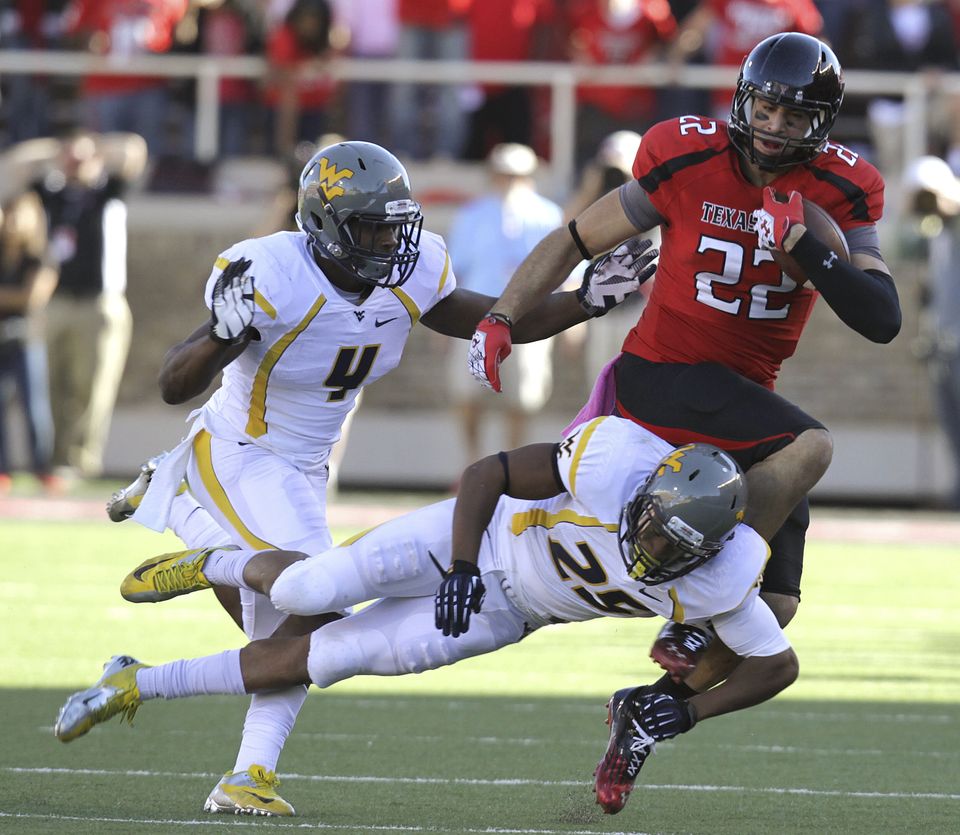 West Virginia: The Mountaineers were flying high after their big debut in the Big XII, beating Baylor at home in an offensive explosion for the ages, 70-63. The following week, they journeyed to Austin to take on then-No. 11 Texas, where they beat the host Longhorns 48-45. It went downhill for five straight weeks after that, with consecutive losses to Texas Tech (49-14), Kansas State (55-14), TCU (39-38), Oklahoma State (55-34), and Oklahoma (50-49). Welcome to the Big XII, Dana Holgorsen. The obvious wall WVU hit was tough schedule, plain and simple. That said, five tough losses obviously took something out of the Mountaineers as well, since they had to struggle to beat Iowa State this past weekend. Whether they have recovered any energy at all will be demonstrated when they play Kansas this upcoming week for what should be a fairly easy clean-up win.
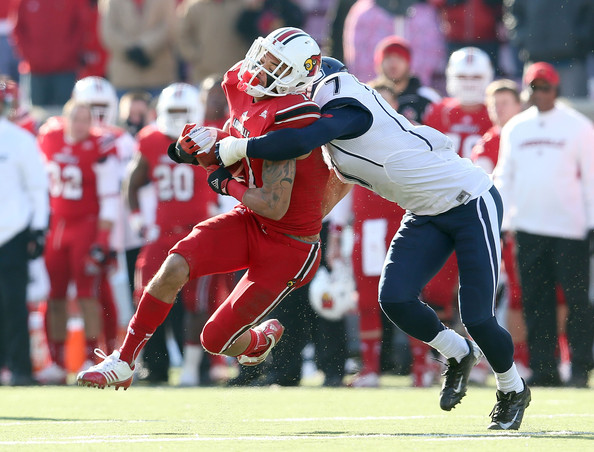 Louisville: So much for running the table for Louisville after losing to Syracuse 45-17 on the road for their tenth game. To be sure, most of their wins up to that point were a little more than close for comfort, such as beating North Carolina only 39-34, beating Southern Miss 21-17 (the rain notwithstanding), or beating awful South Florida only 27-25. With such a pattern of wins, one would think an ugly loss would be inevitable, if only to get it out of their system. Sadly, whatever ailed the Cardinals in Syracuse did not yet pass, for the following game, they coughed up another loss at home to Connecticut in the third overtime. Worse yet, they only have until this Thursday to bounce back on the road against Rutgers in order to win a BCS bowl berth. The Scarlet Knights lost badly that same day to Pittsburgh, so both teams are in a must-win situation. But with the recent pattern of play, the concern remains that U of L might have lost their energy. Thus, the upcoming proposition is dicey at best. Charlie Strong might want to go easy on his boys so they can get their energy.
 Addendum 12-07-12 — Duke: Part of me says “poor Duke,” while the other part of me says “hey, all things considered, they’re doing pretty well.” But nevertheless, they were flying high during the middle of the season, or high by Duke standards at least! Throught Oct. 6, they were 5-1, with the one loss coming to them on the road against Stanford. Any reasonable person would quickly excuse that! Then the next week, they lossed to Virginia Tech, 41-20. Fair enough. Moreover, credit goes to this team, as the following week, they rebounded to beat North Carolina 33-30. Then came four consecutive losses in their last four regular season games, first to Florida State (48-7; imagine that!), then to Clemson (56-20), then to Georgian Tech (42-24 — keep in mind that the Yellow Jackets run out of the flexbone!), and then lossed a shootout to Miami (52-45). In the first three out of four, they were clearly out-manned. The last loss could be attributed to having too much stuffing beat out of them by the first three of those four teams, hence having nothing left in the tank against the ‘Canes. But at least they got a Belk Bowl berth, and have a decent shot at winning it, too, since Cincinnati’s head coach Butch Jones just took the Tennessee job.
Memo to Big Ten: More is not always better November 21, 2012
Posted by intellectualgridiron in Sports.Tags: ACC, Atlantic Coast Confernce, B1G, Badgers, Big 10, Big East, Big Ten, Blazers, Buckeyes, Buffaloes, Cal Poly, college, Colorado, Cornhuskers, D.C., Dan Wetzel, demographics, football, Hawkeyes, Iowa, Iowa City, Jim Delany, Madison, Maryland, Michigan State, Missouri, Nate Silver, NCAA, Nebraska, New Jersey, New York, North Carolina, Northwestern, Notre Dame, Ohio State, Pac-12, Rutgers, Scarlet Knights, SEC, Spartans, Terps, Terrapins, Texas, Texas A&M, UAB, Utah, Utes, Virginia, Washington, Wisconsin, Youngstown State
add a comment
 More is not necessary better. If one of your favorite products introduces a new product line, will that help the overall brand, or will it detract from productive capacity and quality control resources for the product and you and others already know and love? If your favorite airline adds more routes, instead of enhancing the brand, all it might do is cause more flights to be delayed.
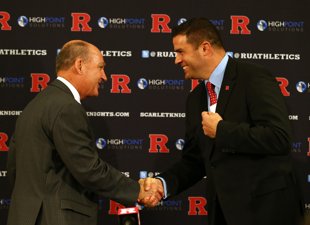
The reason I bring this up is because the news has come out that the Big Ten is inviting both Maryland and Rutgers into their prestigious conference. The invitation obviously benefits these two universities, but how does it benefit the Big Ten? More is not always “more,” as in better. It’s not as if the Big Ten is adding Notre Dame and Texas, in which there would be more great TV games and home games.
The benefits for Maryland and Rutgers are obvious. Neither teams are making much money with their athletics programs (least of all Rutgers), not with the relatively lousy television deals they currently have. By joining the Big 10, that problem instantly vanishes, since that conference has one of the best TV deals in the business. It is not rocket science to figure out why a poor guy wants to marry into a rich family.
Moreover, while those two teams’ conference fit is a geographic stretch, academically it somewhat makes sense. Like almost all other conference members, Maryland and Rutgers are both members of the Association of American Universities, for what that is worth (oddly enough, Nebraska is the only B1G member not yet in that affiliation). Adding these two schools could further enhance the conference’s already solid academic reputation.
But aside from that, how does the Big Ten benefit? From a fan’s perspective alone, this could border on havoc. Think of the traveling distance. Many Big Ten fans travel by the busload to some away games. A band of Nebraska fans traveling to Piscataway, N.J. to see their beloved Cornhuskers play Rutgers would literally be journeying halfway across the country. That’s a huge difference from a more typical conference matchup in which some Wisconsin fans would have but a [roughly] three-hour run to Iowa City to cheer on their Badgers against the Hawkeyes.
Moreover, think of home game schedules for a moment. So few great home games are available year in and year out. Think about how many season ticket-holding fans have to put up with lousy match-ups at home. Wisconsin playing Cal Poly or Ohio State playing Youngstown State at home might be easy wins, but they are horrible games for the fans. Ditto with the Buckeyes playing the Blazers of UAB; yuck! Fans of B1G teams wait patiently from great match-ups, such as the Buckeyes coming in to Camp Randall Stadium in Madison for a night game, or Michigan State coming into Northwestern for a close, hard-fought match-up.
With Rutgers and Maryland now in the mix, those great regional rivalries that fans hunger for are now further in jeopardy in place of a potentially mediocre match-up with these mediocre teams. Again, what has the Big Ten, on balance, to gain from this? The Terrapins’ affiliation with the conference will not make the program improve.
It also messes with traditional rivalries. The Terps have nothing to do with the Spartans, Buckeyes or Badgers. Their rivals are Virginia, North Carolina, etc., all in the Atlantic Coast Conference. Leaving the ACC for the B1G means all those rivalries instantly vanish.
Ah, but adding Rutgers and Maryland into the conference means that the Big 10 can tap into the New York City and Washington, D.C. markets, say the expansion advocates. But people in those markets don’t care about either team, so says Nate Silver, who has a great piece that voices that same concerns written on this page. Silver’s analysis shows that there are low percentages of college football fans in those two large metro areas. Why compromise teams’ schedules for such a diminishing return?
The bottom line is that the Big Ten, arguably most prestigious athletic conference overall in college athletics (notwithstanding football alone, in which the SEC is, at this time, head and shoulders above everyone else), is running a serious risk of diluting their brand.
If you want further proof of this real possibility of brand dilution, look no further than the Pac-12 to see how this move makes no sense. Any benefit of adding Utah and Colorado is marginal at best. The Utes have been mediocre this year, and the Buffaloes have been an outright embarrassment, as they are arguably the worst team in the FBS (see: “Dang, they’re bad,” see: “Can the season end?”). Yes, the Pac-12 has some great teams right now: six of its member teams are, as of his week, ranked in the top 25. But Utah is not among those who are ranked, and, as already mentioned, Colorado is embarrassingly abysmal.
At least when the SEC expanded, it brought in Missouri and Texas A&M; two quality programs. Maryland and Rutgers just dilute the brand, and further weaken an already teetering Big East. Big Ten Commissioner Jim Delany may think that bringing these two teams in will allow for it to reach certain key “demographics,” but not only does Nate Silver show that those demos are not as inviting as they would initially appear, Dan Wetzel of Rivals/Yahoo! points out similar problems. Delany and the rest of the conference leadership need to snap out of this trance before they make a horrible mistake that will ruin the brand.
Whither the conferences in major college football? September 8, 2011
Posted by intellectualgridiron in Sports.Tags: ACC, Big 8, Big East, Big Ten, Big XII, Colorado, conferences, football, Jupiter, Miami, NCAA, Nebraska, Oklahoma, Oklahoma State, SEC, solar system, Southeastern Conference, static, SWC, Texas, Texas A&M, Virginia Tech
2 comments
When I teach my course in American government at my community college in Louisville, one thing I have taken to doing early in the course’s term is to hand out a sheet to each student with a list of important rules in physics/economics. My rationale for this is to get the students thinking about the potential consequences of certain actions on the part of government. One such rule I lay out for them is thus: “Nothing is static.” Just try to disprove that rule. After all, nothing is static in the economy, nothing is static in our own interpersonal relationships, the climate is certainly not static — regardless of what the enviro-socialists want us to think — and indeed, nothing is static in the Solar system, not with variations in solar radiation output that have implications for the temperatures on this planet as well as for Mars and the Gallilean satellites around Jupiter.
The recent announcement that Texas A&M will depart the Big XII Conference for the Southeastern Conference come June of next year has reminded me of this rule once again. Though this is not the first move of a D-1A (pardon me, Football Bowl Subdivision) school to shake things up a bit regarding conference affilition, this one move could open the floodgates for radical conference realignment, the likes of which none of us have seen in our lifetime.
Most moves up to this point seemed fairly self-contained. When the Southwest Conference folded after 1995, the top four teams in that conference joined the Big 8, thus giving birth to the Big XII. The other four teams disbersed, many initially ending up in Conference USA, which banded together lots of erstwhile mid-majors and independents. The arrangement within the Big XII was one that on paper made geographic sense, at least longitudinally (much like the erstwhile Pac-10), with Nebraska the anchoring power in the north, and Texas the anchoring power in the south. Furthermore, should Texas have a down year, Oklahoma was eventually strong enough to fill that power gap on the southern end.
The switch-ups we witnessed earlier last decade did not seem to portend major realignment, either. The only thing that Miami, Virginia Tech, and Boston College bolting from the Big East to the Atlantic Coast Conference amounted to was to question whether or not the former still deserved to have a berth in the BCS bowl games.
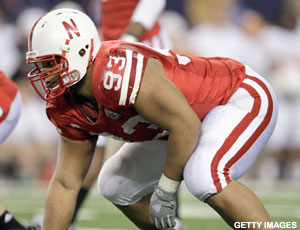 All that was put in jeopardy with Nebraska bolting for the Big Ten after last season. Less consequential was Colorado moving to join the Pac-10, now the Pac-12. As things currently stand, the Big Ten now has 12 teams, and the Big XII has been reduced to nine, or at least will be with the Aggies’ imminent departure. This current state of affairs raises two simultaneous possibilities. For one, many thought that even though the Cornhuskers left for the Big Ten, the Big XII could still limp on, possibly even bring in new up-and-coming teams to fill the void left by the Huskers and the Buffaloes. With A&M soon to leave, the death knell for the Big XII has been all but sounded. Even though, at this moment, Oklahoma and Texas both remain, and Oklahoma State would add increasing credibility, given their up-and-coming status (thank you, T. Boone Pickens), the gradual disintegration of the conference, first at the northern end and now at the southern end leaves many to conclude that more dominos shall inevitably fall.
 One such departure has already pushed Southeastern Conference membership to a future number of 13. Further speculation has been fueled as to whom else the SEC might court. Already, conferences such as the Pac-12 have been making major overtures for the Sooners and the Cowboys to join them. The Longhorns are an even more juicy target for conferences as well, though UT, what with its special brand and its own sports channel in the newly-created Longhorn Network, has the prestige, winning tradition, not to mention geographic advantages to be successful as an independent. Indeed, what we may be witnessing is Texas becoming the Notre Dame of the 21st Century in terms of athletic prestige, winning tradition, privileged status, and ability to attract top recruits.
But, in returning to the point of the SEC’s burgeoning membership, 13 could be a magic number, magic in the sense that it creates the possibly for that number to grow further, not just for the southeastern juggernaut power, but for conferences elsewhere. As mentioned earlier, the possibility persists that Oklahoma and Oklahoma State could end up in the Pac-12, bumping their lucky number up to fourteen. Moreover, it is not inconceivable that Texas could join that new mega-conference as well. USC plus the Sooners plus the Longhorns equals one formidable conference indeed. Iowa State could end up following suit in a different sense by joining the Big Ten (Nebraska is already there, and in-state rival Iowa has been a long-time member). Geographically, that theoretical move is quite logical. Where Kansas, Kansas State, Baylor, Missouri and Texas Tech might end up — again, should the dominoes continue to fall — is anybody’s guess, though the Mizzou Tigers might end up joining the Big Ten as well. That possibility has been broached several times before, in fact. My only reservation against that is, can one conference abide three different teams whose colors are (officially) Old Gold & Black?
While there could be a scramble for a would-be disintegrated Big XII’s table scraps, the Southeastern Conference might try to bring in other powers to join their juggernaut league (Florida State and Virginia Tech have been listed as possibilities). Might such a conference cannibalization prompt the ACC and the Big East to join forces? Given that Texas A&M has turned its back on its long-time rivals and all-too willingly allowed itself to be used by the SEC, perhaps all of us ought to rethink what is possible.
The bottom line in all of these prognostications is that we could be witnessing a radical realignment of teams into mega-conferences, which in turn will have major implications for bowl game affiliations, and even coveted BCS eligibility. If the Sooners and Cowboys end up joining the Pac-12 and that move makes no sense to many on a geographic level, just keep in mind that Texas Christian University — the recent Rose Bowl champs — are about to join the Big East. The new paradigm is that geography is hardly a constraint anymore when it comes to conference affiliation, and it’s all part of the brave new world of NCAA football realignment about to happen before our eyes. What we fans and observers of big-time college football thought were secure affiliations over the past 15 years have turned out to be anything but. Once again, the firm rule about nothing being static has held.
 intellectualgridiron