Rioting in England the end-result of the Liberal Welfare State August 11, 2011
Posted by intellectualgridiron in Politics.Tags: amoral, Ann Coulter, Cal Thomas, entitlement, failure, feral, hoodlum, hooligan, law and order, left, leftist, liberalism, Max Hastings, property, riot, violence, welfare, welfare state
3 comments
The headline to this article by Max Hastings of the Daily Mail says it all, how the liberal welfare state produces feral human beings who see no moral compunction at all in this senseless violence and destruction and theft of other people’s private property. Keep in mind that London is supposed to host the Summer Olympic Games in just a little less than a year (I just thought I’d toss that one out there).
Many on the left erroneously think that “poverty” is the root cause of violence and related crime. Cal Thomas, however, chimes in by reminding us that years of amoral teaching and spiritual bankruptcy are a huge part of the blame. Lack of proper religious grounding can lead anybody to think that theft and violence is okay, regardless of economic status.
Did anybody notice that most of the perpetrators of this violent spree came from single-parent homes, mostly without a father figure in their lives to provide them needed guidance in their formative years? Ann Coulter certainly did notice, and it is not much of a stretch of the imagination to figure out that the problems that infect the urban ghettos in America have similar root causes of massive welfare causing fatherless homes. If nothing else, pride on one’s ancestral accomplishments should be enough incentive to preserve the dignity of one’s own homeland. But when politically-correct elites browbeat you into abandoning pride in your own country, non-thinking hooligans are left with the default position that nothing is worth preserving. Congratulations, leftists: your lasting accomplishment is that you have produced amoral, aimless, indolent, entitlement-addled, feral beings who do not even merit the title of human.
Addenda: Jonah Goldberg chimes in on the recent riots in Great Britain, pointing out that those who rationalize said riots miss the mark by a considerable margin. As usual, he also reveals some keen insights. Among these insights are that the left has effectively replaced “income inequality” with “poverty” as the “root cause” of such violence. On the other hand, if those on the right are correct in pointing out the lack of morals and proper religious grounding are the cause of such degenerate behavior, there is not much government can do, except do away with the coddling social programs that breed indolence and thus moral atrophy.
Speaking of shrinking government in Britain, how is that going? George Will offers his analysis of the ongoing challenges PM David Cameron faces in that important endeavor.
Meanwhile, if anybody has read Jonah Goldberg’s take on these events by now, one paranthetical aside that stands out is that what could have helped the storeowners and other business owners more than a more assertive police would have been gun rights, thus allowing them to defend their own rightful property. Therefore, another important memory-refresher from these disgusting events is the importance of the 2nd Amendment. Such is the main thrust of Doug Giles’ comments on the riots in Merry Old England.
Purdue debuts new football uniforms August 7, 2011
Posted by intellectualgridiron in Sports.Tags: black, Boilermakers, Boilers, college athletics, college sports, design, DIN, football, gold, helmet, marketing, Nike, Purdue, Purdue football, tradition, uniforms
add a comment
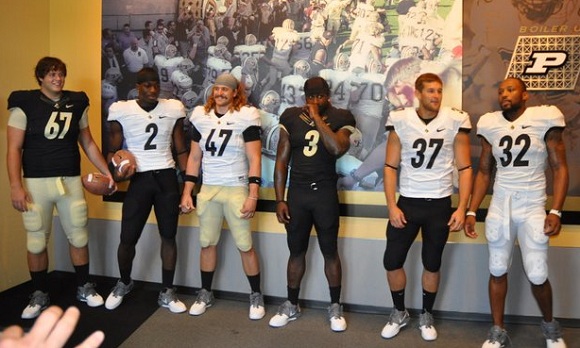
As a former student manager for the Purdue football team, I, along with a handful of other lucky souls, have more than intimate knowledge about Boilermaker football uniforms, and college football equipment in general. Needless to say, whenever I receive news of a total redesign of the Boilers’ gridiron game unis, my interest is more than a little engaged. At first glance of this redesigned series of gameday garments, part of me says “neat!” while the other part of me says “what on Earth were they thinking?” First off, I get it. Young players these days love the latest and greatest football fashions. It’s the marketing, stupid, and fresh uni designs have been smartly used as a recruiting tool these days. Hey, it worked for Oregon. Meanwhile, has Penn State gotten this memo? Will they ever?
Before further discussions proceed, a full gallery of the new Purdue uniforms can be seen via this link.
First of all, here is what I like, either sort of, or all the way. Let’s start with the numbers, which I sort of like. Of all the number designs, do I find this font to be the most aesthetically pleasing? No, I do not. Frankly, the traditional jersey numbers have worked just fine for traditional powers such as Texas, Alabama, Oklahoma, LSU, Georgia, Ohio State, and so on, so part of me asks, ‘what makes Purdue so special?’ That being said, the press release on Purdue’s athletics website points out that these numbers are in the “DIN” font, a typeface first developed in 1923, and since the mid-Twenties has been adopted as the standard font for engineering applications. It also became the typeface of choice for metal stencil applications in trainyards. Seeing things along those lines, the engineering and train connection to the DIN font makes this a very appropriate choice. Plus, a font that’s almost 80 years old, when applied in a new way (new jerseys) can still look current; further proof that what is old is new.
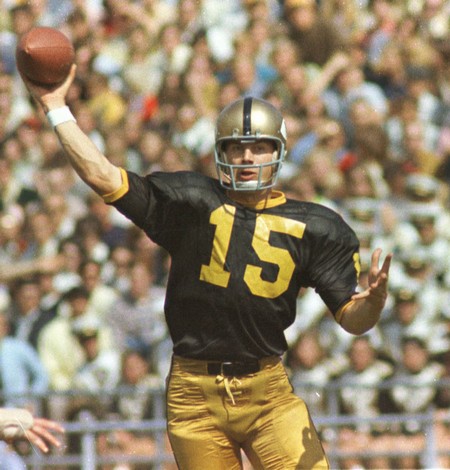 Speaking of the numbers, another thing I love about the new design is the all-gold numbers on the black home jersey. Those familiar with earlier eras of Purdue football will no doubt recall that “back in the day,” Purdue had a long-standing history displaying gold numbers on black jerseys. Iconic photos of players in the 1930s, 1940s, 1950s, as well as the 1960s attest to this (check out some of the photos of Bob Griese and Mike Phipps as Boilermakers, and you shall see what I mean!). While that started to change in the 1970s and espeically in the 1980s with the introduction of white numbers on Purdue’s black jerseys, gold numbers were still not unheard of as recently as the ’90s, but have been no more for about 14 years, until now. Kudos to whomever had them brought back, as they are a nice, throwback touch.
Dare I say, I also applaud the choice to go back to a plain black stripe on the helmets. To be sure, white and thin double-black stripes were a unique touch, one that was without precedence when Coach Tiller had them implemented on his new design (that template essentially being a carbon-copy of his Wyoming uni template, one that he transplanted with him in 1997). But the single black stripe on the gold helmet again speaks to some of Purdue’s glory days, such as the ’60s and the Mollenkopf era — another nice, traditional touch.
Now on to the more unpleasant matters. Let us start with the stripes. To preempt any misunderstandings, I am very happy that stripes stayed on the pants. I abhorred the 1990s fashion trend of stripe-less pants, and I am glad to see that we in the football community have moved on, with some exceptions. What I do not like is how the stripes changed. I absolutely loved our thin, double-stripe pattern. It was a direct throwback to our older styles of uniforms from the 1940s through the 1960s. The black pants with the gold stripes looked like an army general’s dress uniform — very classy. Plus, we, along with Alabama, were the only teams to use such stripes. I understand that times they are a-changin’, but if marketing is going to modify the stripes on the pants, can they at least have the decency to make sure those stripes are complete? These new stripes fail to go all the way up the pants, for goodness sake!
In another matter, there is no earthly reason why Purdue should ever be wearing white pants. Ever. Period. The only time I would condone it is if we had a black road helmet to provide the proper aesthetic contrast, say, a black helmet with a metallic gold “P” and a metallic gold 1-inch center stripe. Then the get-up wouldn’t look half-bad — for a road uniform, at least. In the meantime, though, my advice is, forget the white pants ever happened, and stick with the black pants on the road.
One recurring issue that nobody seems willing to address is the terrible shade of gold to which Purdue has been chained in recent years. A simple looking up of our official school colors will show the inquisitive individual that Purdue’s school colors are Old Gold and Black. Got that? Old Gold and Black. Sadly, the last time the Boilers had a real, old gold in their helmets was 1996, and the last time their pants were the genuine old gold was 1995, Mike Alstott’s senior year. Since 1997, the gold in Purdue’s pants has been a watered-down, urine-specimen shade of gold, and it’s downright pathetic. The ghastly pale shade is made all the more evident when mated with the white road jersey. One would have hoped that a total redesign of uniform would have given occasion to rectify this problem. Yet nothing has been done about this glaring weakness.
Whether the marketing wing of Purdue’s athletic department is at fault for consciously picking this sickly shade of gold, or Nike is being a less-than-responsive provider in imposing a one-size-fits-all shade of gold on all its clientele that use that hue, or both, the bottom line is that it remains unacceptable. Check out UCLA’s gold pants some time. They still have a substantive gold in their uniforms, which is proof positive that the proper shade is available. Get it together, you guys.
Captain America: A Great American Film August 5, 2011
Posted by intellectualgridiron in Pop Culture.Tags: Captain America, Chris Evans, Hayley Atwell, hero, Hugo Weaving, movie, movies, patriotism, period piece, superhero, theatre, Tommy Lee Jones, world war 2, WWII
1 comment so far
 If you have not seen Captain America in the theatres yet and are looking for a good film to see this weekend, look no further. This is a film that delivers. To offer a small confession, I have seen more than a few superhero flicks in the theatres since the New Millenium began, and on the whole, I have not been disappointed by them (Hulk from 2003, however, is another matter entirely!). Upon hearing the news that Captain America was to be released in the theatres this summer, I was more than interested, given my past moviegoing experiences for such fare, as well as with my admiration for the character and his patriotic attitude.
Moreover, as somebody who is a sucker for period pieces, I was all the more enthusiastic about seeing the film, since it takes place during WWII. One of the great things about such movies in recent years is, given the high level technology and sophisticated techniques of filmmaking, each period piece tries to out-do each other with providing details of authenticity of past times, from the architecture to the clothing fashions to the cars and music of those respective eras. The WWII-era backdrop in this movie is both nostalgic and convincing, so much so that it could show many of us who were born way after that time why that period was looked on as the “good ol’ days” by those who lived it.
Chris Evans plays the main character, who starts out in the story as Steve Rogers, one’s classic image of a 90-pound weakling, who, despite his skrawny body and sickly appearance, is nevertheless driven by a deep sense of patriotism and duty to one’s country. Furthermore, despite these glaring weaknesses, he’s also resilient — somebody who quickly gets up no matter how many times he gets knocked down. Rule no. 1 of any movie story is that the audience must be able to sympathize with the main character. If you’re a red-blooded American, you cannot help but love Steve Rogers. As Captain America, the hero is quite formidable yet still sympathetic.
Obviously, his weaknesses prevent him from passing physical muster for military service, despite trying to enlist several times. This determination catches the eye of an immigrant scientist — played by Stanley Tucci — who is conducting a secret military experiment, offering him a chance to help his country in a special way. Rogers takes the chance, and the story really takes off from there.
On the other side, the arch-villain Red Skull is played convincingly by Hugo Weaving. No doubt moviegoers would instantly recognize him for his memorable work as Agent Smith in The Matrix trilogy. FYI, he also supplied the voice for Megatron in the Transformers trilogy, so clearly Weaving has had experience in these sorts of roles!
The love interest is supplied by a charismatic British intelligence agent played by Hayley Atwell. The romance that eventually develops between her and Captain America has an appealingly old-fashioned feel, as if it were straight out of a real 1940s movie. Tommy Lee Jones turns in yet another reliable performance, this time as a tough army commander, and the rest of the supporting cast is solid, too.
I was especially pleased to learn before attending the film’s showing that the movie was directed by Joe Johnston, whose previous credits include The Rocketeer, which I still contend is one of the most underrated movies of the 1990s. One of the reasons I am so fond of that film is that it takes place in 1938 Los Angeles, and shows the sumptuous art deco architectural interiors of that time, the classic propeller airplanes, the 1930s cars of all sorts of makes and models, the period attire (gotta love those double-breasted suits and fedoras!), not to mention that 1938 was the height of the Swing Era, and I was able to identify at least three different Artie Shaw tunes.
Suffice it to say, Johnston pays just as close attention to detail with the WWII period trappings of Captain America that he did to that similar period in The Rocketeer. If the viewer were to pay a few extra bucks for a 3-D showing, he or she would be all the more apt to be immersed in that era, particularly the artwork, the wartime propaganda posters, the clothes (always the clothes!), the cars, and more.
My only criticism of the film is that I found it rather light on contemporary recordings in its soundtrack. I was able to make out I’ll Remember April by Woody Herman and Jersey Bounce by Benny Goodman, but that’s it. As a long-time Goodman afficionado, I can vouch that Jersey Bounce is a decent record, and since it was recorded in 1942, it’s quite appropriate, but Benny and his band did other records of the time that were even a bit more peppy that could have provided the right mood and contemporary backdrop during some other scene, namely Yours Is My Heart Alone from 1940. Surely they could have squeezed in Glenn Miller’s American Patrol (1942) some place, or an early ’40s Artie Shaw ballad, say Moonglow (1941), or even Stardust (1940) during one of the more tender scenes between Evans and Atwell.
Much credit is due to whomever chose to have the movie take place in the era when the character Captain America was created. World War II provides the perfect patriotic setting where the true essence of the character can be appreciated by viewers of all ages. In subsequent decades, namely the 1960s, the bleeding-heart comic book writers essentially perverted the character by superimposing their post-modern claptrap onto this paragon of patriotism, as Mark Steyn so eloqently observed.
They say that the numbers don’t lie. That is especially the case when it comes to box office receipts. It is no secret that Hollywood has been guilty of producing more than a few anti-American (or, at least anti-U.S. military/CIA) films in the recent years. Ben Shapiro offers a laundry list of examples, such as the Bourne Ultimatum, Lions for Lambs, Shooter, Grace is Gone, Rendition, and The Torturer. He could have also added Jarhead and Syriana to that list. No doubt this sort of muddying of the moral waters appeals to post-modernists and other supposed sophisticates.
Yet the average public has chosen to favor other sorts of films, which explains why superhero movies have done so well at the box office since the beginning of the New Millenium. X-Men grossed $157 Million by late 2000. Spider-Man grossed $403 Million by late summer of 2002. X2 tallied almost $215 Million by early fall of 2003, Batman Begins tallied $205 Million by October of 2005, Superman Returns rang up $200 Million by late October of ’06, and The Dark Knight set a record with $533 Million in box offices receipts. In just a couple of weeks, Captain America already has brought in $130 Million in domestic sales alone. The message is clear: people like to watch movies where good and evil are easily defined. Captain America not only delivers on that message alone, but it delivers with an unabashedly patriotic message that America stands for ideals that are worth fighting and dying for, and does so with fantastic period panache. If you’re a red-blooded American, this film will give you your money’s worth.
Hubble discovers new Pluto Satellite July 21, 2011
Posted by intellectualgridiron in Science.Tags: astronomy, discovery, dwarf planet Pluto, facilitation, Hubble, hubble telescope, kuiper belt object, moon, satellite, solar system, space, space buffs
add a comment
The venerable Hubble telescope is the gift that keeps on giving. Its latest gift to researchers and amateur space buffs alike is the facilitation of the discovery of yet another moon around the enigmatic dwarf planet Pluto. Despite the scientific community having downgraded Pluto’s status from full-fledged planet in the solar system to a lesser category (varying from “dwarf planet” to “Trans-Neptunian Object” to “Plutoid” to “Kuiper Belt Object” to “Plutino”) several years ago, astronomers continue to utilize the Hubble and other telescopes to find that the Plutonian sub-system is bigger than initally thought. The latest-discovered Plutino, thanks to the capabilities of the Hubble craft, is unofficially dubbed “P-4.” Not bad for a “dwarf planet” only about 1440 miles in diameter.

Important Perspectives on “Overpopulation” July 20, 2011
Posted by intellectualgridiron in Politics.Tags: Bible, economics, environment, overpopulation, population
add a comment
Jeff Jacoby of the Boston Globe has just written an excellent piece in which he once again debunks the modern-day Multhusians. The term, in case the dear reader is unaware, is rooted in Thomas Malthus, the 18th Century doomsayer who was famous for warning everybody who would listen that population growth would eventually outstrip the food supply. Yet, as Jacoby points out, the world’s population has grown almost sevenfold in the past 200 years, yet people today, on average, have a higher level of education, are better-fed, more productive, and lead more comfortable lives than ever before.
On a micro-level, Jacoby begins the article with the glorious news that David and Victoria Beckham have just welcomed their fourth child into the world. The news is glorious in that two famous people with very good genetics are passing those good genes on for future generations to enjoy. Moreover, the Bible, particularly the book of Genesis, teaches us that babies are a blessing. But the usual, if not insane, voices have criticized the happy couple on the supposed grounds that they are being “environmentally irresponsible.” The dirty little secret of such critics, though, is that they reject Biblical teachings, and instead espouse an Earth-worshipping paganism, in direct violation of Commandment No. 1.
This is insane on two levels. Mark Steyn has pointed out that for every “eco-abortion” done in England or Germany, that is just one more kid that people will have in Yemen or Somalia. Worse yet, those who advocate “eco-abortions” are, in essence, advocating economic stagnation. Economic growth and population growth are closely linked — indeed, they are practically one and the same. Given, an increasing population means an increasing amount of people who need jobs in order to make a living. What fuels job growth is demand for productivity — demand that will never materialize if the population is not big enough to support it. Is it just me, or do most of these zero-population advocates already have a decent net worth that would insulate them from the reality that many of us have to contend with? The astutue analyst Michael Barone said it best:
“Now some people say that low population growth is desirable. The argument goes that it reduces environmental damage and prevents the visual blight of sprawl. But states and nations with slow growth end up with aging populations and not enough people of working age to generate an economy capable of supporting them in the style to which they’ve grown accustomed. Slow growth is nice if you’ve got a good-sized trust fund and some nice acreage in a place like Aspen. But it reduces opportunity for those who don’t start off with such advantages to move upward on the economic ladder.”
The reason that yours truly refuses to succumb to the “overpopulation” hysteria is that all the empirical evidence tells me that there is no such thing. Dr. Thomas Sowell said it best:
“The next time someone tries to sell overpopulation hysteria, ask them to name just one country that had a higher standard of living when its population was half of what it is today.”
Kudos to the Beckhams, not only for passing on their good genes, but also for doing their part in helping to raise the world’s standard of living.
The Worst, Good, and Best College Football Helmets July 20, 2011
Posted by intellectualgridiron in Sports.Tags: color, design, equipment, football, helmet, style
6 comments
Nothing is as iconic to a program as the look of its helmet. It is what people are most apt to recognize when watching a team on TV, and is, by and large, the enduring symbol of the program, and, to some people, it is what comes to mind when the very school is mentioned. For example, when Notre Dame is mentioned, who does not think of the plain golden shells? Mention Michigan, and everyone is apt to think of the dark blue helmets with the distinct yellow patterns.
But as any discerning fan could tell you, not all helmet designs are created equally. Some look so-s0, some look far better, and others need a re-design faster than you can snap the ball after a hard count. After years of observation, I have come up with my own list of the helmets that merit distinction over others. So below are listed the worst, the good, and the best (what, you thought I’d be using the “good, bad and the ugly” cliche?)
The Worst:
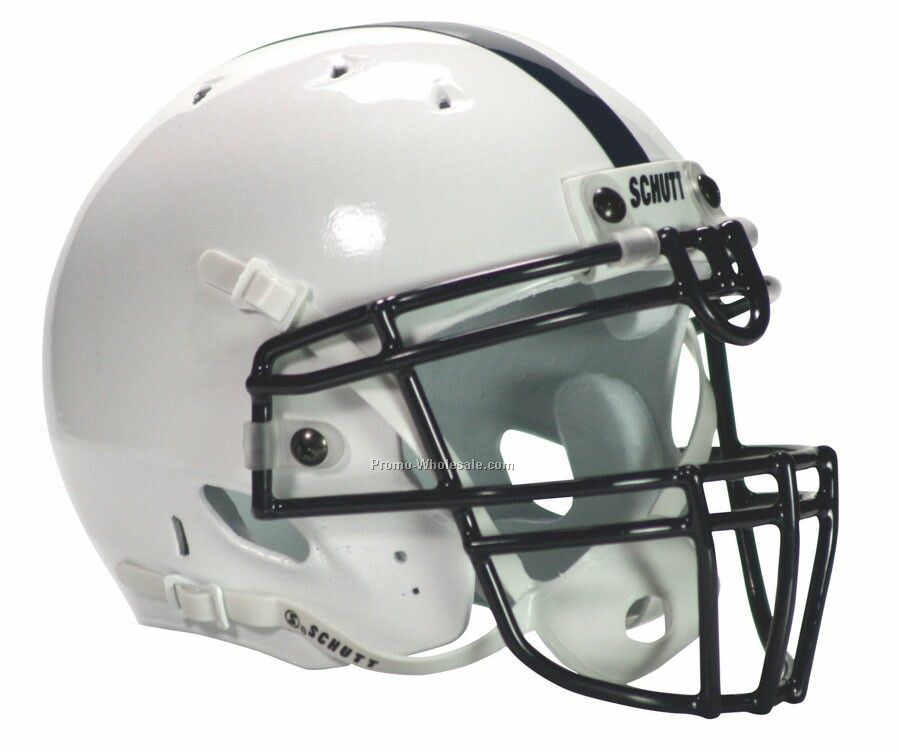
Penn State: Yes, I’ve read other sports blogs that have actually ranked this helmet as one of the best-looking in college football. (Pause) Needless to say, those guys need their heads examined. The whole Penn State uniform is a waste, starting with the helmet. It needs that oblong-shaped Nittany Lion logo on each side in the worst way. As it is, the helmet is a symbol of a larger problem with the program, and indeed with the entire state. Joe Grand-Pa and Pennsylvania are both clinging to a glorious past that is becoming an increasingly fading memory. A changing of the guard and of head coach — and deciding to the join the late 20th Century with a helmet decal would show that they’re no longer living in the ‘was’ and are finally living in the ‘is.’
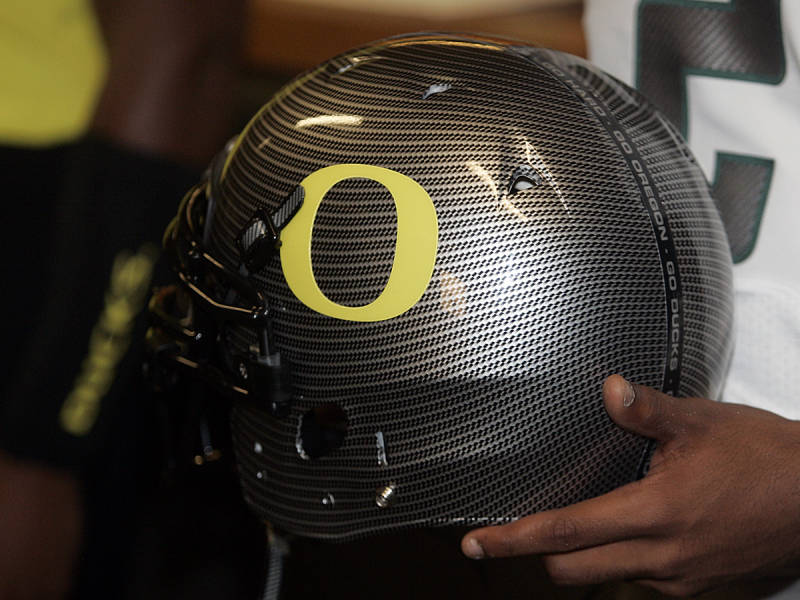
Oregon “graphite” helmet: I hear this design appeals to young people. I’m still young, but I suppose not young enough. Moreover, I cannot believe that the team chose this helmet over their beautiful green helmets when butting heads with Auburn in the BCS National Championship game. They deserved to lose on those grounds alone.
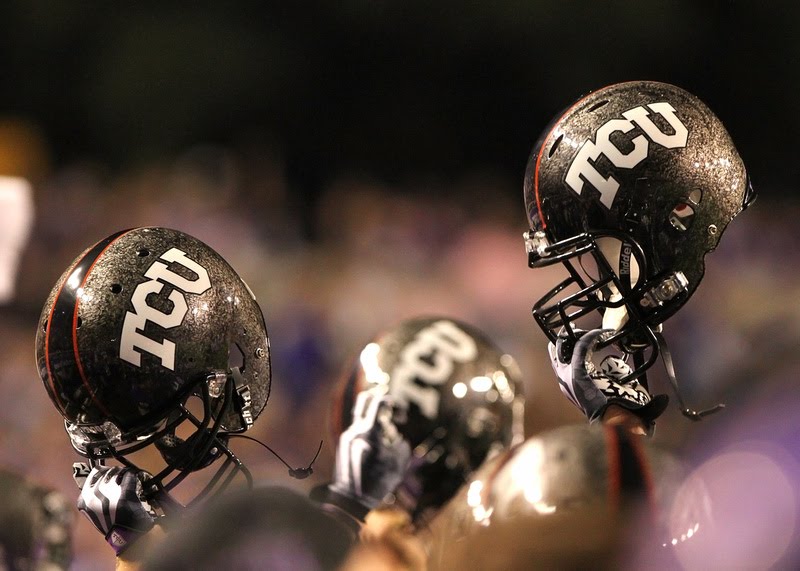
TCU “pewter” helmet: I have nothing against pewter. In fact, I think it looks pretty sweet as part of the Tampa Bay Buccaneers’ ensemble. But this is way over the line. It looks like the T-1000 nemesis from the movie “Terminator 2” threw up all over them. Worse yet, there’s no sign of the horned lizard on the decal. The program has those beautiful purple helmets, and yet they have worn these monstrosities? What in the name of Sammy Baugh and Davey O’Brien is this world coming to?
The Good (the best honorable mentions):
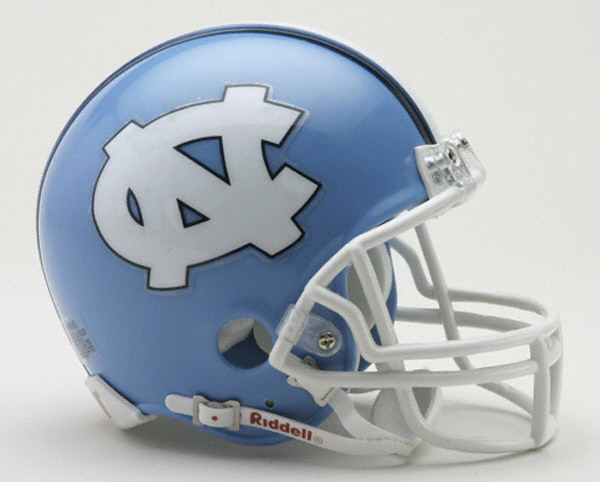
North Carolina: Few college helmets rock the Carolina blue. Only one, to the best of my knowledge, does so at the D-1A (pardon me, the FBS) level. Plus, UNC has, for a long time, used a tasteful among of dark blue trim, and the NC brand decal looks like its the perfect size.
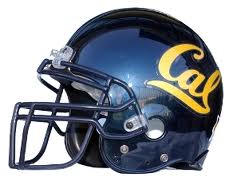
California: Given that dark blue is my favorite color, I confess to have a bias in favor of such a shell color. But the Chicago Bears helmets are dark blue, and yet those helmet look generic as all get-out. Indeed, there are two things that give Cal’s helmet nice aesthetics. One, its dark blue is a very, very fine metallic. Two, if you look closely enough, the yellow-gold “Cal” decal is govered in metallic gold glitter. It’s a nice combination.
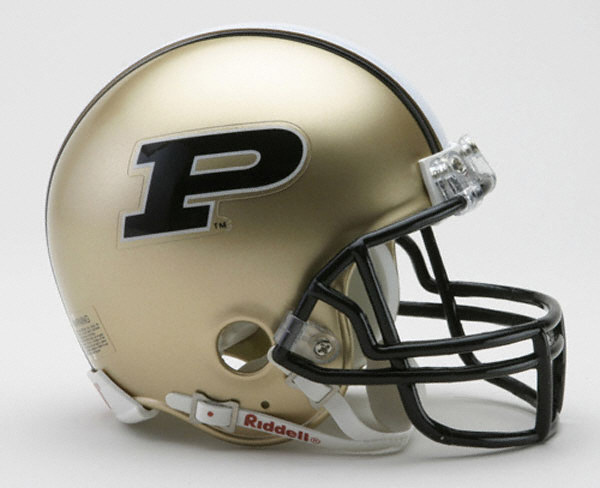
Purdue: As any marketing consultant will tell you, if you want your product to look prestigious, make it black and gold. Behold, Exhibit A. If only the gold were a little darker to make it more commensurate with “Old Gold.” In years past, that was indeed the case. That said, can a “P” logo look any neater?
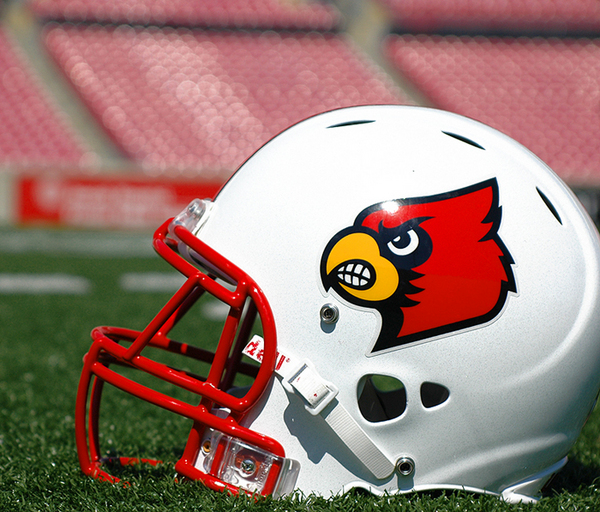
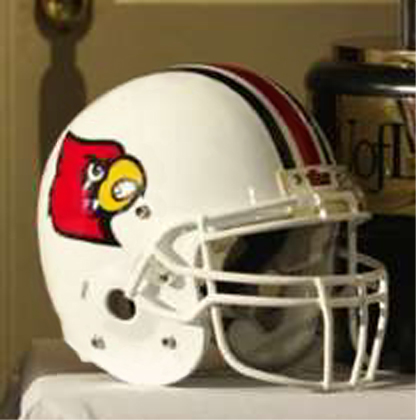
Louisville: Where to begin? The Cardinal mascot/nickname manifests itself in a number of different leagues, not just U of L: Ball State, Illinois State, St. Louis in MLB and Arizona in the NFL. That said, none of them come close to the best-looking Cardinal logo: that distinction belongs to Louisville. Its red facemask during the Bobby Petrino (and, regrettably, the Steve Kragthorpe) eras provided the wonderful contrast to the white shell, so it was a shame the Charlie Strong switched to the white facemask upon his inauguration as U of L’s current chief executive. To be sure, though, his introduction of the black and red triple centerstripes was an improvement over the tapering red centerstripe that they replaced. If Coach Strong brought back the red grilles, he would achieve perfection of that design. FYI: look closely at a U of L helmet, and you shall see that the white shell is (or, at least was) covered in silver glitter, topped off with clearcoat.
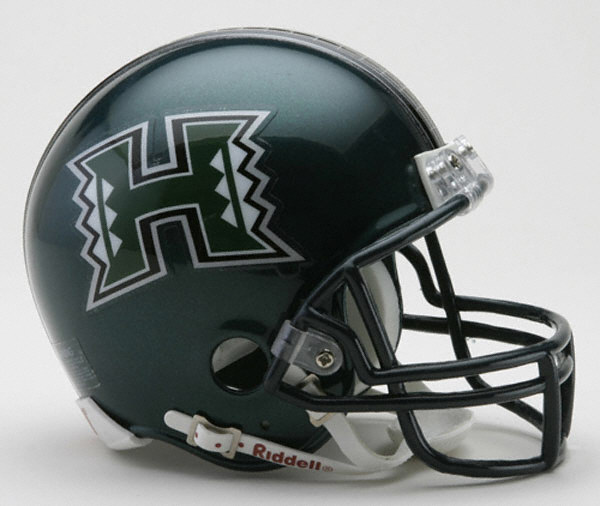
Hawaii: Can a metallic green be any darker and still be green? That alone gives it a considerable cool factor. Moreover, the Tapa-inspired “H” decal is most appropriate for the university and geographic setting, and who is not mesmerized by the elaborate pattern in the center stripe? As an aside, the silver road helmets were a mistake. All green, all the time, is the only way to go for the [erstwhile Rainbow] Warriors.
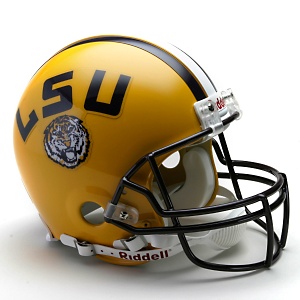
LSU: Some teams prefer the use of a single letter or two or three for their decal. Others prefer a pictorial depiction of the team nickname. The Bayou Bengals are one of the very few that do both, and do so with a basic helmet pattern (yellow-gold shell, purple and white triple center stripes) that has remained unchanged since 1956.
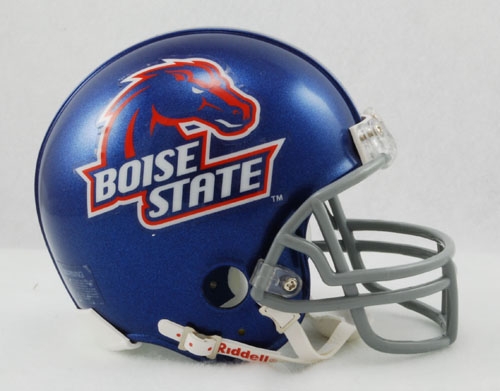
Boise State: The metallic royal blue shell makes this stand out. The orange time on the decal makes for a nice, aesthetically complementary appearance. To be sure, it was a mistake for the program to switch over to gray facemasks, as the white ones provided a much better contrast.
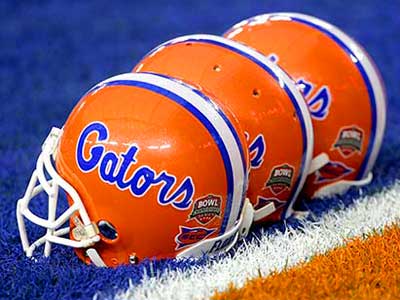
Florida: Given that I have included Boise State in this list of honorable mentions on the grounds that their blue and orange are textbook “complementary colors,” it is only logical I include the Gators’ bright orange helm as a contrast yet on the same grounds.
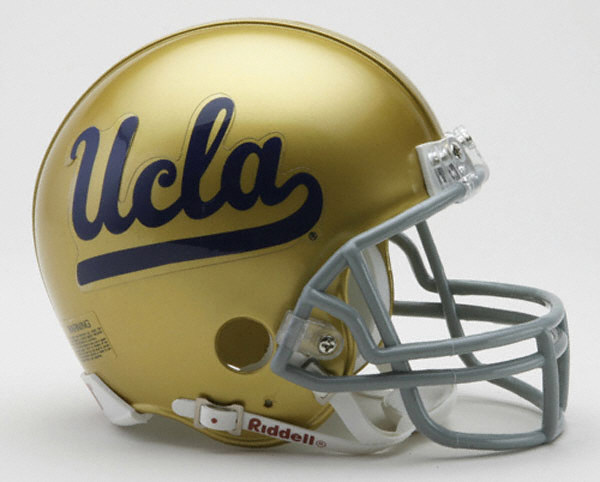
UCLA: Possibly the nicest color of gold in all of college football.
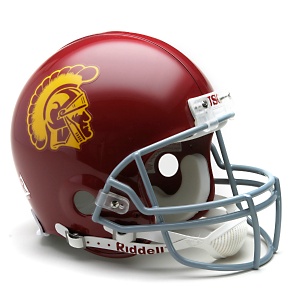
USC: I’ll be the first to admit, perhaps the Trojans’ fine tradition might have something to do with this mentioning. But that aside, Southern Cal’s cardinal color does the helmet a heap of justice, and with the recent addition of a thin, fine metallic top coat, it looks even “deeper” during night games.
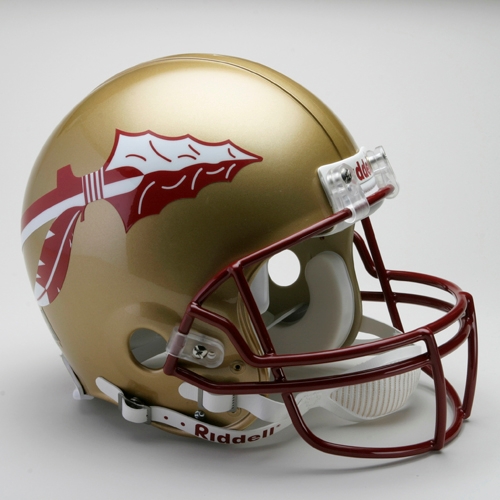
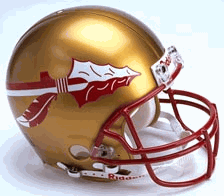
Florida State: The Seminoles have traditionally sported a nice-looking metallic gold on their helmets, and my generation has grown up associating the garnet and white spearhead with some of the highest levels of modern success. If only their gold still looked like it does in the left-hand photo, then they would have the nicest gold of any football helmet, hands down.

Northwestern: To be sure, this photo does the helmet design zero justice. The television screen, in my experience, gives the same meager result. NWU’s helmet must be seen in person to be truly appreciated. Its base, cast-in color of the shell is actually black. The metallic purple pearl and candy coat gives it the deepest purple of which one could conceive, and the black facemask brings out the purple all the more. Besides, if you’re going to use the letter “N” for a logo, does the Wildcats’ N get any better (I ask rhetorically)?
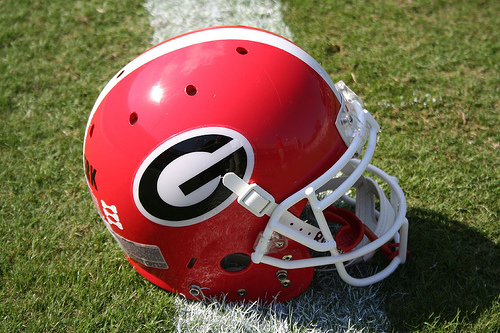
Georgia: Straight red with no frills, and possibly the best-looking “G” logo in the business. The single, white centerstripe is the same as it was when the program debuted this overall design in 1964.

Cincinnati: Do not be fooled. This is not just another black helmet, oh no. Having seen one of these shells up close and personally, this is actually one of the most uniquely-colored helmets in all of football. Picture this: a black shell, lightly covered in red glitter, topped off with a red candy coat for good measure. Though that color combo is difficult to discern on TV, in person, you cannot take your eyes off it, it looks that cool.
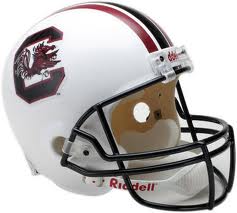
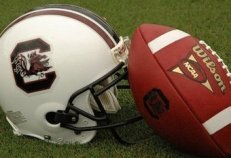
South Carolina: Normally when a team switches from a colored shell to a white shell, my standard reaction is that whoever came up with that idea needs his head examined. To further augment the irony, prior to Lou Holtz’s arrival, the Gamecocks already had a nice-looking helmet with their garnet shall. But when one sees things in toto, combined with the knowledge that South Carolina has had the same garnet and black triple center stripe pattern since 1956, it all makes for a very attractive package indeed. Plus, the “C” logo is quite elaborate.
The Best:
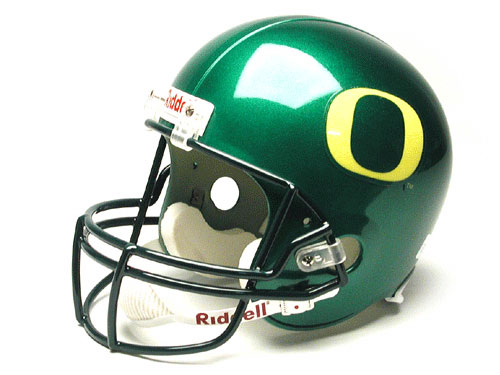
Oregon: The Ducks did a heckuva job when they unveiled this new helmet design for the 1999 season; in so doing, they set a precedent for what to expect out of early 21st Century helmet design. Their metallic green is perhaps the most intriguing of that color in all of college football, and the ultra-modern-looking, yellow “O” provides just the right contrast. It is a wonder they even bother with their white, yellow, black and “graphite” helmets at all. What were they thinking not wearing these green babies against Auburn?
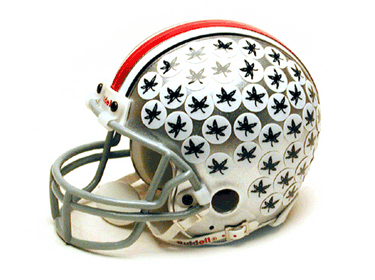
Ohio State: By itself, it’s a rather generic design, to be sure. Covered in Buckeyes, it’s one of the most sublime looks in college football. It has gotten only better within the past ten years. What used to be a generic fine silver coat has given way to something much neater: A heavy silver base coat, combined with a topping of silver glitter, sealed with clear coat, making a very “deep” silver look. The Buckeyes have set the standard for silver helmets in all of football, college or pro.
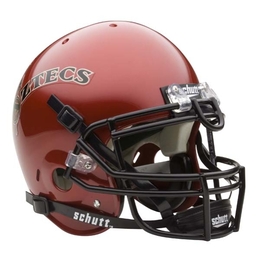
San Diego State: What, the purists ask? Why this peasant amongst traditional powers’ royalty? The answer is simple: the Aztecs have a distinct metallic red that makes it unique in college football, to say nothing of aesthetically pleasing. My best guess as to their secret? Possibly a black base shell, painted a gold-tinged metallic, then topped off with a red candy coat. It’s a viewing pleasure.
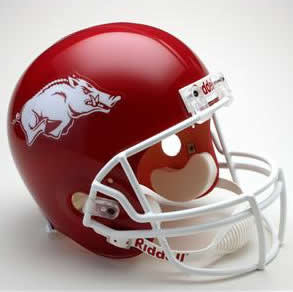
Arkansas: The Razorbacks themselves have a red (technically it’s “Cardinal” like that of USC, Iowa State, even Wisconsin) all their own, giving them arguably the most distinctive red-based shell in the game. Given that they now have one of the best coaches in the business with Bobby Petrino, chances are more folks will pay attention to this distinct helmet in the near future.
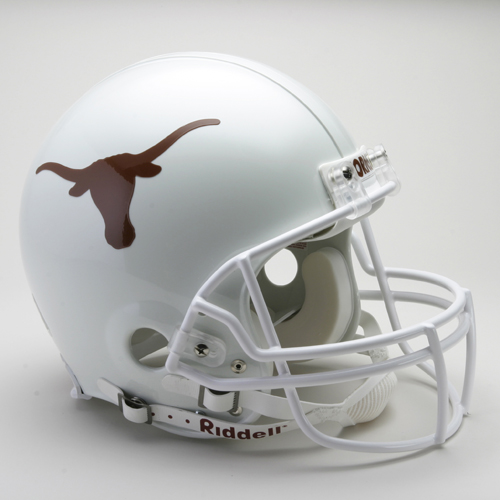
Texas: Normally, a plain white helmet with a white facemask is the epitome of generic in my book. But in this case, the iconic Longhorn silhouette logo provides an excellent contrast, one that gives the white shell and white grille a very clean look. Hook ’em!
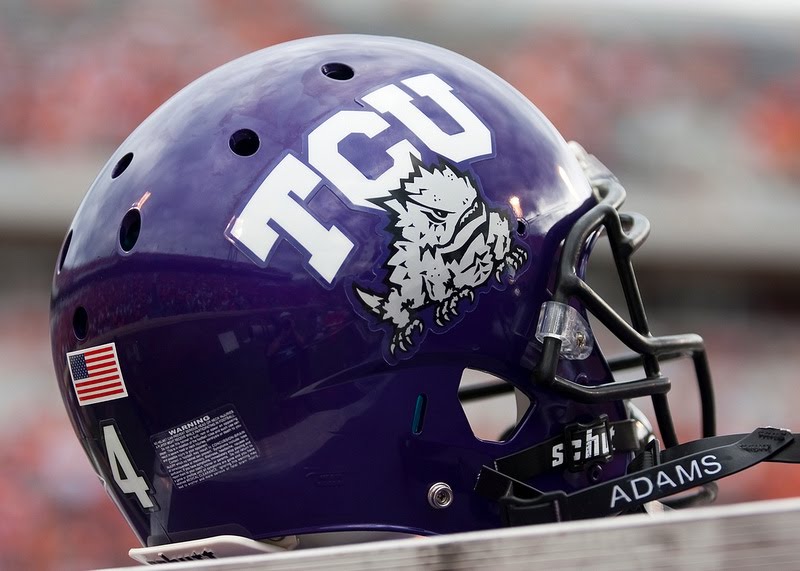
TCU: This helmet is listed for the same reasons that I previously listed Northwestern’s helmet, and then some. The reason I rank it higher than NWU’s is thus: does it get any better than a silver-colored horned lizard on a deep purple helmet? I submit ‘no.’

Kentucky: Probably the most beautiful blue helmet in football, of any league. It is almost enough to make you forget that most UK fans have their priorities out of whack, what with their fixation on basketball.
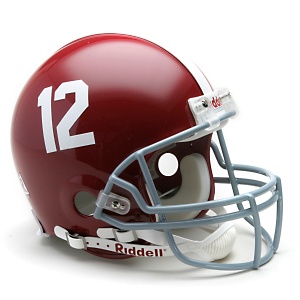
Alabama: What other legendary football program can take small numbers, put them on the side of the helmet, and call that a fashion statement? Granted, Bama was not the first with this feature, but they are the ones who have become the best-known for it. That, plus the crimson helmet and gray facemask combo never goes out of style. The Alabama helmet is a reminder that, like wearing a nice tuxedo, true elegance comes in the form of simplicity, not flamboyance.
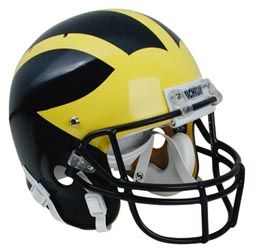
Michigan: Nothing beats the unique patten of the Michigan helmet. It is, arguably, the very symbol of the whole Wolverine athletics department, if not the university itself. Michigan’s hockey team uses this same patten on their hockey helmets. The football team’s truck has a custom paint job with this famous pattern on the top of the cab. I was not even ten years old when I first saw these helmets while watching Michigan play USC in the 1990 Rose Bowl. Fritz Crisler was said to have brought this pattern with him from Princeton and introduced it to the program in 1938. In all actuality, though, it is an innovation, not on outright invention. This famous pattern is actually a combination of certain styling queues already prevalent in the 1930s. Some teams had the “wing” on their helmets, while others used the three lines on their helmets in the ’30s and the ’40s. Even more fascinating is how the pattern is applied. The shell itself is actually that pale yellow (supposedly in line with the “maize” part of Michigan’s colors of Maize and Blue). A stencil pattern is applied, and the ultra-dark blue paint (perhaps the darkest blue in college football) is sprayed over it, followed by removal of said stencil. Voila — instant iconic helmet.
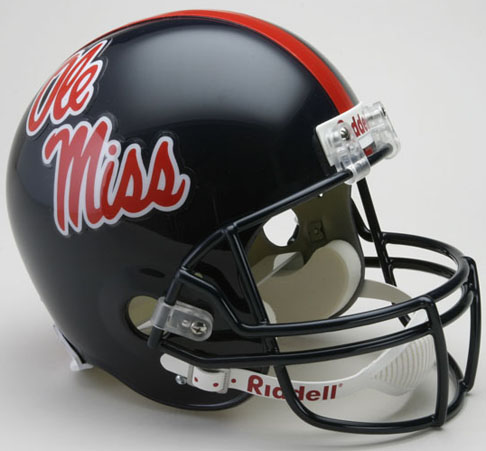
Ole Miss: Granted, this is not likely to be given a top-ten spot in most people’s helmet rankings. As I confessed earlier, though, I am naturally biased towards dark blue helmets. But so what? There are a number of them: what make Ole Miss so special? To me, nothing is better than dark blue with red trim. This helmet has that in spades, and carries a genteel tradition befitting legends such as Archie Manning and Johnny Vaught. It might be a quirky pick to some, but it works for me!
Coulda’, Woulda’, Shoulda’
Some teams used to have great-looking helmets, but have since tried to out-think the room and changed what were good things into not-so-great-looking things.
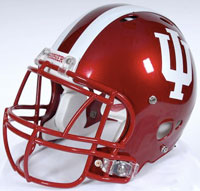
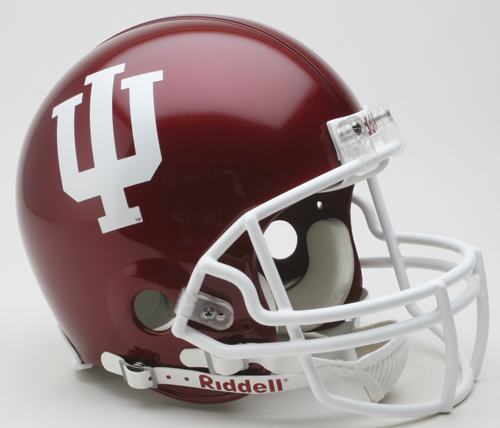
Indiana: The one on the right is what they used to have. Granted, the metallic crimson is quite pretty, before and after. But whereas the “before” had a matching crimson facemask and some nice white center stripes to provide a certain contrast, the “after” now looks like a cheap knock-off of Oklahoma.

Boston College: To be fair, there are many things to like about this helmet. Maroon and gold is always a winning combination, especially if the gold in question is of the metallic nature. The maroon center stripe and facemask provide a nice contrast, too. The problem? That’s all there is: without a decent decal on the side, it is a grossly incomplete design. A suggested solution to this problem would be to come up with a decal that is a combination of the “BC” logo with an eagle in the middle. Do that, and the design would merit a spot among the honorable mentions. Do it not, and the helmet remains an incomplete design and never lived up to its potential.
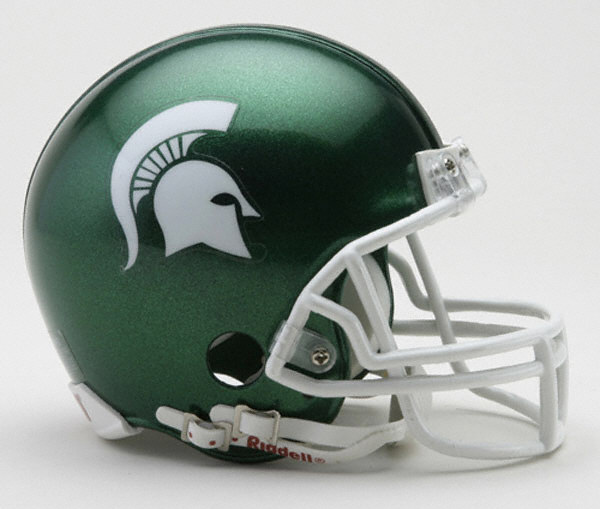
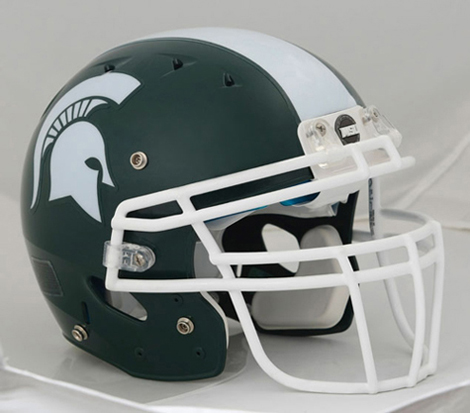
Michigan State: In recent years, the Spartans have had a really nice-looking metallic green. Moreover, take out 2001-2002 (where Bobby Williams foolishly went back to the generic “S” decal), and MSU has had an awesome Spartan helmet profile decal since 1995. A nice metallic green just the right hint of blue, an awesome Spartan decal, and a white center stripe made for a nice-looking helmet design, one that would have merited some sort of ranking. Not anymore, not with making the green darker, which detracts from the aesthetic, nor with the obtrusive tapering white centerstripe.
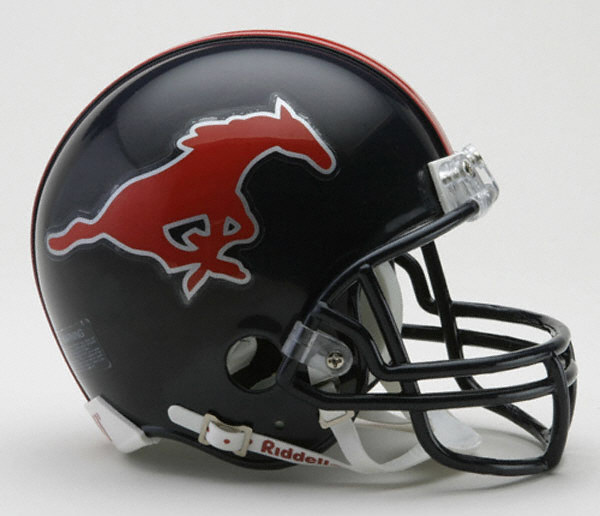
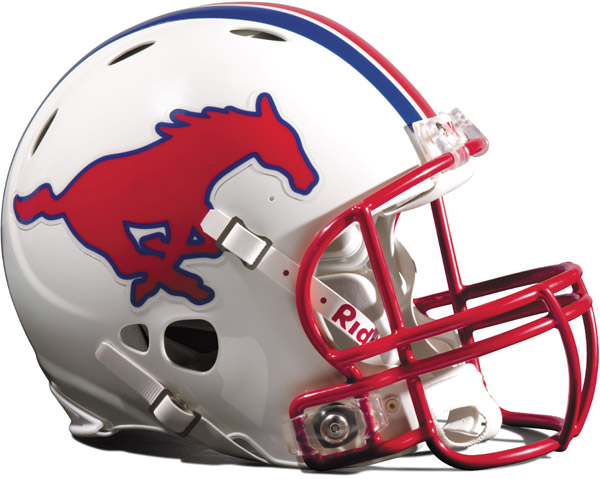
SMU: On the right is what the Mustangs had from 2004 to 2007. During that time, they had one of the nicest-looking shells in the game. Then somebody (I suspect June Jones, when he took over as head coach) got the bright idea to switch over to white helmets. Perhaps he wanted to hark back to the program’s glory days of the 1980s (pre-death penalty, at least). Whatever his intent may have been, the white helmet is come-down compared to the dark blue. Oh well…at least they got the royal blue and red center stripe combo right on the white shell. Give them credit for that.
Do any of you dear readers think I am leaving any out? Sound off in the comments section. I would enjoy your reading your thoughts.
About the Author July 18, 2011
Posted by intellectualgridiron in About the Author.Tags: About me, Aggies, Alamo Bowl, author background, autobiography, Cougars, Danny Hope, engineer, football, Houston, Joe Tiller, Kevin Sumlin, Louisville, National College, Outback Bowl, Patrick Murray, Purdue, renaissance man, Rose Bowl, Sarge, Texas A&M
add a comment

My name is Patrick Murray, though many of my friends from college know me as “Sarge”.* This website that I maintain is dedicated to the advancement of knowledge and insight, specializing in the virtues of limited government, as well as of scientific, historical, and pop cultural insights, plus the occasional sports commentary for fun.
I was born in Louisville, Ky., on March 2, 1980. I graduated from high school in Madison, Ind., where I lettered for three seasons in football and track. My undergraduate years were spent at Purdue University, where I majored in Mass Communications with a minor in History (honestly, I felt more like a science and history student masquerading as a comm student!). On the side, I took some courses in German, Latin, Entomology, Oceanography and Paleontology — in other words, fun stuff!
Outside of the classroom at Purdue, I served for three seasons as a student manager on the Purdue football team. That job allowed for me to see almost every stadium in the Big Ten (except for Iowa and Illinois), to say nothing of making some special life-long friends. I have a number of friends who play in the NFL — including Drew Brees, with whom I celebrated my 19th, 20th, and 21st birthday — and I remain an avid football fan to this day. As a manager, I worked directly under Coach Joe Tiller, and during the games, I helped out then-O-line Coach Danny Hope, who later became the current head coach from 2009 thought 2012. I also worked with Coach Kevin Sumlin, who was then the receivers coach (he played at linebacker for Purdue), before going on to give the Houston Cougars program a shot in the arm and then leading the Texas A&M Aggies to become the hot program it is today.
My services with the team also allowed for me to travel to special away games, including a season opener in Los Angeles Coliseum against USC (before the Pete Carroll era, to be sure!) in 1998, and in the Citrus Bowl against Central Florida in 1999. The three bowl games I was a small part of were the 1998 Alamo Bowl in San Antonio, the 2000 Outback Bowl in Tampa, Fla., and of course, the 2001 Rose Bowl in Pasadena, Calif. Those were memorable times.
After I graduated from Purdue, I went straight into business graduate school at the University of Louisville, where I earned my MBA. The next few years found me knocking around in the customer service sector until I just happened to find a teaching opportunity as an adjunct faculty member at the Louisville campus of National College. Finally I was able to find a job more commensurate with my education and talents. At that school, I have taught a number of different business courses, including Intro to Business, Principles of Management, Small Business Management, Operations Management, Purchasing & Materials Management, and, my favorite, Strategic Management. In addition to all of those, I have taught a number of general education courses, such as Public Speaking, Georgraphy, American History (both 1896-1945 and 1945-2000), Political Science, and American Government (needless to say, another one of my favorites to teach!). Starting in the late Spring of 2013, I have also taught computer skills courses (Microsoft Word, PowerPoint, Excel, etc.).
In more recent years, I have elected to fulfill a very latent goal of mine, and that is to become a mechanical draftsman (sometimes known as a CAD operator), if not an outright engineer. I have a design internship under my belt at a materials handling system manufacturer in Jeffersonville, Ind., and worked as a design engineer for a conveyor systems manufacturer on the southern edge of Louisville. In April of 2014, I accepted a position as an on-site project manager for a conveyor systems integrator, and have helped build sorter systems at FedEx Ground facilities in Fort Wayne, Ind., Indianapolis, New Castle, Del., Philadelphia, and Santa Fe Springs, Calif. This job has allowed for me to travel extensively and to engage in extensive learning in so doing.
Assuming that I have failed to establish my renaissance man credentials yet, it is also worth noting that I have given a couple of education seminars on insects to the docents at the Louisville Zoo — an occasion that allowed for me to show my rather extensive exotic insect collection. I also am an avid photographer (I use a Canon 7D), where I specialize in macro nature (particularly insects), aquarium fish, classic cars, and some sports. In addition, I have been a guest on a friend’s radio show on multiple occasions, discussing the Constitution and our Founding Fathers.

* The “Sarge” cognomen started back in June of 1997 — right before my senior year of high school — and was attending football camp at Purdue. The era of Coach Tiller was about to begin, and this camp gave me the opportunity to get to know all the coaches. Part of the camp’s curriculum was for the campers to coalesce into passing league teams, where we had such games for three consecutive nights, four games a night. My team’s coach was Coach Gary Emanuel, Purdue’s once and again current D-line coach. He did not know my name, but noticed I took a rather militaristic approach towards addressing my superiors (e.g., “yessir,” “no, sir.”). Such is the way I was raised. Noticing this, Coach Emanuel started calling me “Sarge,” and the name stuck. When I got on with the team as a manager, all the coaches remembered me, and soon the players too, started calling me by the same cognomen. It was only a matter of time before the cognomen in question spilled out beyond the gridiron to the greater campus.
 intellectualgridiron