College Football Week 5 Awards October 1, 2012
Posted by intellectualgridiron in Sports.Tags: Alabama, Arkansas, Army, Art Briles, Auburn, Baylor, Bayou Bengals, Big 10, Bo Pelini, Boilermakers, Boise State, Boston College, Cincinnati, college football, Colorado, Commonwealth Stadium, Cougars, Dana Holgorsen, Danny Hope, Derek Dooley, Fighting Illini, Florida, Florida State, Georgia, Georgia Tech, Huskers, Idaho, Illinois, Indiana, Kansas, Kansas State, Kentucky Wildcats, Kevin Sumlin, Kevin Wilson, Louisiana Tech, Louisiana-Monroe, LSU, Mark Dantonio, Marshall, Miami Hurricanes, Miami Redhawks, Michigan State, Middle Tennessee State, Mountaineers, NCAA, Nebraska, New Mexico State, Nittany Lions, North Carolina, Notre Dame, Ohio State, Oklahoma, Ole Miss, Oregon, Oregon State, Penn State, Purdue, Sonny Dykes, South Carolina, Southern Miss, Stony Brook, Tennessee, Texas, Texas A&M, Texas Tech, Thundering Herd, Tim Beckman, Towson, Tulane, UCLA, uniforms, unis, Urban Meyer, Virginia Tech, Washington State, West Virginia, Wisconsin Badgers
add a comment
COACHES
Wish I were him: Kevin Sumlin, Texas A&M
Glad I’m not him: Derek Dooley, Tennessee
Lucky guy: Bo Pelini, Nebraska
Poor guy: Mark Dantonio, Michigan State
Desperately seeking a wake-up call: Danny Hope, Purdue
Desperately seeking a P.R. man: Sonny Dykes, Louisiana Tech
Desperately seeking sunglasses and a fake beard: Tim Beckman, Illinois
Desperately seeking … anything: Kevin Wilson, Indiana
TEAMS
Thought you’d kick butt, you did: North Carolina (defeated Idaho 66-0)
Thought you’d kick butt, you didn’t: LSU (defeated Towson 38-22)
Thought you’d get your butt kicked, you did: Colorado (lost to UCLA 42-14)
Thought you’d get your butt kicked, you didn’t: Marshall (lost to Purdue 51-41)
Thought you wouldn’t kick butt, you did: Penn State (beat Illinois 35-7)
Dang, they’re good: Florida State
Dang, they’re bad: Army
Did the season start? Virginia Tech
Can the season end? Indiana
Can the season never end? Oregon
GAMES
Play this again: West Virginia 70, Baylor 63
Never play this again: Louisiana Monroe 63, Tulane 10
What? Cincinnati 27, Virginia Tech 24
Huh? Stony Brook 23, Army 3
Are you kidding me? Penn State 35 – Illinois 7
Oh – my – God: Middle Tennessee State 49, Georgia Tech 28
Told you so: No.5 Georgia 51, Tennessee 44
NEXT WEEK
Ticket to die for: No. 5 Georgia @ No. 6 South Carolina
Best non-Big Six vs. Big Six matchup: Miami (Fla.) @ No. 9 Notre Dame (assuming one were to count Independents as “non-Big Six, otherwise, it would be Miami (Ohio) @ Cincinnati.
Best non-Big Six matchup: Louisiana Monroe @ Middle Tennessee State
Upset alert: No. 8 West Virginia @ No. 11 Texas
Must win: No. 17 Oklahoma @ Texas Tech
Get-well opportunity: No. 20 Michigan State @ Indiana
Offensive explosion: Washington State @ No. 18 Oregon State
Defensive struggle: No. 4 LSU @ No. 10 Florida
Great game no one is talking about: Michigan @ Purdue
Intriguing coaching matchup: Urban Meyer of Ohio State vs. Bo Pelini of Nebraska
Who’s bringing the body bags? Kansas @ No. 7 Kansas State
Why are they playing? No. 24 Boise State @ Southern Miss
Plenty of good seats remaining: Boston College @ Army (or, New Mexico State @ Idaho, take your pick)
They shoot horses, don’t they? Arkansas @ Auburn
What we have learned after Week 5:
Remember last week’s predicted “Offensive Explosion”? Scratch that. Yes, hindsight is indeed 20-20, but West Virginia’s Big XII debut against Baylor was far more than an “Intriguing Coaching Matchup” between the Mountaineers’ Dana Holgorsen and the Bears’ Art Briles. The score of the game was so high, in what has become to be a seemingly typical Baylor fashion these days, that one needed oxygen to read the numbers. The Mountaineers made a very splashy conference debut, winning at home 70-63.
Also, remember last week’s predicted “Defensive Struggle”? Scratch that one, too. Penn State defeated Illinois in the Fighting Illini’s home stadium, 35-7. That cannot be attributed alone to the Illini wearing dark blue helmets for the first time since, well, pretty much ever. The available evidence on hand indicates that Illinois has worn orange helmets since at least 1945, if not earlier. I cannot find any photographic record yet of them ever wearing blue helmets, but the search shall continue. Just don’t hold your breath in the meantime. That aside, has Penn State found some offense, or is Illinois that horrible? The Nittany Lions have sputtered offensively practically the whole season until yesterday, while the Fighting Illini were 2-2 going into that game.
The Purdue-Marshall match-up in West Lafayette, Ind., was tagged for this past week’s “They Shoot Horses, Don’t They” slot. The selection was by default, since the odds of a major blowout anywhere else aside from other chosen games seemed much higher. But while the Boilermakers were making gamey mincemeat out of the Thundering Herd in the first half, they let off the gas too soon in the second half. A clearly visible epidemic of dropped passes in the third quarter especially raised concerns for Purdue’s prospects in the Big Ten. Until now, plenty of talk has abounded regarding the Boilers having a very attainable shot at representing the Leaders division of the Big 10 in the championship game in Indianapolis. After this game, some doubts will no doubt linger. Much work is to be done if Purdue is to triumph at home next week against Michigan, and quell the justifiable newfound doubts in so doing. Get it together, Boilers.
The LSU-Towson matchup was to be, on paper, a slaughter so massive as to border on a war crime. Most fans could not even point Towson’s location out on a map (hint: it is a very nice suburb in the northern part of Baltimore). The only factor one can attribute to LSU’s inexplicably close margin of victory (38-22) is that the Bayou Bengals must have kept the playbook very, very limited so as to avoid divulging any trade secrets as they prepare to take on a quietly improving Florida team next week.
The Upset Alert prediction of last week (South Carolina @ Kentucky) seemed to almost come to fruition, as the Gamecocks wasted an entire half, trailing the Wildcats in Commonwealth Stadium by more than a touchdown. Only after they made the proper halftime adjustments did they assert themselves like a top-ten team should, and pulled themselves out of an unnecessary hole with a modest score of 38-17. South Carolina will not have such a luxury of using an entire half of a football game as their learning curve next week, when they will take on cross-border, arch-rival Georgia in what will without a doubt be the game of the week.
Awesome unis:
The Wisconsin-Nebraska game was not only a great game to watch from a purely game-play standpoint, with great execution on both sides of the ball. It was also a feast for the eyes from two teams who historically where rather stodgy uniforms. Both teams had sick-looking alternate, quasi-throwback unis (and we mean “sick” in the hip, with-it, good way!). The Badgers’ red helmets and red shoulders on white jerseys was a feast alone for the eyes, to say nothing of Huskers’ red jersey-pants combo with tasteful black trim, along with the first black helmets the team as ever donned – EVER. The proverbial icing on the cake was the large school letters worn on the front of both teams’ jerseys. All in all, a nice combination of throwback elements from the 1920s, 1940s, and 1950s! Speaking of which, did anybody notice the nice late ‘50s-style numbers on Wisconsin’s jerseys? One word: neato!
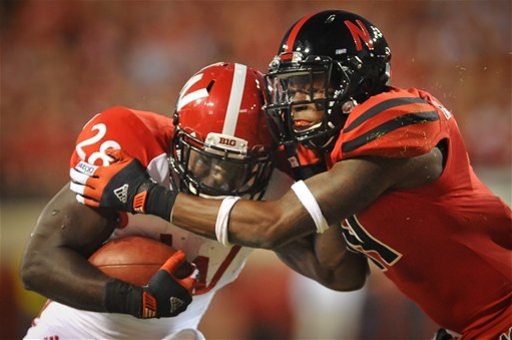

While we’re on the awesome uniform topic, it was nice to see LSU where purple jerseys again, as they have been known to do once in a blue moon. Moreover, I am prepared to designate Ole Miss’ road uniforms as the nicest away unis in the SEC. The all-gray is a unique touch, but the red-on-navy blue trim is an unbeatable combination, especially as it scrolls over the shoulders. On the other side of the continent, what is up with Oregon wearing gray pants? This thought especially came to mind as I watched them play Washington State in Pullman, Wash. Did the Ducks not know full-well that the Cougars were wearing gray pants at home? Would it have been too much trouble to wear green pants instead to provide a better contrast on the field? Sheesh.
College Football Week 4 Awards September 24, 2012
Posted by intellectualgridiron in Sports.Tags: Al Golden, Alabama, Arkansas, Art Briles, Baylor, Brady Hoke, Buffalo, Central Michigan, college football, Colorado, Connecticut, Dana Holgorsen, Florida State, Georgia Tech, Idaho, Idaho State, Illinois, Iowa, Jim Mora, Jimbo Fisher, Joker Phillips, Kansas State, Kentucky, Kyle Flood, Louisiana Tech, Louisville, LSU, Marshall, Maryland, Miami, Michigan, Michigan State, NCAA, Nebraska, North Carolina, Northern Illinois, Ohio State, Oklahoma, Oklahoma State, Oregon, Oregon State, Paul Johnson, Penn State, Purdue, Rice, Rutgers, South Carolina, Southern Miss, Stanford, Texas, Tim Beckman, Towson, UAB, UCLA, Washington, Washington State, West Virginia
add a comment
In just our second week of picking up where the good sportswriters at Yahoo ! left off, here are the week 4 awards for college football teams and coaches – enjoy!
COACHES
Wish I were him: Jimbo Fisher, Florida State (notwithstanding his son’s illness)
Glad I’m not him: Brady Hoke, Michigan
Lucky guy: Al Golden, Miami (Fla.)
Poor guy: Paul Johnson, Georgia Tech
Desperately seeking a wake-up call: Jim Mora, UCLA
Desperately seeking a P.R. man: Kyle Flood, Rutgers
Desperately seeking sunglasses and a fake beard: Tim Beckman, Illinois
Desperately seeking … anything: Joker Phillips, Kentucky
TEAMS
Thought you’d kick butt, you did: Alabama
Thought you’d kick butt, you didn’t: West Virginia (defeated Maryland 31-21)
Thought you’d get your butt kicked, you did: Kentucky (lost to Florida 38-0)
Thought you’d get your butt kicked, you didn’t: UAB (lost to Ohio State 29-15)
Thought you wouldn’t kick butt, you did: Louisiana Tech (defeated Illinois 52-24)
Dang, they’re good: Oregon
Dang, they’re bad: Arkansas
Did the season start? Michigan
Can the season end? Kentucky
Can the season never end? Florida State
GAMES
Play this again: Marshall 54, Rice 51, 2OT
Never play this again: Nebraska 73, Idaho St. 7
What? Rutgers 35, Arkansas 26
Huh? Oregon St. 27, No. 19 UCLA 20
Are you kidding me? Colorado 35, Washington State 34
Oh – my – God: Central Michigan 32, Iowa 31
Told you so: No. 15 Kansas State 24, No. 6 Oklahoma 19
NEXT WEEK
Ticket to die for: No. 12 Texas @ Oklahoma State (or Tennessee @ No. 5 Georgia)
Best non-Big Six vs. Big Six matchup: Louisville @ Southern Miss
Best non-Big Six matchup: Central Michigan @ Northern Illinois
Upset alert: No. 7 South Carolina @ Kentucky
Must win: No. 21 Michigan State vs. No. 16 Ohio State
Offensive explosion: Oregon @ Washington State
Defensive struggle: Penn State @ Illinois
Great game no one is talking about: No. 9 Stanford @ Washington, Thurs., 9 PM EDT
Intriguing coaching matchup: Dana Holgorsen of West Virginia vs. Art Briles of Baylor
Who’s bringing the body bags? Towson @ LSU
Why are they playing? Idaho @ North Carolina
Plenty of good seats remaining: Buffalo @ Connecticut
They shoot horses, don’t they? Marshall @ Purdue
NCAA out of Bounds in Sanctioning Penn State September 20, 2012
Posted by intellectualgridiron in Sports.Tags: athletics, Bill O'Brien, college football, draconian, Jerry Sandusky, Joe Paterno, NCAA, Nittany Lions, penalty, Penn State, probation, Rodney Erickson, sanctions, scholarship, transfer
1 comment so far

Back-up placekicker Sam Ficken for Penn State, walking off the field dejected in losing on the road to Virginia. Ficken was the Nittany Lions’ back-up kicker, as their erstwhile starting kicker transferred to the University of Texas amid the chaos in Happy Valley.
Anybody who is remotely aware of the major developments in the world of big-time sports, specifically college football, has no doubt heard the news about the mountain of sanctions that the NCAA has arbitrarily heaped onto the once-vaunted football program of Pennsylvania State University, a.k.a., Penn State. These sanctions include a $60 million fine, a four-year postseason bowl ban, a Draconian reduction in scholarships (10 initial, 20 total each year for four years), and, to add insult to injury, vacate all the wins during the late Joe Paterno’s tenure dating back to 1998 – the year when the bulk of the child abuses perpetrated by then-assistant coach Jerry Sandusky were first internally known among some staff members.
Before the discussion proceeds any further, be it known and understood that I carry no water for Penn State. As a graduate of a Big 10 Conference rival, I had no love for a team that beat us in all the years that we played them during my time as a college student. Furthermore, I make no apologies for the stubborn refusal of JoePa to plan and execute his own exit strategy, which he should have done a full decade before his sudden and long-overdue ouster in 2011. Most importantly, this not in any way to rationalize the evils perpetrated by Sandusky, nor to be insensitive to the undue emotional and spiritual scarring wrought upon the innocent young victims.
But what did these evils themselves have to do with the football program at large? Sandusky was found guilty of these heinous crimes in the court of law, and awaits a sentence that will surely be tantamount to spending the rest of his life in prison. He has not been directly affiliated with the program since the end of the 1999 season. Moreover, Paterno has not only ceased to the head coach at PSU – a position he held for more than four decades – but he is deceased. The two individuals to whom legitimate blame for these evils is warranted – the perpetrator in Sandusky and the enabler in Paterno – are either in jail or are underneath the sod (in this case, respectively!).
The point is, the crimes that were done by Sandusky and on Paterno’s watch were transgressions of the legal nature, and were punished in the legal realm. Whatever further punishment awaits both in the next life is a matter for the theologians to debate. But this had nothing to do with NCAA ethics. And is that not the grounds for which this august governing body for collegiate athletics metes out its punishment to member athletics departments?
The NCAA, in their supposed magnanimity, allowed for players currently on the roster of the Penn State football team to transfer to other programs without being forced to sit out for year. Under normal circumstances, players on a Division 1A (pardon me, Football Bowl Subdivision, or FBS) program who choose to transfer to another school/team have to sit out for one season, unless they transfer to a Division 1AA program (pardon me, Football Championship Subdivision, or FCS). For example, if a player is on the roster at, say, the University of Cincinnati, he feels as though he is not a good fit after all, and decides to play elsewhere, he could transfer, to say, Eastern Kentucky University, and play immediately. Not so if he were to transfer to, say, the University of Toledo, or Kent State, the University of Kentucky, or of Louisville, and expect to play immediately, for the NCAA mandates that such a lateral transfer requires the given student to sit out for a year.
At least the governing body in question had the decency to recognize that the current players on the team had nothing to do with the aforementioned evils, and should be let off the proverbial hook so they could continue to be in a position to reap the rewards that winning effort on the field allows. For they have waived the traditional transfer rule and have allowed current PSU players to go to other FBS teams that have a chance to go to a bowl game, thus leaving Penn State in a further weakened state than it already is. At least ten players have taken up the NCAA on this offer, and have transferred elsewhere, notably to Illinois, to Florida, to Texas, N.C. State, even to Cal and USC.
All this leaves the Penn State program in a severely weakened state. The players worth any count have been given the option to seek greener pastures, and have naturally done so. The remaining players are, according to reason, less skilled, and the performance on the field – losing at home to Ohio U at home and to Virginia on the road – with a back-up kicker missing key field goals (the starting kicker wisely fled to join the Texas Longhorns, whose collective star is on the re-rise).
To sum things up, the program is $60 million poorer, bereft of its more-skilled players, and unable to attract players worth any count for the next four years at least on account of both losing some of its scholarships to offer, to say nothing of no prospects of a post-season bowl game for that length of time, no matter how well the team does in the regular season. In short, the NCAA essentially gave them a walking death penalty. The only reason that Penn State acquiesced to these stringent terms is that if PSU did not, the NCAA would have given them the real thing, according to the new president of the university, Rodney Erickson.
The only time the NCAA handed down the “death penalty” to a football program (where the program is not allowed to even field a team and play that sport for an entire season) was to SMU in 1987. The ruling’s reasons, according to NCAA investigators, were, among others, an under-the-table slush fund given to Mustang players, $61,000 total, to be exact. SMU forewent fielding a team for 1988 as well. Contrast that with the Nevin Shapiro booster scandal at the University of Miami (Fla.) that came to light in 2011. According to Shapiro’s own admissions in numerous jailhouse interviews (currently, he is serving a prison term for a $930 million Ponzi scheme), he provided U of Miami football players with “cash, prostitutes, entertainment in his multimillion-dollar homes and yacht, paid trips to high-end restaurants and nightclubs, jewelry, bounties for on-field play (including bounties for injuring opposing players), travel and, on one occasion, an abortion.”
In both the case of SMU as well as Miami, clear recruiting and player compensation violations took place: ethical violations that warranted/warrant NCAA punishment to those programs. Yet Nevin Shapiro’s egregious violations make the SMU slush fund pale in comparison, yet the NCAA has yet to hand down any sanctions whatsoever to “The U.”
Meanwhile, no evidence has yet surfaced regarding the crimes of Jerry Sandusky and the tacit enabling of them by Joe Paterno having any bearing at all on recruiting violations, player compensation, or even cruelty towards players, or any other act which would legally and ethically warrant such Draconian punishment from the NCAA.
As mentioned before, the perpetrator and enablers are long gone from the University. Sandusky awaits his prison sentence, Paterno is under the sod, and anybody else connected to Joe[Grand]Pa, including the former athletics director and even the former university president himself, both former players under Paterno, have been summarily dismissed. Penn State has a new head football coach, a new A.D., and also a new president of this highly respected university. They are earnestly trying to “grow new grass,” so to speak. Why punish them, not to mention the players who have commendably made up their minds to commit their college-playing eligibility to this institution in the wake of these horrifying scandals? Why punish the 107,000+ fans who show up at Beaver Stadium on Saturdays in the Fall? Why punish the millions of Nittany Lion faithful over the actions of a few individuals whose violations were strictly within the legal realm, and had nothing to do with NCAA infractions?
At this time of PSU’s darkest hours, I would advise the rest of the Big Ten fan bases not to dance on the Nittany Lions’ grave. A weakened Penn State means a weakened Big 10 Conference, this at a time when cold weather programs are increasingly at a competitive disadvantage in terms of recruiting the best players nationwide, hence are struggling to be credible contenders for national titles. It also means weakened intra-conference competition, something that could affect other conference teams’ strength of schedules and possibly their national rankings. A strong PSU team would mean the opposite of these potential problems.
If the sages in Indianapolis dictated that the $60 million fine go to programs that work to prevent child abuse and molestation, that would be a fitting penalty that all parties concerned could embrace. But instead, a bunch of detached elitists decided to proceed much further than necessary and bring hard times to a proud university, to a state, and to its national fan base. Shame on the NCAA for unduly and arbitrarily forcing Penn State’s football program into an induced coma. Sanctions towards other programs guilty of actual violations within their jurisdiction are warranted but remain to be administered. The governing body has some explaining to do for this clear double-standard.
As an aside, the new head coach has yet to get the hint that part of “growing new grass” means a clean break from those blindingly generic uniforms. Nameplates on the back of the jerseys are not enough. Bill O’Brien worked in the NFL long enough to understand what a helmet logo decal looks like. It will be interesting to see if and when he eventually gets the hint and starts having some football-shaped Nittany Lion logo decals affixed to the sides of those mind-numbingly generic white helmets. If these horrific developments do not sound the clarion call for Penn State to ditch those horribly generic unis once and for all, what will?
College Football Week 3 Awards September 17, 2012
Posted by intellectualgridiron in Sports.Tags: Alabama, Arizona, Arkansas, Auburn, awards, Ball State, Boise State, BYU, Cal, California, Charlie Strong, Clemson, college football, Colorado, Connecticut, Duke, Eastern Michigan, Florida, Florida Atlantic, Florida International, Florida State, Fresno State, Gene Chizik, Idaho, Indiana, James Franklin, John L. Smith, Joker Phillips, Kansas State, Kentucky, Louisiana-Monroe, Louisville, LSU, Mack Brown, Mark Dantonio, Mark Richt, Maryland, Memphis, Michigan State, Mississippi State, Missouri, Navy, NCAA, North Carolina, Northwestern, Notre Dame, Ohio State, Oklahoma, Oregon, Pat Fitzgerald, Penn State, Pittsburgh, Purdue, rivals, South Carolina, Stanford, Temple, Tennessee, Texas, Todd Berry, Troy, UAB, USC, Virginia Tech, West Virginia, Western Kentucky, Yahoo!
1 comment so far
It was so much fun. Every Sunday afternoon in the Fall of very recent years, we looked forward to the sportswriters of Rivals/Yahoo.com giving us their take on the good, the bad, and the ugly of the college football games and teams from the previous day. Their awards were very informal yet well to the point, and never failed to produce a number of chuckles and at times a few belly laughs. Those days seem to be gone. Yahoo!’s online sports section has been given a sleek makeover, but in this new format, the weekly awards seem to have been lost by the wayside. Maybe one could account for this because one of their main writers, Tom Dienhart, now blogs for the Big Ten Network. Who knows? The bottom line is, despite my best efforts, I cannot find it anymore. What website that is worth its weight in attracting eyeballs would make such an enjoyable weekly post so hard to find?
With all of this in mind, inspiration hit me last night to take it upon myself to dole out the awards instead. Afterall, I’m an alumnus of a Big Ten program, and have worked with coaches now on a number of “Big-Six” conference teams. It may not be Rivals/Yahoo!, but if you love college football, you might be apt to find this to be the next best thing. I have tweaked some of the awards to suit the unique situations that arise from week to week, but for the most part, the awards are the same. Therefore, I offer the awards for the third week of major college football, and aim to continue to do so until the able writers at Yahoo! ‘get it together’ and resume their Sunday duties.
Wish I were him: Mack Brown, Texas
Glad I’m not him: Mark Dantonio, Michigan State
Lucky guy: Gene Chizik, Auburn
Poor guy: Todd Berry, Louisiana-Monroe
Desperately seeking a wake-up call: Charlie Strong, Louisville
Desperately seeking a P.R. man: Pat Fitzgerald, Northwestern
Desperately seeking sunglasses and a fake beard: Joker Phillips, Kentucky
Desperately seeking … anything: John L. Smith, Arkansas
TEAMS
Thought you’d kick butt, you did: Purdue (beat Eastern Michigan 54-16)
Thought you’d kick butt, you didn’t: Mississippi State (beat Troy 30-24)
Thought you’d get your butt kicked, you did: Idaho (lost to LSU 63-14)
Thought you’d get your butt kicked, you didn’t: Pittsburgh (beat Virginia Tech 35-17)
Thought you’d reach a turning point, you didn’t: Tennessee (lost to Florida 37-20)
Dang, they’re good: Alabama
Dang, they’re bad: Colorado (or Kentucky: take your pick!)
Ya’ know, they’re not so bad: Cal
Did the season start? Penn State
Can the season end? Navy
Can the season never end? Stanford
Play this again: Stanford 21, USC 14
Never play this again: Fresno State 69, Colorado 14
Unbelieveable Irony: Connecticut 24, Maryland 21
What? Ball State 41, Indiana 39
Huh? Notre Dame 20, Michigan State 3
Are you kidding me? Pittsburgh 35, Virginia Tech 17
Oh – my – God: Western Kentucky 31, Kentucky 30
Told you so: Louisville 39, North Carolina 34
NEXT WEEK
Ticket to die for: No. 11 Clemson @ No. 5 Florida State
Best non-Big Six vs. Big Six matchup: Florida International vs. Louisville
Best non-Big Six matchup: BYU @ Boise State
Upset alert: Kansas State @ Oklahoma
Must win: USC vs. California
Offensive explosion: Arizona @ Oregon
Defensive struggle: Temple @ Penn State
Great game no one is talking about: Missouri @ South Carolina
Intriguing coaching matchup: Mark Richt of Georgia vs. James Franklin of Vanderbilt
Who’s bringing the body bags? Florida Atlantic @ Alabama
Why are they playing? UAB @ Ohio State
Plenty of good seats remaining: Memphis @ Duke
They shoot horses, don’t they? Maryland @ West Virginia
What are your thoughts, dear readers? Comments are welcome!
Classical Music guide addendum December 14, 2011
Posted by intellectualgridiron in Pop Culture.Tags: Boccherini, Brahms, Carl Philipp Emanuel, Couperin, Gabrieli, Gershwin, Gottschalk, Ives, Johann Christian, Mendelssohn, Penderecki, Schoenberg, Schubert, Telemann, Wilhelm Friedemann
add a comment
WWWD (What would Woody do)? November 14, 2011
Posted by intellectualgridiron in Sports.Tags: Barry Switzer, Bear Bryant, Bobby Bowden, college football, Frank Kush, Howard Schnellenberger, Jerry Sandusky, Joe Paterno, JoePa, Lou Holtz, management, molestation, Ohio State, old school, pedophilia, Penn State, scandal, scenario, Woody Hayes
1 comment so far
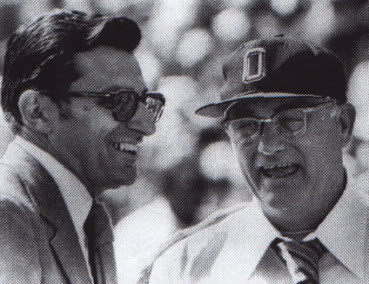 How would Woody have done it? That is a popular question to ask in Columbus, Ohio, and throughout the Buckeye State. It can be a very effective conversation-starter in that part of the country, though beware of the side-effect of it possibly sparking some not-so-civil debates, too. But it may seem like an odd question to ask in the wake of the earth-shaking scandal at conference neighbor Penn State, a controversy so huge it has already resulted not only in the immediate termination of 46-year head coach Joe Paterno, but also in that athletics director Tim Curley has been placed on administrative leave, as he is charged with perjury and failure to report a crime, not to mention the resignation of the university president himself. In case you have been under a rock for the past eight days or so, long-time Penn State assistant coach Jerry Sandusky, who mysteriously retired from coaching at age 55 in 1999, has been charged with molesting a total of eight young boys (that we know of) over the past 15 years.
In hindsight, it has been alleged that Sandusky’s retirement at that relatively early age came about because this perverted proclivity of his was an obvious liability to the program, and was quietly nudged out. Still, for the past 12 years, not only has Sandusky been allowed back on campus, but was granted practically unlimited access to the football facilities (locker room, weight
room, you name it) and was on campus frequently as part of his non-profit organization that he established to help at-risk youth – commendable thing by itself, to be sure.
If I do a little rudimentary arithmetic, 2011 minus 15 equals 1996. Yet Sandusky was not gently nudged out until 1999, three years later. That alone does not seem right. So I come back to my original inquiry: how would Woody have handled it? Given his hard-nosed, no-nonsense demeanor, one can surmise two possible scenarios.
Scenario A: Upon learning the news that Woody has a sick pervert on his staff, Woody, barges into that coach’s office, confronts him point-blank, with the upshot that said coach has 15 minutes to clear out his office before he calls campus security, and follows up with the ultimatum that said coach better not do so much as come within a hundred yards of the campus ever again, or there shall be hell to pay.
Scenario B: Instead of the pedophile coach being charged with child molestation, Woody would be charged with manslaughter, for many a red-blooded American male would find it to be his manly duty to dispatch with the pervert himself with one’s own bare hands.
The reason I mention Woody at all in the wake of these now-discovered, hideous, though alleged, evils on the part of Jerry Sandusky is there is some commonality with the late Wayne Woodrow Hayes and Joe[Grand]Pa. Both are/were larger-than-life figures for their respective programs. Both have/had won national championships. Moreover, both have been known, either publicly or privately, as uncompromising, my-way-or-the-highway leaders, and both careers ended in scandal, albeit to varying degrees.
But an even bigger reason for mentioning Hayes at a time like this is that both he and Paterno are considered “old school.” The aforementioned “scenarios” are surely commensurate with an “old school” solution to having such a pervert in one’s midst. Unfortunately in this case, those are not the only two old school scenarios out there. Even more unfortunately, Paterno chose old
school Scenario C: keep it quiet, and sweep it under the rug. Not really a good idea back then, and a horrible one in these modern times.
The rationalizations for Paterno not dealing with this problem in a more direct manner are fairly diverse, among those being “maybe he did not know.” Puh-leeze. As a former staff member on a Big Ten football team, I have witnessed first-hand the long hours the head coach and his assistants alike work for months on end. A coaching staff in D-1 college football becomes a very closely-knit bunch. There is no physical way on this Earth that the other coaches did not know about Sandusky’s alleged perversion. Anyone to suggest otherwise knows nothing about the social nature and the demands of the profession.
Given this reality, how come nothing was done to address this glaring liability? The aforementioned “Scenario C” only partially provides the answer. A more thorough explanation would be the overall organizational culture, something one can only lay at the feet of the head coach himself. As I have explained to many of my students when teaching business courses at National College in
Louisville, Ky., the head coach of a football program is in every way the CEO of that program. The main job of the CEO of any organization is not only to set the company’s strategy (to both devise and implement), but to set the organization’s tone – indeed, it’s very culture. As we the public have now discovered in the most unwitting way possible – within reason – the culture Paterno established was one of enabling, as in, looking the other way.
Seeing things another way, can one see other “old school” coaches establishing an enabling culture like at Penn State? Could one envision, say, Barry Switzer, Howard Schnellenberger, Bear Bryant, or even Lou Holtz countenancing such alleged evils on their watch?
There are many lessons to be learned from this stranger-than-fiction, sordid tale. I could have thought of a few possible ways that would lead to JoePa’s long-overdue departure, but if somebody earlier this year told me that a scandal of this magnitude would A) actually occur, and B) lead to Paterno’s immediate ouster, I would have said they were crazy. But aside from that, the lessons:
Lesson 1: It never ends well for these geriatric head coaches that have been a legendary, overpowering fixture at a program for multiple decades when they do not know when it is time to exit the stage. Just ask Florida State’s dad-gum coach Bobby Bowden. To the credit of Bear Bryant, arguably the greatest coach of all time in any sport, not just football, he finally figured out when it was time to say “when.” It ended well for him (he even went out winning a bowl game). Not so much Sweet Ol’ Bobby, nor for Joe[Grand]Pa.
Lesson 2: An enabling culture will eventually come back to haunt you, whether you are a living legend, or a young, seemingly innocent up-and-comer (e.g., Mike McQueary). If you are the latter, it can ruin your career before it fully develops. If you are the former, it can permanently tarnish if not outright ruin the legacy you have labored decades to build.
Lesson 3: Speaking of not ending well, that is particularly the case for these dictatorial, inflexible, my-way-or-the-highway head coaches, as Joe Paterno is now learning the hard way (at age 84). He could have learned this lesson from Frank Kush at Arizona State. Heck, he could have asked Woody.
Asteroid headed for Earth….sort of. November 7, 2011
Posted by intellectualgridiron in Science.Tags: asteroid, Earth, impact, Jay Melosh, moon, Purdue, science, scientist, YU55
add a comment
 No doubt everyone can breathe a sigh of relief after reading those last two words of the headline. But it is true, sort of. An asteroid that is a quarter of a mile long — bigger than even America’s largest aircraft carrier, is headed towards the near-vicinity of Earth. Officially named YU55, its current trajectory has it flying by the third rock from the Sun on Nov. 8 at a distance of only 202,ooo miles — closer than the Moon (at only 240,000 miles away).
Scientists have been studying this asteroid long enough to be as certain as humanly possible that it will not hit Earth. If it did — Heaven forbid — though, the result would be a possible oceanic impact, with 70-foot tsunami waves 60 miles away, and causing a 7.0 earthquake that that part of the world. So says asteroid impact expert Jay Melosh of Purdue University, my alma mater.
This scenario pales in comparison to the fictional scenario from Armageddon, where that fictional asteroid was the size of Texas, and should it have crashed into the Pacific Ocean, would have caused a tidal wave to wash up to Denver, and enough dust to cloud out the Sun for an epoch. But as Melosh points out, impacts of the relative proportion of the very real YU55 happen about every 100,000 years. The comforting, silver lining in that otherwise rather disturbing thought is that such impacts are survivable, provided that you’re not within, say, 75 to 100 miles of said impact.
In the meantime, though, this close encounter with the asteroid kind gives scientists and lay astronomers alike the golden opportunity to see a huge chunk of extraterrestrial rock up close and personally. Sites for astronomy enthusiasts have been mapping where in the sky YU55 is expected to pass through. But more importantly, a prevailing theory regarding how the Earth took form involves asteroids, specifically that they were responsible for depositing water and minerals on the planet as it was cooling some two or three billion years ago. YU55’s close, though fleeting, proximity will give professional researchers the opportunity to collect telemetric data that will allow for scientists to test this theory. It also lets astronomers take a close look at the class “C” of asteroids, which are very common but not very well understood. No doubt the upcoming astronomical event could help us rectify that problem.
Fifty newly discovered planets announced September 30, 2011
Posted by intellectualgridiron in Science.Tags: astronomy, exoplanets, life-supporting, planets, super-earth
1 comment so far
 The largest haul yet of newly discovered extrasolar planets was recently announced. That alone is news, but the types of planets discovered within said haul makes for even more amazing news. In addition to numerous Neptune-like planets, scientists have also discovered what they call “super-Earths” that orbit stars very similar to our sun. One planet in particular, dubbed HD 85512b, lies at the edge of what astronomers have determined to be the star system’s “habitable zone.”
That term deserves a bit of explanation. Layman and scientist alike clamor for finding a planet that can support life as we know it. But to do that requires particular conditions that were not discovered outside of our solar system until recently. Basically, the “habitable zone” is the distance range from a given star in which a planet can orbit and be able to support life. Too close to the star outside of this zone, and any water — aside from a Nitrogen-Oxygen mix atmosphere, is pretty much the Nummer Eins requirement for complex organisms to survive — will boil away (read: Venus). Too far away from the star, and water will perpetually freeze (Mars being a borderline case in that regard). What scientist have just discovered are some planets within the zone — not too cold, not too hot, but just right.
Another such planet inhabiting its own “Goldilocks zone” is a world dubbed Gliese 581d, though it orbits a red dwarf star, and as such, its habitable zone is much closer to its respective star than Earth’s orbit is to our Sun. On the other hand, should the system in which the binary Rigel star (a.k.a., Orion’s left foot) have such a zone, it would be much further away. The reasons could hardly be more obvious. In addition to being many times the size of our Sun, it also burns much hotter: it’s temperature is about 11,000 Kelvin, in contrast to the Sun’s comparatively milder 5,778 K emanating from its photosphere. Translation: Rigel’s habitable zone, should it even have one, would be a heckuva lot further away from that star than Earth 93 million-mile distance from Sol.
Seeing things in a larger context, it is remarkable how many gas giants have been discovered outside of our solar system, but how very few smaller rock planets we have found. As Earthlings, it is only natural to see things within the purview of our own star’s system, and as such, we are quite apt to see Jupiter, Neptune, and Saturn as exceptional worlds. But given the extrasolar gas giant-to-rock planet discovery ratio as of late, these recent developments should serve as a reminder how truly exceptional this third rock from the Sun is.
 intellectualgridiron