‘Sochi Da’? More Like ‘Sochi, Nyet!’! February 5, 2014
Posted by intellectualgridiron in Politics, Sports.Tags: Albertville, Anglosphere, Australia, authoritarian, billion, Black Sea, Bolshevik, Calgary, Canada, Chechnya, commerce, Committee, corruption, Games, Germany, Great Britain, International, IOC, Islamic, Japan, KGB, kleptocracy, Lake Placid, Moslem, Munich, Muslim, Nagano, Olympics, oriented, Putin, Rasputin, ring, Robert Craft, Russia, Russian, Salt Lake, Sochi, Super Bowl, terror, terrorism, Torino, United States, Vancouver, Vladimir, winter
add a comment

Does this look like a winter sports destination to you? Can one think of anything more antithetical to the Winter Olympics than palm trees? Yet this only scratches the surface regarding all the things wrong with Sochi, and it calls the collective judgment of the IOC into serious question.
As a life-long fan of the Olympics, I must concede that I am very excited for the Winter Games to commence this Friday evening. But this time I am excited with reservations, namely on the very choice of the city and country to host these Games. It is painfully clear to me that the judgement of the leadership of the International Olympic Committee (henceforth the IOC) was, to put it mildly, severely compromised.
What’s wrong with Sochi? Let us count the ways. Start with the fact that it is out-of-the-way. For the previous three Winter Olympics in a row (Salt Lake City, Torino, and Vancouver), the IOC got it mostly right. The United States and Canada are commerce-oriented, and have first-rate infrastructures, not to mention the population bases in the bookend cities dictate the size and quantity of hotel rooms to accommodate massive influxes of spectators for gigantic events, like, say, the Olympics. Torino was not a terrible choice in that they had a solid population base to handle the Games and the many myriads of people. It’s just that Italy is not exactly commerce-oriented, not when compared to the Anglosphere or even Germany, for that matter.
Another huge problem with Sochi is the geography itself, and in more ways than one. The most obvious problem is that fact that Sochi is a subtropical resort, hardly the ideal spot for the designated hub of winter sports championship events. At least the nearby mountains are snowy, though. The size of the town is not quite up to what is needed for the Winter Games of this modern size. Gone are the days when a tiny ski resort town like Lake Placid (population: less than 4,000) could handle the Winter Olympics. It was fine when you had only 19 countries competing, with a total of about 200 total athletes (as was the case in 1932), and they barely, just barely pulled it off in 1980. Calgary turned out to be a great choice in 1988, but then small town problems persisted again with Albertville (whose 1992 population was only about 35,000), and also with Nagano (1998: just too far out of the way), which brings us back to Sochi. At only about 340,000, it’s not as big as metro Salt Lake City, let alone Calgary, Torino or Vancouver.
Isolation is another issue. It is located on the eastern end of the Black Sea, way too out-of-the-way compared to major population centers of countries with a sufficient degree of commerce-orientation. That isolation makes it unduly taxing on the kind of nations that will make the most substantial contributions athletically and in terms of medal counts.
This does not even take into consideration the issue of sticker shock for families trying to make it to Sochi to cheer on their sons or daughters in person as they compete. Unlike commerce-oriented locales like Calgary, Salt Lake or Vancouver, which have plenty of hotel rooms all over their respective metro areas, Sochi has yet to build up the hotel space designed to handle the major crush of people about to descend on it. Combine high demand for hotel rooms and low supply thereof, and out-of-the-way air travel, and you have a prohibitively expensive combination that will keep the vast majority of families away, period.
For those who do have hotel rooms, particularly those in the media, there are plenty of issues to contend with that are non-issues in more civilized parts of the world. The Russian government has had seven, count ’em, seven years to prepare for these games, yet look at the laundry list of issues that members of the media have to contend with regarding their lodging while covering these Games.
There have been twitter-fed reports from journalists of having to climb out of their windows just to leave their hotels. Also, there are reports of hotel lobbies have no floors; of having to contend with stray dogs in hotels — you know, the stray dogs that the Russian government is not murdering with typical Bolshevik brutality. Then there is the glaring lack of water at some hotels, and where there is water, that people are advised not to drink it.
Seven years and 51 Billion (with a ‘B’) dollars later, and this is the best they could do? Actually, why are we not surprised? This is, after all, Russia, whose people had to make multiple botched attempts to bump off Rasputin. Never underestimate the power of Russian incompetence — or corruption, for that matter.
Remember, folks, one thing that separates the developed First World from every place else is a more open, transparent government, and relatively minimized corruption. It is clear that with $51 Billion wasted in Sochi, somebody got paid off.
Now let us consider the not-so-small issue of athlete and spectator safety. Did the IOC consider Sochi’s close proximity to Chechnya and the fact that that spot of the world is a hotbed for Moslem terror? Or did that just slip the IOC’s collective mind as they awarded the hosting of the 2014 Winter Games to Vladimir Putin’s kleptocracy?
The term ‘kleptocrat’ is not used lightly, either. During a formal reception, New England Patriots owner Robert Kraft happened to bump into Putin. The latter asked to see Kraft’s Super Bowl ring, and Kraft, ever the gentleman, obliged without hesitation in the interests of both classy conduct and international relations. If only Putin were as much of a gentleman. Instead of doing the right thing and returning the ring to Mr. Kraft, after the Pats’ owner so kindly handed over such a precious article of jewelry to the despot for his own close inspection and presumed admiration, Putin just put the ring in his suit pocket and immediately surrounded himself with three KGB agents before leaving the party without delay. This, ladies and gentlemen, is the leader of the nation that is about to host the Winter Olympics.
I ask yet again: did the IOC consider that? Did they consider anything? If current hindsight is any indication, they did not. They did not consider the relative lack of commerce-orientation and the necessary infrastructure that it inevitably entails. They, apparently, did not consider basic geography, be it climate (remember, the whole subtropical resort deal), nor the human side of geography (Chechnya, Islamic terrorism, etc.) and its obvious security risks that imperil athletes and spectators alike. Neither did the IOC consider geography in terms of fundamental location, and the fact that it is out-of-the-way compared to many other sites in more civilized locales. Need we mention the IOC’s lack of consideration regarding the human rights violations and the increased authoritarianism of Putin’s regime? This is to say nothing of the rampant corruption that has left everybody outside of the teams themselves lacking for basic living necessities in their lodging.
There are really only a small handful of countries that are capable of competently handling the Olympics, given the size to which the Games have grown. And remember, the words ‘competence’ and ‘Russia’ hardly go together! Again, the importance of the commerce-orientation in a country is that it has the infrastructure (transportation, hotel accommodations, sanitation/cleanliness, etc.) that can handle such an astronomically massive set of events. But moreover, this same small handful of governments that are sufficiently free/democratic, and have a free press that can call wayward politicians and government officials into proper account (barring left-wing media malpractice, anyway). Such openness is a symptom of the proper commitment towards first-world living standards and infrastructure in the first place. The United States, Canada, Great Britain, Germany, Australia and Japan — to an extent — can all pull it off well. Why roll the dice with some place so isolated, in a dangerous part of the world, with a non-winter sports climate, in a country with an increasingly dictatorial government?
Of course, one plausible explanation for this gross lack of judgment on the part of the IOC is that maybe part the $51 Billion spent on these Games in Russia was dangled in front of the faces of key IOC members to cast the vote in favor of Putin’s regime. This is Europe, after all, where such corruption is more commonplace than in the Anglosphere, by and large.
The truth of the matter is, as mentioned before, the vast majority of countries are not built to handle the Olympics. Contrary to the feel-good, politically-correct mantra, not everybody deserves a chance to host something so huge. Not all cultures are equal, hence not all countries are properly equipped to handle such a massive undertaking. The wise approach would be to cycle the Games around in a handful of cities/countries that have proven that they can handle such events without a hitch. Why not cycle it from Salt Lake to Munich to Vancouver (or Calgary) and repeat the cycle? Don’t out-think the room, IOC.
America’s Greatest Music: Beyond The Sea, etc. December 25, 2013
Posted by intellectualgridiron in Pop Culture.Tags: album, America's, As In A Morning Sunrise, Atco, Atlantic, Berthold Brecht, Beyond the Sea, big band, Bobby Darin, Charles Trenet, Christmas Eve, Greatest, I'll Remember April, La Mer, Louis Armstrong, Mack the Knife, music, Queen of the Hop, Richard Weiss, Softly, Splish Splash, That's All, Threepenny Opera
add a comment
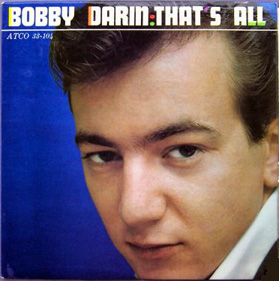 The past five days mark of the 55th Anniversary of some of the best records made over that span of time. Starting on Dec. 19 1958, Bobby Darin and the in-house orchestra at Atco Records (a pop subsidiary label of Atlantic), conducted by Richard Weiss, cut the tracks for the album that arguably would define his career: “That’s All.”
By this time, Darin had already established himself in the teen market with hits such as “Splish Splash” (1957) and “Queen of the Hop” (1958) and “Dream Lover” (1959), but everyone thought he was crazy when we wanted to cut an album for the adult market. Nevertheless, the Atco executives green-lit the project, and in late December of ’58, these key tracks were cut, starting with what would become the biggest record of 1959, “Mack the Knife.”
Recorded on Dec. 19, 1958, this song was written by Bertholt Brecht for his famous “Threepenny Opera” (little known fact: it was originally written in German) 30 years earlier, and Louis Armstrong had already given a bit of new life to the song with a hit of it in 1956. But no matter who came before or later (Dean Martin did a live performance of it in ’59), Darin clearly owns the song with this definitive version, which remains an all-time classic to this day.
That same recording date, Darin also cut “That’s the Way Love Is,” which is also a fine record, and one that does an excellent job of nailing the feeling one feels when a guy has that one special woman in his life and how strangely all that works.
In between this aforementioned span of time, he also cut two other dynamite records, both being strong, jazzy versions of the standards “Softly, As In A Morning Sunrise,” and “I’ll Remember April,” which are great for getting you up in the morning.
But the session was capped off with another definite pop record of the 1950s, and of Darin ‘s career: “Beyond the Sea.” The song was first recorded as “La Mer” by Charles Trenet in 1946, but Darin sang it to the English lyrics we all know and love today. If ever somebody dear to you has been situated overseas, this song is the ultimate morale-booster, and it was recorded on Christmas Eve of 1958, 55 years ago today.
Oh, and the title cut was, ironically, the last track on this album: it’s arrangement is, er, rather unique compared to the more traditional arrangements of this particular standard.
The 2013-2014 NCAA Bowl Games: The Good, The Bad, and the Intriguing December 21, 2013
Posted by intellectualgridiron in Sports.Tags: Alabama, Alamo, Arizona State, Armed Forces, Auburn, Baylor, BBVA Compass, Boise State, Bowl, bowl game, Buffalo, BYU, Central Florida, Clemson, college, Cotton, Fiesta, Florida State, football, Fresno State, Hawaii, Heart of Dallas, Holiday, Houston, Idaho Potato Bowl, Kraft Fight Hunger, Las Vegas, Louisiana-Lafayette, Michigan State, Middle Tennessee, Missouri, national championship, Navy, NCAA, New Orleans, North Texas, Northern Illinois, Ohio State, Oklahoma, Oklahoma State, Orange, Oregon, Oregon State, Poinsettia, Rose, San Diego State, Southern California, Stanford, Sugar, Texas, Texas Tech, Tulane, UNLV, USC, Utah State, Vanderbilt, Washington
add a comment

Oklahoma State and Missouri used to play each other routinely as conference foes, even as recently as 2009. Since Mizzou skipped the Big XII for the SEC, however, that routine came to an abrupt end. Now, they are to meet each other again in the Cotton Bowl.
Ticket to die for: Could it be any more obvious? No. 1 Florida State vs. No. 2 Auburn in the BCS National Championship Game (Jan. 6)
Best non-Big Six vs. Big Six matchup: (two good ones) No. 20 Fresno State vs. No. 25 USC in the Las Vegas Bowl (Dec. 21), and Boise State vs. Oregon State in the Hawaii Bowl (Dec. 24)
Best non-Big Six matchup: Utah State vs. No. 23 Northern Illinois in the Poinsettia Bowl (Dec. 26)
Upset alert: No. 5 Stanford vs. No. 4 Michigan State in the Rose Bowl (Jan. 1)
Must win: No. 12 Clemson vs. No. 7 Ohio State in the Orange Bowl (Jan. 3)
Think there’s enough Crimson? No. 11 Oklahoma vs. No. 3 Alabama in the Sugar Bowl (Jan. 2)
Old Rivals Reunite: No. 13 Oklahoma State vs. No. 8 Missouri in the Cotton Bowl (Jan. 3)
Offensive explosion: No. 14 Arizona State vs. Texas Tech in the Holiday Bowl (Dec. 30)
Defensive struggle: Middle Tennessee vs. Navy in the Armed Forces Bowl (Dec. 30)
Great game no one is talking about: BYU vs. Washington in the Kraft Fight Hunger Bowl (Dec. 27)
Home Field Advantage: Louisiana-Lafayette @ Tulane in the New Orleans Bowl (Dec. 21)
Could be bad for the home team: No. 10 Oregon vs. Texas in the Alamo Bowl (Dec. 30)
Intriguing coaching matchup: Brady Hoke of Michigan vs. Bill Snyder of Kansas State in the Buffalo Wild Wings Bowl (Dec. 28)
Who’s bringing the body bags? No. 6 Baylor vs. No. 15 Central Florida in the Fiesta Bowl (Jan. 1)
Why are they playing? UNLV vs. North Texas in the Heart of Dallas Bowl (Jan. 1)
Plenty of good seats remaining: Buffalo vs. San Diego State in the Idaho Potato Bowl (Dec. 21)
They shoot horses, don’t they? Vanderbilt vs. Houston in the BBVA Compass Bowl (Jan. 4)
College Football Week 15 Awards December 9, 2013
Posted by intellectualgridiron in Sports.Tags: Army, Auburn, Bowling Green, Central Florida, Cincinnati, Duke, Florida State, George O'Leary, Joey Jones, June Jones, Louisville, Mark Dantonio, Memphis, Michigan State, Mike Gundy, Missouri, Navy, Northern Illinois, Ohio State, Oklahoma, Oklahoma State, Philadelphia, Rod Carey, SMU, South Alabama, South Florida, Texas, UCF, UConn, Urban Meyer, USF, Willie Taggart
add a comment
(Note: All rankings are current AP [week 15] unless otherwise noted.)
COACHES
Wish I were him: Mark Dantonio, Michigan State
Glad I’m not him: Urban Meyer, Ohio State
Lucky guy: George O’Leary, Central Florida
Poor guy: June Jones, SMU
Desperately seeking a clue: Mike Gundy, Oklahoma State
Desperately seeking a P.R. man: Joey Jones, South Alabama
Desperately seeking sunglasses and a fake beard: Rod Carey, Northern Illinois
Desperately seeking … anything: Willie Taggart, South Florida
TEAMS
Thought you’d kick butt, you did: Florida State (defeated Duke 45-7)
Thought you’d kick butt, you didn’t: Northern Illinois (lost to Bowling Green 47-20)
Thought you’d get your butt kicked, you did: Duke (lost to Florida State 45-7)
Thought you’d get your butt kicked, you didn’t: Bowling Green (defeated NU 47-20)
Thought you wouldn’t kick butt, you did: UConn (defeated Memphis 45-10)
Dang, they’re good: Florida State
Dang, they’re bad: South Florida
Can’t Stand Prosperity: Ohio State
Did the season start? Texas
Can the season end? Memphis
Can the season never end? Michigan State
GAMES
Play this again: No. 3 Auburn 59, No. 5 Missouri 42
Play this again, too: Louisville 31, Cincinnati 24, OT
Never play this again: No. 1 Florida State 45, Duke 7
What? UConn 45, Memphis 10
Huh? No. 17 Oklahoma 33, No. 6 Oklahoma State 24
Are you kidding me? Bowling Green 47, No. 16 Northern Illinois 20
Oh – my – God: No. 11 Michigan State 34, No. 2 Ohio State 24
NEXT WEEK
Ticket to die for: none, except for Army vs. Navy in Philadelphia: God bless our troops!
Steve Sarkisian to USC December 3, 2013
Posted by intellectualgridiron in Sports.Tags: Alabama, Bobby Petrino, Bobby Williams, Citrus Bowl, coach, Ed Orgeron, FBS, football, Georgia, Huskies, James Franklin, Kevin Sumlin, LSU, Michigan State, NCAA, Nick Saban, Ohio State, Pac-12, Pete Carroll, SEC, Southern California, Steve Sarkisian, Texas, Trojans, Urban Meyer, USC, Washington
add a comment
 The latest news has it that Steve Sarkisian has been named the next head coach at the University of Southern California. When one considers that the available pool of good coaches is very limited right now (what with relatively few firings and hirings at this time) and most of the best coaches are already ensconced in good programs (Saban at Alabama, Meyer at Ohio State, etc.), this was an excellent hire.
Granted, many were advocating for the permanent hire of Ed Orgeron. But as well as he has done in the moment, one must ask, could he sustain the positive trend long-term? His track record might not suggest that. Plus, we have seen the temp-to-permanent hire scenario before in major college football, and it usually does not turn out that well. Remember Bobby Williams at Michigan State? After Nick Saban left for the LSU job, Williams led the Spartans to victory over a formidable Florida Gators squad in the 1999-2000 Citrus Bowl. Everybody immediately allowed for themselves to be prisoners of the moment and made Williams the permanent head coach at MSU after that. Part of the rationale was how much the players loved the guy. Bad idea. Coaches like Bobby Petrino and Nick Saban are not loved by their players, but those coaches get results from the team. Meanwhile, the program at MSU eroded after three full seasons under Williams’ leadership. Orgeron currently enjoys similar popularity with the players at USC. While this produces short-term gains, it will take somebody who is a bit more of a taskmaster to make sure that these positive trends can be sustained.
But what about Kevin Sumlin as a possibility? Yes, Coach Sumlin has become a rather hot commodity over the past year or two, but his one weakness is that, while his offenses have considerable fire power, his defenses, well, not so much, and USC prides itself on not only being “Tailback U,” but also having tough “D”’s that shut down the pass-happy intra-conference opposition. Could Coach Sumlin sustain that reputation, given his track record with weaker defenses in the recent pass? At this point, it does not appear as though he couch.
What about other candidates, say, James Franklin, whose name was bandied about as a possibility? A fine choice, especially given what he has accomplished at Vanderbilt under very restrictive circumstances with which the rest of the teams in the SEC do not have to contend. Still, he has one glaring weakness: he has no west coast ties. In the world of college football recruiting, this is vital. A great deal of recruiting has to do with knowing the high school coaches in the key recruiting areas. Franklin knows none.
But “Sark” knows plenty. He knew them as a high-ranking assistant at USC under Pete Carroll, and he still knows them while trying to recruit the players for Washington. In that important respect, this shall be a seamless transition for him. Instead of recruiting key players in the talent hotbed that is California, he shall do so wearing Cardinal-and-Gold polo shirt as opposed to a Purple-and-Gold one. Moreover, his experience with the program gives him intimate knowledge of organizational culture, making him a good company fit. This is thus a good hire for the Trojans in any important respect.
To be sure, the gain for USC is a major loss for Washington, where Sarkisian had a good thing going. But as great as things were with the Huskies, the USC job is rated by coaches and others “in the know” as one of the three absolute best coaching jobs in all of college football, along with Texas and Georgia (yes, Georgia). In other words, if the Trojans come calling, unless you are coaching at one of those two schools, you are a fool to pass up this golden opportunity. Sorry about the setback for UW, but good for Sark, and good for USC.
College Football Week 14 Awards December 1, 2013
Posted by intellectualgridiron in Sports.Tags: ACC, Alabama, Arkansas, Atlanta, Auburn, B1G, Ball State, Baylor, BCS, Big Ten, Blue Devils, Boilermakers, Boise State, Bowling Green, Buckeyes, Bulldogs, Central Florida, championship, Clemson, Dabo Swinney, Dan Mullen, Duke, Florida, Florida State, Fresno State, FSU, Gamecocks, Gary Pinkel, Gators, George O'Leary, Georgia Tech, Gus Malzahn, Hoosiers, Idaho, Indiana, Iron Bowl, June Jones, Kyle Whittingham, LA-Lafayette, LSU, MAC, Memphis, Miami, Michigan, Mississippi State, Missouri, New Mexico, Nick Saban, Northern Illinois, Ohio, Ohio State, Oklahoma, Oklahoma State, Oregon, Oregon State, Paul Johnson, Penn State, Purdue, rivalry, Rutgers, San Jose State, SEC, Seminoles, SMU, South Alabama, South Carolina, South Florida, Steve Spurrier, Texas, Texas Tech, Thanksgiving, The Boot, Tigers, Tom O'Brien, UCF, UConn, Utah, Western Michigan, Will Muschamp, Wisconsin, Wolverines
add a comment
(Note: All rankings are current AP [week 14] unless otherwise noted.)
COACHES
Wish I were him: Gus Malzahn, Auburn
Glad I’m not him: Nick Saban, Alabama
Lucky guy: Dan Mullen, Mississippi State
Poor guy: Paul Johnson, Georgia Tech
Desperately seeking a clue: Kyle Whittingham, Utah
Desperately seeking a P.R. man: Tom O’Brien, Penn State
Desperately seeking sunglasses and a fake beard: Dabo Swinney, Clemson
Desperately seeking … anything: Will Muschamp, Florida
TEAMS
Thought you’d kick butt, you did: Ball State (defeated Miami, Ohio 55-14)
Thought you’d kick butt, you didn’t: Northern Illinois (defeated Western Michigan only 33-14)
Thought you’d get your butt kicked, you did: New Mexico (lost to Boise State 45-17)
Thought you’d get your butt kicked, you didn’t: South Florida (lost to Central Florida 23-20)
Thought you wouldn’t kick butt, you did: Texas (defeated Texas Tech 41-16)
Dang, they’re good: Florida State
Dang, they’re bad: Idaho
Did the season start? Rutgers
Can the season end? Purdue
Can the season never end? Auburn
GAMES
Play this again: No. 3 Ohio State 42, Michigan 41
Play this again, too: No. 4 Auburn 34, No. 1 Alabama 28
Take a look at this again, while you’re at it: No. 13 Oregon 36, Oregon State 35
Never play this again: Ball State 55, Miami (Ohio) 14
What? San Jose State 62, No. 16 Fresno State 52
Huh? Penn State 37, No. 15 Wisconsin 24
Are you kidding me? No. 10 South Carolina 31, No. 6 Clemson 17
Oh – my – God: No. 4 Auburn 34, No. 1 Alabama 28
NEXT WEEK
(rankings are current AP (post-week 14, pre-week 15)
Ticket to die for: No. 3 Auburn vs. No. 5 Missouri in the SEC Championship game
Best non-Big Six vs. Big Six matchup: (none)
Best non-Big Six matchup: LA-Lafayette @ South Alabama
Upset alert: No. 10 Michigan State vs. No. 2 Ohio State in the B1G Championship game
Must win: No. 18 Oklahoma @ No. 7 Oklahoma State
Offensive explosion: Texas @ No. 9 Baylor (Thurs.)
Defensive struggle: Memphis @ UConn
Great game no one is talking about: Bowling Green vs. No. 16 Northern Illinois in the MAC Championship game, Fri.
Intriguing coaching matchup: George O’Leary of UCF vs. June Jones of SMU
Who’s bringing the body bags? No. 20 Duke vs. No. 1 Florida State
Plenty of good seats remaining: Memphis @ UConn
They shoot horses, don’t they? South Florida @ Rutgers
Week 14 in review:
Wow. Many end-of-year (or NEARLY end-of-year) weekends that bill themselves as “Rivalry Week” rarely live up to the hype. Much of the time, the rivalry games end up as rather one-sided affairs. Not this time, though. Take the Ohio State-Michigan game, for example. On paper, it should not have been anything of a contest at all. But the Wolverines showed up in this game as they had not done so all year. Sure, they looked formidable against Notre Dame early in the season, but they brought their game to a whole level above that in giving the Buckeyes the biggest fight of the season. It was fitting that they saved their best game for their last of the season, and against their sworn enemy from Columbus. In the end, a one-point margin of victory helped preserve the Buckeyes’ undefeated season and a shot at the BCS title game.
The “Egg Bowl” rivalry between Ole Miss and Mississippi State also lived up to its tradition, in more ways than one. For starters, it returned to its Thanksgiving Day timeslot for the first time in several years. For another, the game was close and hard-fought right to the end, with the Bulldogs pulling out the victory they needed to become bowl-eligible.
Duke-North Carolina may be known for its bitter basketball rivalry, but today, the football rivalry was a big deal and a good game. The Blue Devils ended up winning, narrowly, 27-25, and in so doing they clinched a spot in the ACC Championship game for the first time ever.
Another such game that looked one-sided on paper but in reality was hard-fought to the end was the LSU-Arkansas match-up on Friday. It seems not to matter how well LSU has done in the year, or how mediocre or play the play of the Razorbacks may be, but the Hogs always seem to bring their “A-game” when they play the Tigers. Perhaps the trophy for which they play is sufficient motivation, as “The Boot” (it is shaped in the manner of Arkansas and Louisiana together on a map) weighs 175 pounds.
Yes, there were rivalry games that were rather one-sided affairs. The Florida-Florida State game, usually played in or around the last weekend of the college football season, was almost always the game of the week back in the 1990s. That started to change a decade ago when FSU’s on-field performance began to deteriorate. But recently, the Seminoles have made the right moves to return to football factory status, while the Gators’ collective performance has seen much better days. The outcome of Florida State’s 37-7 win therefore came as no surprise.
Same thing for the Purdue-Indiana game. While Purdue owns the series by slightly more than a 2-1 margin, today, they did not show it, as the Hoosiers beat the Boilermakers 56-36, and four of Purdue’s touchdowns came in the last 20 minutes of the game, leaving the Boiler Faithful to scratch their heads all the more.
Then there was the “Iron Bowl,” that annual storied match-up between Auburn and Alabama, arguably the most intense, heated, and passionate of all the in-state rivalries. Through much of the season, the game was not on many peoples’ radar screens. Not after Auburn’s dismal performance last year; not even when the Tigers were slowly getting better and better with each game under new head coach Gus Malzahn. Yet by game time, they worked their way up to the No. 4 team in the nation, giving the engaged observer pause that this match-up could be one of the most epic in the history of the rivalry. The game remained close throughout regulation, and technically was tied up at its end, as the last second ticked off during a field goal attempt. That same attempt came up short; short enough that an Auburn returner was able to field it in the end zone, before promptly running out of it straight up the field. Wait a minute, the observers were telling themselves, nothing is going to come of this. Nothing hardly ever does. Yet the returner kept dodging a few would-be tacklers as he ran along the sideline. In fact, he continued to run past a few more would-be tacklers before all jerseys of the opposing color were in his proverbial rear view mirror. Wait, can this actually happen? OMG, it IS happening! But this NEVER happens! And yet it IS! I am in shock.
The Iron Bowl, it turned out, was not just an incredible game in this history of this most-storied of rivalries. THIS was a shot heard ‘round the world, and we are all still in shock from it today.
Still, not a bad turnaround from going winless in the SEC last year to having only one loss this year, even now potentially vying for a shot at the national title. Guz Malzahn deserves “coach of the year” accolades for that alone.
Oh, and Stanford-Notre Dame turned out to be a very watchable game in its own right. If that’s not enough, Steve Spurrier proved that he is the man yet again by schooling Dabo Swinney in Columbia, with his South Carolina Gamecocks trouncing the Clemson Tigers 31-17. Had his squad not blown the game to hot-and-cold Tennessee earlier in the year, they would have punched their ticket to Atlanta to represent the East division in the conference championship game. Instead, the team that will have that honor will be, inexplicably, Gary Pinkel and the Missouri Tigers. Such is the world of college football at the end of the 2013 regular season. What a way to cap things off, and best of all, there is a great after-party next Saturday with more games on the slate!
New Apex Predator Theropod Dino Species Discovered November 29, 2013
Posted by intellectualgridiron in Science.Tags: Acrocanthosaurus, Allosaur, apex, Carcharodontosaurus, Carnosaur, dino, dinosaur, meekerorum, Paleontology, Predator, Siats, Theropod, Tyrranosaur, Utah, Ute
add a comment
 Paleontologists announced a major discovery in Paris recently, that of a new species of apex Theropod predator found in North America. At over 30 feet long and weighing 4 tons, It was one of the greatest land predators on Earth when it lived 100 million years ago. Scientists found the fossilized remains sticking out from a slope in the Cedar Mountain Formation of Utah in 2008. It would take two years to slowly remove them from the rocks and cleaned, and two more to analyze the bones to see if in fact this were a new species not yet in the scientific/fossil record, etc. Scientists named it Siats meekerorum; the genus honors the mythical, cannibalistic monster from Ute tribal lore (the genus name is pronounced “SEE-atch”).
The fact that a new 30-foot Theropod has been discovered is amazing news enough. But what is even more amazing is that this is the first predatory dino species this size to be discovered in North America in more than six decades.
“It’s been 63 years since a predator of this size has been named from North America,” said Lindsay Zanno, of North Carolina’s State University and Museum of Natural Sciences, in a press release.
“This dinosaur was a colossal predator, second only to the great T. rex and perhaps Acrocanthosaurus in the North American fossil record,” Zanno continued.
Even more significant is that the discovery of a predatory species this size fills in a 30 million-year gap between the extinction of Allosaurs and the maturation of the evolution of the Tyrannosaurs in North America. True, Carcharodontosaurus was a major predator at this time, too, but the current fossil record indicates it was only around from 100-93 million years ago — much more narrow span of time. Moreover, its fossils have been found in what used to be the supercontinent Gondwana (specifically, present-day Africa and South America). The aforementioned Acrocathosaurus was in the same taxonomical family as C. saharicus, and it was found in North America, but its known span of existence, according to current fossil records, was about 116-110 million years ago.
The discovery of this species has shed new light as to which species sat atop of the proverbial pyramid in this given ecosystem in North America some 98 million years ago. The Tyrannosaurids that did exist at this time were much smaller. The extinction of Acrocanthosaurus first, and later Siats meekororum dying out, eventually opened up the opportunity for Tyrannosaurids to grow larger into the T-rex that we all know and love today.
Mack Brown’s Possible Replacements November 25, 2013
Posted by intellectualgridiron in Sports.Tags: Alabama, Arizona State, Bobby Petrino, Boise State, Broncos, Bryan Harsin, BYU, caretaker, Chris Petersen, college, Crimson Tide, Dan Hawkins, Drew Brees, football, Greg Robinson, Huskies, Johnny Manziel, Longhorns, Mack Brown, Manny Diaz, Mike Gundy, NCAA, Nick Saban, Oklahoma, Oklahoma State, Ole Miss, Oregon, Red River Shootout, RG3, Robert Griffin III, Steve Sarkisian, TCU, Texas, turnaround, UCLA, Urban Meyer, USC, Washington, West Virginia, Western Kentucky, Will Muschamp, WKU
add a comment
 Allow me to preface this article in that writing this brings me no joy at all. For the majority of Mack Brown’s tenure at the University of Texas, he proved to be the perfect organizational fit for the program and the university. Moreover, he is demonstrably among the most adept coaches in college football at the ‘people’ side of the business. One can clearly see this in how we carries himself during the impromptu halftime interviews before he heads into the locker room to make halftime adjustments with his team. Anybody who has observed him during these interviews can vouch that he comes across as a happy gentleman to the sideline reporter for that given game, and he treats said reporter as if he or she is certainly worth his time, despite the more pressing matters that surely weigh on his mind at those given moments. Reportedly, he treats people with the same class and dignity behind the scenes/off-camera as well.
The problem, however, is that since the 2010 season, the program has clearly headed in the wrong direction. The mediocre season of 2006 was excusable, given the drop-off a defending national champion normally experiences (Alabama being an exception to the rule). The fact that they were able to return to the national title game just four years after winning their most recent one showed that the program was still among the strongest nationally. Yet starting in 2010, a precipitous drop-off in performance occurred, one that made the 2006 season look phenomenal by comparison.
Granted, not all of this is Mack Brown’s fault. The downside to being one of the sexiest programs in all of college football is that you are constantly a prime target for other programs to lure away your best assistant coaches, either for lateral moves with even higher pay, or for head coaching gigs of their own, such as Bryan Harsin (erstwhile offensive coordinator, now head coach at Arkansas State) or Will Muschamp (formerly defensive coordinator, currently embattled Florida head coach). This creates a major problem of coaching continuity. How this translates into the program suffering is simple: instead of concentrating all of his off-the-field attention on recruiting, Brown and Co. have to divert part of that time and energy into hunting for suitable replacement personnel. This reduced time for recruiting analysis in turn leads to whiffing on key recruits, which partially explains the Horns’ mediocre-to-weak performances in most of its big games since 2010.
Another issue is institutional arrogance, something Mack Brown could help curtail, but hasn’t. He once bragged that if he were head coach at Texas in 1997, he would not have overlooked Drew Brees as possible QB for the Horns. Yet despite this boast, he clearly overlooked Johnny Manziel, and when Texas tried to recruit Robert Griffin III, they tried to recruit him as a defensive back. Let that sink in for a moment. Such institutional arrogance can most effectively be curtailed by the head coach himself, and yet the problem has yet to be addressed.
After a couple of embarrassing losses earlier in the year (one to BYU, the other to Ole Miss), we all left the program for dead. Then the unexpected happened in that instead of getting blown out by Oklahoma in the Red River Shootout (like in 2012), we had our way with the Sooners instead. Needless to say, this took us all by surprise, albeit pleasantly. We quickly got the impression that perhaps things had quickly turned out, that all it took was the firing of defensive coordinator Manny Diaz and replacing him with the more capable Greg Robinson. More wins over TCU and Kansas soon followed. We initially chalked up having to go into OT to beat West Virginia to simple things such as, A) it was on the road, and B) it was West Virginia, and team very unpredictable in terms of whether they will come out flat or with their hair on fire.
But after the undressing the Longhorns had at the hands of Oklahoma State last week, we were all shocked back into reality. There are still systemic problems in the program that have remained unaddressed. The positively embarrassing loss to Oklahoma last year left many fans grumbling that it was time for a changing of the guard, including the thoughtful writers at Barking Carnival. Even after a face-saving win over the Sooners this year, the loss to the Cowboys reminded us that glaring issues remain unaddressed, issues that will only be resolved by a change in direction of the program, which is best accomplished with a new CEO of the company.
So who are the viable replacements? In truth, more than a few names are bandied about, but for the sake of cutting through the clutter, let us reduce that relatively lengthy list to a couple of already-mentioned names, plus one or two more than people have not mentioned or are reticent to for whatever reason.
I agree with Big(g) Ern at Barking Carnival. New Texas athletics director Steve Patterson should at least ask Nick Saban and Urban Meyer if they are interested. Neither are likely to be, given their current situations, but there is no harm in asking, and confirmed “no’s” from both men will put meaningless speculation from fans to rest once and for all, save for the most delusional of meatballs.
Besides, it is unlikely that Saban would leave Alabama for Texas, no matter how much money you offer him. He is 62 years old, already has a palace of a house, and is not someone who uses all that money to buy expensive toys. The reason being, he has no interest in expensive toys; he’s a workaholic, and workaholics are driven by the job, not by toys. Besides, he has built an almost-bulletproof dynasty at one of the most storied programs in all of college football; how does one top that?
So who could it be? Let us start with the most obvious of names:
Mike Gundy: This could work. He’s one of those coaches who is highly effective if he has tons of resources at his disposal. That might not be the most flattering of commentaries, but given that he has been back up with T. Boone Pickens’ money, he has managed to do great things at Oklahoma State. Imagine what he could accomplish with the unlimited monetary back of Texas’ boosters? If such possibilities stand to reason, it would be enough for us to divert our attention from his teenage-like hairline, despite being a man of 46.
Chris Petersen: This also could work. It is at this juncture that I part company with the thoughtful fellows at Barking Carnival. They seem to think that because the luster of the Boise State program is fading, that Petersen himself is by consequence a less viable candidate for the position. But the diminished national prestige of the program is not Petersen’s fault. It is just that the Broncos’ stock has peaked in value. Boise State has become a victim of its own success. Given that Idaho is hardly hotbed for top-tier college talent, they have to look elsewhere (mostly California) for good players. The highest-profile recruits in that region will usually choose USC, UCLA, Oregon or Arizona State over Boise State, so they have to devise a system to root out guys with enough talent to compete, but at the same time, find guys who are “tweeners” that are usually overlooked by the big boys. Then, Boise State needs to devise and offensive and defensive system that plays to the strengths of these “tweener” recruits.
At this, they have been remarkably successful until recently. What has happened is that they have become a victim of their own success. No team that is viable on a national scale wants to play Boise State anymore because they – the Broncos — could upset them, thus ruining a potential run at a national title. Worse yet, there is little incentive to play Boise State in their home stadium, since the university has done nothing to expand the stadium’s capacity from its paltry 37,000 despite a solid 8 or 9-year run of success. A good deal of the team’s recent success was at the hands of Chris Petersen, who would be wise to take a more prestigious job while he can before staying at BSU too long with cause his stock to irreparably dip. Petersen has proven to be a very adept caretaker CEO, and the Texas program is not in shambles – yet. Texas has good talent pieces in place, they just lack the coaching – and the A+ QB that would be becoming of such a program – to allow for the team to truly play up to its potential.
Who is a coach that has not been mentioned but has potential? One name this is always possible – though few seem to want to admit it – Bobby Petrino.
Try not to laugh. Yes, his, ahem, swordplay at Arkansas was a major black mark (or, er, scarlet letter) on his career and indeed, life, resume, but let that not obfuscate a simple fact. The guy can coach. He can also recruit, too. Yes, much like Urban Meyer at Florida, his Louisville team bordered on an inmate colony, but part of his untouchable skill set was his ability to be a captain running a tightly-run ship, not allowing any sort of wiggle room for would-be thugs to run amok. An advantage of recruiting in Texas, for Texas, is that he could bring in the highest-caliber of athletes in-state without have to run the degree of risk of bringing in potential off-the-field liabilities like he did at Louisville and at Arkansas.
But again, he can coach. Few coaches in the business seem to have the keen sense of knowing when it is the right time to pass and when it is the right time to run the ball like Petrino. Between his ability to acquire talent, manage personnel, and call plays makes him one of the most dangerous coaches in the business. Placing him with the unlimited resources of the Texas Longhorns program could potentially create a juggernaut that would rival the current dynasty of the Alabama Crimson Tide.
Yes, he is currently in his first year at Western Kentucky, but he is also incredibly mercenary. His loyalty does seem to go to the highest bidder, but by that same token, can anybody think of a better job than the Texas job? College coaches around the country recognize it without hesitation as one of the three best jobs in the nation. Translation: assuming he A) were offered the Texas job, and B) took the Texas job, what could lure him away from it? As smart as he is, he would surely have the sense to avoid the, er, swordplay that ended the good thing he had going at Arkansas.
So, in summation, Chris Petersen would be my second choice to replace Mack Brown at Texas, but Petrino would be my first. The program is not exactly down the drain yet, so a turnaround CEO might not be needed, at least not yet. If brought in soon enough, a good caretaker CEO could still bring the Horns to the level of performance fans rightfully expect.
Addendum, 12-06-13: Chris Petersen, mentioned as a potential replacement for Mack Brown earlier in this article, has since taken the Washington Huskies job vacated by Steve Sarkisian. The news was announced this morning. In truth, he is a good fit for that program. He loves the Pacific Northwest, has recruited in the Seattle area before, and is a good caretaker CEO. Sarkisian already turned the Huskies around into a well-function, 9-win-a-year organization; Petersen can now come in and keep the good thing going, just as he did after Dan Hawkins left Boise State for Colorado. In summation, this is a good hire for the Huskies.

