College Football Drills in Wintertime February 28, 2013
Posted by intellectualgridiron in Sports.Tags: 06:00, 6 A.M., 6 AM, 6 AM's, ball, Clemson, coach, college, conditioning, Cup, directional, drills, football, Fulmer, Georgia, Jim Colletto, Joe Tiller, Mark Richt, mat, Mollenkopf, NCAA, North Texas, practice, puke, Purdue, spring, Sun Belt, winter
add a comment
We are still in the winter season, normally associated with basketball, wrestling (the non-pro kind!) and Winter Olympic-related sports. The Super Bowl has been concluded for almost a month by now, and the college football bowl games have been over for almost two. But do not think that nothing is going on in the world of college football; things are anything but sleepy in that world right now, and I don’t mean the latest developments in the Fulmer Cup, either!
The truth is, college football is very active right now, just not active in the way that ordinary fans, hard-core and casual alike, can readily see or discern. That is because fans do not see the tough conditioning drills that players put themselves through (scratch that, that COACHES put players through) during the week, often at very inconvenient times of day, to get them ready for Spring Ball.
Conditioning is the game, here. The NCAA restricts coaches to 15 spring practice sessions, so there’s no time to waste on gassers or the like when there’s plenty of schematic options to explore to see how they play out and to try to install new offensive stuff for the regular season come Fall.
That means that these boys need to be in shape for all of that. What is truly interesting is all the different approaches that coaching staffs take towards these conditioning sessions, starting with what their nomenclature. One generic, all-purpose term is “winter conditioning drills,” since they last from early February, usually, to early March, though that alone varies from program to program. Another term some teams use is “mat drills,” since some of the conditioning drills take place on wrestling mats or a similar playing surface. At Purdue, we just called them “6 AM’s”, since that’s when these drills officially began.
Six-AM’s are a royal pain in the ass. There, I said it. Some coaches seem to agree, with is why schools of thought differ even on this approach, since some programs WISELY undertake these conditioning sessions in the AFTERNOON (why, what a novel idea!). As disastrous a head coach as Jim Colletto was while at Purdue, one of the few bright spots during an otherwise dark time for the program was that he had said conditioning drills held in the afternoon, when normal people are still, you know, functional. Coach Joe Tiller, however, in a hasty move to — otherwise commendably — change the tone of the program (and goodness knows it needed a change of tone at the time) had them in the morning, hence the term at the beginning of this paragraph.
But Purdue is not the only one; many a program from UConn to USC has had these sessions at 06:00, for whatever reason. Luckily, there are voices of reason at big-time programs that still have them in the afternoon. Take Georgia, for example (this policy alone strengthens my faith in Mark Richt’s adept leadership):
FYI, those human-centipede push-ups are a lot harder than they look! Notice the presence of a red mat in the middle of the indoor practice field, though. We never used a mat for drills on the astroturf playing field of Mollenkopf Athletic Center (field turf was finally installed in there in 2006), which might account for the absence of the mat drill term within our organizational lexicon.
Still, another interesting thing to marvel is what sort of combination of drills the coaches prefer to get their players into shape. We never did the human-centipede push-up drill at Purdue, for example, but one constant one will find from program to program are all sorts of directional drills. Those are simply where the coaches have players run or side-shuffle in one direction then instantly turn to run in a different direction and so on. Players would go to various drill stations throughout the session and about four or five-minute intervals, and variations of directional drills were usually two out of several of said stations. Because two stories of staircases leading to the coaches’ offices were located close to the indoor field, another station was to have players run up and down said stairs — ensuring that endurance and power were covered!
Clemson is considered a big-time program, but sadly they still cling to the out-dated notion of having drills pre-dawn. North Texas, an inconsistent contender in the Sun Belt, also still have their sessions before sunrise.
Notice the good examples of directional drills show in the above video. The tug-of-war drill is no doubt a cool idea! Another constant one sees during these drills from program to program are the puke buckets. Part of the job of the managers are to set up these drills (meaning they must report around 5:30 AM), and part of the setting-up is placing those plastic, dark gray garbage cans in, er, strategic areas for players to conveniently access in the split second before they blow hash. On further review, one advantage to running before dawn is that one needs not to worry about losing one’s breakfast!
At Purdue, after the players were thoroughly worn out from all the drills, to cap things off, the coaches had them run 100-yard wind sprints repeatedly. After all of that, the session would not be completed until all the players on the team did positioning drills (lie on your back, the whistle blows, then you instantly switch to lying on your chest, etc.) to the coaches’ satisfaction. Doing these twice a week to start out seemed manageable. Three times a week and it wears considerably on you; but at four times a week, it pushes you towards the brink of insanity, and makes you jump for joy when it comes time for spring practices to commence. At least we could brag, though, that we practiced while [normal] people slept!
Addendum, 04-03-13: Yes, by now, spring practices are in full-swing all across the land, but I just came across a video of Purdue’s 6 AM drills for 2013, and naturally found that to be a great fit for the article — enjoy!
You too can put together a Top 25 CFB preseason poll! February 17, 2013
Posted by intellectualgridiron in Sports.Tags: ACC, Alabama, AP, Auburn, B1G, Big 10, Big 12, Big East, Big Ten, Big XII, Boise State, Braxton Miller, Cal, Charlie Weis, Cincinnati, Clemson, college, conference, Duke, Florida, Florida State, football, Georgia, Georgia Tech, Kansas, Kansas State, Louisville, LSU, MAC, Manti Te'o, Michigan, Michigan State, Mississippi, NCAA, Nebraska, Northern Illinois, Northwestern, Notre Dame, Ohio State, Oklahoma, Ole Miss, Oregon, Pac-12, preseason, Purdue, ranking, San Jose State, SEC, South Carolina, Stanford, Texas, Texas A&M, Texas Tech, Tim Tebow, Tommy Tuberville, top 25, UC, Urban Meyer, USC, Utah State, Vanderbilt, West Virginia, Will Muschamp
add a comment
Ever wanted to make a college football Top-25 preseason ranking but just didn’t know how? Well, now you do! Thanks to the hilarious writers at SBNation’s Every Day Should Be Saturday, we now have a guide at our disposal to put such a list together and look like prognostication geniuses in so doing! I have taken the liberty of quoting the guiding text to give you reference while we play along. The quoted text from the actual (and funny) guide page is given in italics.
1. Alabama. Look, maybe you have a perfectly strong case for some other school, but if you go off the reservation right away, the readers are going to suspect something is amiss. Stay with the pack here and, if the Tide stumble, you’ll be one of many mistaken scribes, not a distinct and lonesome idiot.
Alabama looks and sounds like a winner to me!
2. Big 12 or Big Ten team. BOOM! Because you started comfortable, those stupid readers didn’t see this knowledge roundhouse coming. Pick a team that didn’t meet expectations in 2012 and talk about how they’ll be “hungry” and “focused” because of it.
Michigan, perhaps?
3. SEC team. Mention how battle tested playing in the conference will leave this team by the end of the season. Then hedge by saying SEC play could eat them alive. SPORTSNIGMA!
Texas A&M; they’re really hot right now. Seriously, so much for them having to get behind Arkansas like we all predicted last year!
4. Ohio State. Emphasize how good the team looked in the first year of a new system. Ignore that they barely beat Cal, Indiana, and Purdue. Clunky suggestion that Braxton Miller could be the next Tim Tebow. Obliquely suggest Urban Meyer could quit at any week for any reason.
Ohio State, and this is why I didn’t put them at the No. 2 spot like I would have otherwise.
5. Oregon or Stanford. Sh-t, you meant to put one of them higher, but that much backspacing seems like a real pain in the ass. Say something here about how you’re being cautious not to put too much stock into a big bowl performance.
Stanford, for reasons of coaching continuity.
6. Team Coming Off A Big Bowl Performance. Clemson-Louisville national championship game ahoy!
Okay, I’ll bite. What the heck; let’s put Louisville in there for the fun of it!
7. SEC team. Which one? Any one THAT’S JUST HOW DAMN GOOD THEY ARE MAN. (Seriously, though, not Auburn.)
Seriously; definitely not Auburn! Already put Texas A&M in there, so let’s have LSU fill this slot, shall we? Or maybe South Carolina; yeah, definitely the Gamecocks. They’re doing quite well right now.
8. Notre Dame. Yes, Irish fans are going to be super pissed at the perceived disrespect, but that’d be true even if you ranked ND numbers one, two, and three simultaneously. Don’t fight a losing battle. Just slot them here and suggest that they could be better off without Manti Te’o.
Notre Dame; and they might not miss Manti Te’o that much if their highly-ranked recruiting class has any teeth to it, unlike “highly-ranked” recruiting classes under Charlie Weis.
9. Oregon or Stanford (whoever you didn’t put at 5). Say something about how they’ve lost a lot of key pieces. Is it true? Players graduate, don’t they?
Oregon, for reasons of lack of coaching continuity.
10. ACC team. You’ll need to construct a paper fortune teller and write the names of four plausibly successful teams twice each. Be sure you only do it twice, because if you write out “Georgia Tech” three times on the same piece of paper Paul Johnson appears out of nowhere and insists on rearranging your pantry.
Well, we already put Louisville at No. 6, so we might as well put Florida State into this one.
11. Team that will likely have three losses before Halloween. Your obligation in preparing this ranking is not simply to come up with a sensible accounting of the top 25 teams heading into the season. It’s also to provide us with teams destined to leave unreasonable expectations unfulfilled. Who will be this year’s Arkansas? THE POWER IS YOURS!
Ole Miss, because expectations are high due to their half-way decent team from last year and No. 7-ranked recruiting class this year.
12. Team with the highest ranked recruiting class that you have not yet included. I mean, all that talent wouldn’t be going to a bad team, would it? And I bet half of them start right away! (note: I do not know how recruiting works)
I want to put Florida here, because they’ve got the No. 4-ranked recruiting class, and I’ve got to stick ‘em somewhere! But, skip down to No 14, and you’ll find out that cannot be done, according to this system. So, we’ll put in Oklahoma.
13. This is exhausting. You really deserve a lemonade, and maybe even an oatmeal cookie. I mean, people bitch about preseason rankings, but then they lap them right up like hungry dogs. Do they not understand how market forces work? Oh, um, Michigan State. Whatever.
Georgia; gotta stick ‘em somewhere.
14. Florida. “Will Muschamp is driving a truck with a great engine and no brake pads. Will Muschamp is eating a sandwich with meat and no bread. Will Muschamp is developing a model that explains how light behaves like a particle but not as a wave.” Metaphor them to death in this middle section.
Okay, NOW we’re allowed to put Florida in there.
15. School that was good six years ago and has stunk since. Because these things are cyclical, or something.
USC, anybody?
16. Team stocked with seniors that have mostly underachieved up to this point. They just want it more, man. That’s why they’re fighting in spring practice. Out of love.
Michigan State, perhaps?
17. Big 12 team with a miserably weak non conference schedule. Basically, this is between Texas Tech, West Virginia, Kansas, and Kansas State. Kansas is out for reasons of being Kansas, so just pick one of the other three and feel like a genius up to, but not beyond, Week 5.
West Virginia is the safest pick out of the three, at least through Week 5. After Week 5, it might be Texas Tech. Just sayin’.
18. Big East team. Start out by noting that the conference had a better bowl winning percentage last year than the every other AQ conference. Pretend you knew that Memphis was joining this year without looking. Realize that the team you pick could join the ACC before this gets published. Shrug, and continue trying to beat Jetpack Joyride.
Cincinnati, because after U of L, UC is the only Big East team that comes to mind, and goodness knows what could happen with Tommy Tuberville at the helm.
19. Team that was terrible but hired a trendy coach. You’ve already won me over, Cal, in spite of me.
Okay, let’s go with Cal. Let me waste another space on something ridiculous, why don’t you!
20. School from a non AQ conference. Again, this is mostly an exercise in antagonizing fans, so just find a Mountain West or MAC team that could plausibly win eight games and put them here. Then say something snide about the Big Ten.
Ah, so THIS is where you put in Boise State!
21. Scandium. Don’t think it belongs here? Check your atomic numbers, clown.
Okay, now they’re being downright silly. Not funny, just silly. Let’s go with LSU.
22. Team with a coach on the hot seat. If you’re not sure who qualifies, just pick any coach that hasn’t won a conference title in the last two years and say he’s on the hot seat.
Texas, because even though I love Mack Brown as a person, he ought to be on the hot seat after three consecutive seasons of underperformance.
23. Almost there! Pick any team, say this is a make-or-break season for the program, and move forward.
Auburn, because after the horrible year they had last season, we’ll now see how quickly they can bounce back.
24. Duke.
Are you kidding me? Alright, we’ll play along for the funny hell of it.
25. Team that barely made a bowl last year. “Trial by fire has made them stronger” sounds way more optimistic than “holy sh– they needed a punt return touchdown to beat Sweet Valley High.”
Heck, Purdue barely made it to a bowl game last year, but I’m certainly not putting them at No. 25! I’d put somebody like Nebraska in there, but I don’t know if it fits the template. Screw it; I’ll put Nebraska in anyway.
Now, let us see how this ranking plays out, according to the above formula:
- Alabama
- Michigan
- Texas A&M
- Ohio State
- Stanford
- Louisville
- South Carolina
- Notre Dame
- Oregon
- Florida State
- Ole Miss
- Oklahoma
- Georgia
- Florida
- USC
- Michigan State
- West Virginia
- Cincinnati
- Cal
- Boise State
- LSU
- Texas
- Auburn
- Duke (groan!)
- Nebraska
I know, I know; LSU is ranked way too low, and it bothers the heck out of me, too. Just for fun, let us compare this with the current 2013 AP preseason Top 25 poll:
- Alabama (no surprise there!)
- Oregon
- Ohio State
- Notre Dame
- Texas A&M
- Georgia
- Stanford
- South Carolina
- Florida
- Florida State
- Clemson
- Kansas State
- Louisville
- LSU (beats not being ranked at all!)
- Oklahoma (I knew they were overvalued!)
- Utah State (there had better be a darn good reason for this!)
- Northwestern (quite plausible, actually)
- Boise State (are you sure you want them that high, AP?)
- Texas
- Oregon State
- San Jose State (huh?)
- Northern Illinois (I guess they felt compelled to stick a MAC team somewhere)
- Vanderbilt (also plausible; have you seen their recruiting class lately?)
- Michigan
- Nebraska
For starters, I’m really regretting sticking Michigan in that No. 2 slot, but the formula called for a Big Ten team, and Ohio State was already locked in to No. 4; what was I to do? The Florida State ranking, though, seems pretty spot-on, and many others (Alabama, Ohio State, Texas A&M, Stanford, South Carolina, and Nebraska are within one or two rankings). Yes, it’s all in fun and jest, to be sure, but it shows that sometimes these whacky formulas work, other times, not so much. And it still sticks in my craw that it compelled me to under-value the Bayou Bengals, and grossly over-value Michigan.
The potentially existential problem at the University of Texas February 10, 2013
Posted by intellectualgridiron in Politics.Tags: 3M, academia, academic, B1G, Berkeley, Big Ten, brand, Cadillac, Cal, Carrier, Chevrolet, Chevy, critical, culture clash, doctorate, DuPont, education, engineering, equity, Evergreen, Florida, G.E., G.M., GE, General Electric, General Motors, GM, Golden, Great Lakes, Harvard, higher ed, Hoosier, Indiana, institution, Ivy League, leftism, Lockheed-Martin, Magnum, marketable, marketing, Marxism, masters, Michigan, Minnesota, Pac-12, Packard, Penn State, prestige, professor, public, Purdue, R&D, research, school, SEC, secondary, state, Texas, UCLA, undergrad, United Technologies, university, USA Today, UT, vocation, Washington, Wisconsin, world-class
add a comment
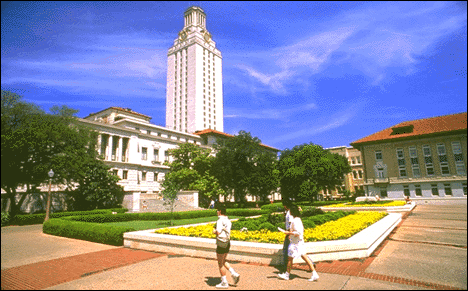 On the surface, it seems there has never been a better time to be a part of a major university, particularly the state-funded type. Education remains in high demand, after all, and those working as full-time academics (extra emphasis on “full-time”) make good money. Individual states take pride in their flagship schools as being centers for world-class research, that some of the most cutting-edge, world-changing advances in technology, from electronics to engineering to chemistry to medicine, have come out of these sorts of universities. Note that I said “some” research, for just as many cutting-edge discoveries have come out of R&D departments in General Electric, General Motors, DuPont, 3M, Magnum Research, Lockheed-Martin, and the like (note that they are all for-profit companies in the private sector!).
But that stipulation aside, these flagship schools are often viewed with some degree of prestige. Pennsylvania, for example, rightly takes pride in the academic excellence at Penn State, as it is regarded as a “public Ivy.” Ditto for the University of Michigan in the Great Lakes State, or for both Indiana and Purdue Universities in the neighboring Hoosier State. The Universities of Wisconsin and Minnesota are also known for quality, world-class research and are thus a source of pride for their respective states. Same can be said for Cal-Berkeley and UCLA in the once-Golden State or for the University of Washington in the Evergreen State. Even the SEC, not necessarily known for its academic prowess overall compared to the Big Ten or even the Pac-12, nevertheless has a good example of a big, state flagship school with good academics (though a recent development, to be sure) in the University of Florida. And yes, the adjective “state” also means “public,” with college tuition being more affordable for in-state students than if said students were to attend private schools for their higher education instead.
So what is the problem? Well, the issue has two large, important dimensions. At the heart of said issue is an existential crisis that seems to be gripping the University of Texas, another great example of a state flagship school that has good academics both at the undergrad level as well as the graduate one. This existential, if not outright identity, crisis is the result of something of a culture clash within the vaunted institution. USA Today reports that opposing factions within the school have very different visions for the direction and purpose of the UT. The conflict basically goes this way: do we focus on the prestigious aspects of the school, or do we make it more accessible? It’s basically a Cadillac vs. Chevy argument. Cadillacs are much nicer and classier, but Chevys will still get you where you need to go without breaking the bank in the process. Both arguments have merit, but which way should the university go?
The prestige/class argument certainly has its place, but has severe limitations. Undergrads usually choose their school based on its academic reputation, yet said reputation comes from research done by faculty and doctoral students. Just because a professor is a leading researcher in his field does not necessarily mean he will be effectively imparting that insight to the undergrads. In fact, in all likelihood, he might farm out that teaching to his teacher’s assistants, themselves concentrating on establishing their own reputations in academia. The only way an undergraduate student would have a course taught be one of these hypothetical leading professors is if they take an arcane course that is directly within the narrow scope of the professor’s arcane research, as Dr. Thomas Sowell points out. Such is often the case at Harvard and the other Ivy League schools, but less so at certain places like Purdue.
This leads us even further into the problem with “prestige.” While some research is very useful in the real world, other research, not so much. If the cutting-edge research is within the fields of engineering, medicine, food science, agriculture, chemistry, computers/electronics, or even business management to an extent, then all those things can translate to useful applications to advance our standard of living in the real world. But if a professor is a leading researcher in sociology, communication, “women’s studies,” or “critical theory” (i.e., Marxism), so what? How does a degree in a field of that sort of related study translate into marketable skills, which, now more than ever, are key to getting a job in a tough economy?
Long gone are the days when just having any old degree will get you a decent-paying job. Employers look for specific skills to make specific contributions to their companies’ productivity. Therefore, if major universities wish to remain relevant, the other argument goes, then they must adapt their teaching curricula to meet these more basic student needs so that said students, once they graduate, can be productive elements of society, and thus truly get their money’s worth.
Specifically, employers are looking for – depending on your industry, and yes, I’m generalizing here – nurses, engineers, chemists (to an extent), I.T. professionals/computer engineers/programmers, and accountants, not to mention HVAC technicians, plumbers, the latter two do not even require a four-year degree insomuch as a vocational certification. Getting a degree in sociology will not help fulfill employers’ needs.
I for one lean towards the latter camp, but coming from an academically-oriented family myself, I fully sympathize with the other side’s point of view. Where I part company with the other side is the blind eye they turn to, if not outright abet, all the side-effects that come with the purely theoretical, no-real-world-application side of academia. To put it bluntly, one does not hear a peep of Marxism, or any other permutation of Leftist philosophy from engineering or medical schools. Perhaps many a chemistry professor might vote for all the local, state and national Democrat lefties du jour, but one hardly hears any of their ideology trickle down into the classroom. Ditto for engineering professors, or even math professors, though one is likely to find some conservatives in those camps and others where part of their profession is making sure that the numbers actually, you know, add up.
That can hardly be said for many courses in communications, English, sociology, “critical theory/studies,” any ethnic study one cares to choose, or even many – though thankfully not all – history courses and pretty else everywhere else within the purview of liberal arts, sadly.
The irony in the existential debate surrounding the University of Texas is that it has the resources to do a mix of both. It has the resources to offer trade-oriented education to the majority of its would-be undergrads, while at the same time offer English, History, Foreign Languages, Math and Science courses to the kids who want to teach in those disciplines at the secondary (i.e., high school level). If kids within the latter category want to continue their studies as actual scholars in those fields, UT ought to have the resources to accommodate that to an extent, as well as continue in the world class research in which the former camp takes so much pride.
A potential problem with this approach is that, yes, it can muddle the brand, and would run the risk trying to make the University of Texas all things to all people, which hardly anybody outside of G.E. and Carrier/United Technologies are capable of doing. Muddying the brand is problematic enough. Packard tried that in the 1930s in order to survive the Great Depression. Rival Cadillac already had the luxury of having the low-priced Chevrolet brand within the larger General Motors conglomerate. As an independent, though, Packard reasoned that it needed to make low-priced models just to survive, but in doing so, it compromised the prestige of the brand. As any marketing professor worth his or her salt will tell you, though, the solution would have been for Packard to come with its own low-priced flanker brand so as to not compromise the brand equity of its famous luxury marque.
Sounds simple in theory, but for higher education, it is not. If UT were to adopt this idea, how could the ‘man on the street’ differentiate the practical vocation-oriented training from the prestigious research that is normally associated with such an institution? Ultimately, it should come down to individual employers’ ability to be able to see how employment candidates from that school can translate the practical knowledge they have learned into applied abilities to benefit the companies, without regard to prestigious research done elsewhere at such a huge school.
This brief exploration of the opposing issues by no means will settle this huge argument in Austin. But approaching market forces might compel the university to adapt some version of this proposed hybrid model, prestige or no prestige. This discussion is surely to be continued.
 intellectualgridiron