A Possible Replacement for Hazell at Purdue October 17, 2016
Posted by intellectualgridiron in Sports.Tags: ad, athletics, B1G, Big Ten, Brian Kelly, Buffalo, coach, college, Darrell Hazell, Dave Wannstedt, director, FBS, FCS, football, Jim Colletto, Jim Harbaugh, Kansas, Les Miles, Michigan, Mike Bobinski, Morgan Burke, NCAA, Nebraska, Notre Dame, Purdue, Turner Gil, Youngstown State
add a comment
Remember me, Big Ten?
Coach Darrell Hazell has been fired at Purdue. Yes, it was highly commendable how he made lots of friendly gestures in reaching out to the football alums; how well-behaved and polite his kids are; how he preaches morals and good conduct to his players. As a person, Hazell was a very good man. As a coach, he was a charlatan.
We were willing to give him the benefit of the doubt after his first horrible season (2013). The blowout loss at home to then-No. 2 Ohio State on Nov. 2 of that year was an affront to the university, to the Purdue program, to say nothing of all the Purdue football alumni forebears who had to watch such a disgraceful showing. Little did we know that plenty more disgraceful showings were to come in the course of almost four seasons. Those of us who have followed Purdue football for two decades or more know only too well what a disastrous coach Jim Colletto was, but at least the guy could recruit. With Hazell, we have lacked even that silver lining.
It turns out that Hazell was former AD Morgan Burke’s parting “Gift.” The humor is in understanding the double entendre, for the word “Gift” in German – hence the capitalized noun, a constant in that language – means “poison”. In fact, that disastrous hire has permanently tainted Burke’s legacy as an athletics director. Rightfully so, too. This is what happens when you continually hire coaches on the cheap, withhold needed administrative support and resources, then act like you’re going to pay the new head coach real money (actually, not so much, comparatively speaking), only to hire a charlatan who fooled you with one good season at a bottom-feeding MAC program. We saw this scenario before with Turner Gil having one good season at Buffalo, making the gullible think that he was the next Jack Welch. How well did that hire work out of you, Kansas?
To put it another way, Purdue paid Darrell Hazell roughly $1 Million more than they paid Danny Hope per year, even though the former finished with a 9-33 record at that school, while Hope went 22-27 with two bowl appearances. Nothing like paying more for a much worse performance, no?
Thankfully, we now have the prospect of being spared future embarrassments in the seasons to come…provided that new Purdue AD Mike Bobinski makes the right hire. In the college game, hiring the right coach makes all the difference in the world. Just look at Michigan. All of us left that program for dead…or, least for permanent diminished relevance. Then they hired Jim Harbaugh, and in his second year, they are already a national championship contender.
Granted, Purdue is not Michigan, neither in terms of tradition, resources, or recruiting channels. But that is not to say that there is potential to hire a good coach to not just give the program the shot in the arm it needs, but also, immediately give the program the electric shock paddles just to get its heart to beat again.
But who? Several ideas have been tossed out in the comment section of the most recent Hammer and Rails articles. Many of the faithful, for example, seem fixated on Les Miles. Honestly, that would be a pleasing hire to me. He would be effective in shaking up the culture, and would attract lots of eyeballs and thus attract some good recruits. My purpose is to offer an additional idea; not to say it is THE only idea to be considered, but that it is AN idea to be considered. Here it is:
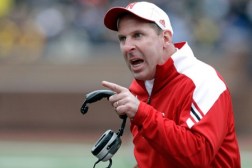
Bo Pelini. There are three major upsides with this possible hire. For one, he is currently coaching at Youngstown State, which is an FCS school. That’s right, he’s not even coaching at an FBS school after Nebraska fired him. It would therefore not be a hard sell for him to come to Purdue for a Power Five FBS job. Indeed, given his current predicament, a salary just slightly higher than Hazell’s might suffice.
Second, Purdue is a Big Ten team, same as his former team Nebraska, who did him dirty. Those idiots fired him for going 9-3. Who in their right mind would do such a thing? Given his reputation for intensity – something Purdue’s program desperately needs, obviously – it would stand to reason that he would not be a “forgive and forget” type. Thus, the opportunity for revenge against those in the conference who wronged him would make Pelini coming to Purdue an even easier sell.
Third, he clearly has recruiting contacts. One would need that in order to be able to win nine games a year in a state that produces zero NFL talent, save for the occasional offensive lineman. His is clearly a name recognized throughout the conference regardless, and that is the most key item.
Indeed, regardless of who becomes the new coach, it is an absolute requirement that he be a recognizable name. We cannot roll the dice with a coach from the MAC again. We already made that mistake. We need a “big name” to show that we truly are committed to not only righting the ship but making sure that it stays on course for the long haul and does not hit a reef again. Bo Pelini would be such a name. If not he, then Les Miles should do just fine, or even Dave Wannstedt, for that matter. If Notre Dame is foolish enough to fire Brian Kelly this year (don’t put it past such a delusional fan base to call for something that monumentally insane, either), then by all means should Purdue empty the bank for him. Morevoer, if such a scenario were to take place, by all means, forget Pelini go all-in on Kelly!
If nothing else, Mike Bobinski ought to heed that last bit of advice, as his young legacy as the new AD at Purdue hangs in the balance with this critical decision. Either Purdue gets a name guy with a proven history, or they will stay in the outhouse forever, reaching for the “flush” handle.
Memo to Big Ten: More is not always better November 21, 2012
Posted by intellectualgridiron in Sports.Tags: ACC, Atlantic Coast Confernce, B1G, Badgers, Big 10, Big East, Big Ten, Blazers, Buckeyes, Buffaloes, Cal Poly, college, Colorado, Cornhuskers, D.C., Dan Wetzel, demographics, football, Hawkeyes, Iowa, Iowa City, Jim Delany, Madison, Maryland, Michigan State, Missouri, Nate Silver, NCAA, Nebraska, New Jersey, New York, North Carolina, Northwestern, Notre Dame, Ohio State, Pac-12, Rutgers, Scarlet Knights, SEC, Spartans, Terps, Terrapins, Texas, Texas A&M, UAB, Utah, Utes, Virginia, Washington, Wisconsin, Youngstown State
add a comment
 More is not necessary better. If one of your favorite products introduces a new product line, will that help the overall brand, or will it detract from productive capacity and quality control resources for the product and you and others already know and love? If your favorite airline adds more routes, instead of enhancing the brand, all it might do is cause more flights to be delayed.
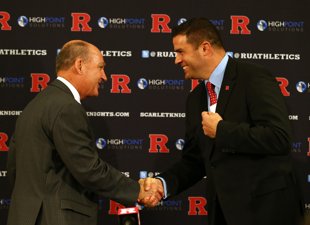
The reason I bring this up is because the news has come out that the Big Ten is inviting both Maryland and Rutgers into their prestigious conference. The invitation obviously benefits these two universities, but how does it benefit the Big Ten? More is not always “more,” as in better. It’s not as if the Big Ten is adding Notre Dame and Texas, in which there would be more great TV games and home games.
The benefits for Maryland and Rutgers are obvious. Neither teams are making much money with their athletics programs (least of all Rutgers), not with the relatively lousy television deals they currently have. By joining the Big 10, that problem instantly vanishes, since that conference has one of the best TV deals in the business. It is not rocket science to figure out why a poor guy wants to marry into a rich family.
Moreover, while those two teams’ conference fit is a geographic stretch, academically it somewhat makes sense. Like almost all other conference members, Maryland and Rutgers are both members of the Association of American Universities, for what that is worth (oddly enough, Nebraska is the only B1G member not yet in that affiliation). Adding these two schools could further enhance the conference’s already solid academic reputation.
But aside from that, how does the Big Ten benefit? From a fan’s perspective alone, this could border on havoc. Think of the traveling distance. Many Big Ten fans travel by the busload to some away games. A band of Nebraska fans traveling to Piscataway, N.J. to see their beloved Cornhuskers play Rutgers would literally be journeying halfway across the country. That’s a huge difference from a more typical conference matchup in which some Wisconsin fans would have but a [roughly] three-hour run to Iowa City to cheer on their Badgers against the Hawkeyes.
Moreover, think of home game schedules for a moment. So few great home games are available year in and year out. Think about how many season ticket-holding fans have to put up with lousy match-ups at home. Wisconsin playing Cal Poly or Ohio State playing Youngstown State at home might be easy wins, but they are horrible games for the fans. Ditto with the Buckeyes playing the Blazers of UAB; yuck! Fans of B1G teams wait patiently from great match-ups, such as the Buckeyes coming in to Camp Randall Stadium in Madison for a night game, or Michigan State coming into Northwestern for a close, hard-fought match-up.
With Rutgers and Maryland now in the mix, those great regional rivalries that fans hunger for are now further in jeopardy in place of a potentially mediocre match-up with these mediocre teams. Again, what has the Big Ten, on balance, to gain from this? The Terrapins’ affiliation with the conference will not make the program improve.
It also messes with traditional rivalries. The Terps have nothing to do with the Spartans, Buckeyes or Badgers. Their rivals are Virginia, North Carolina, etc., all in the Atlantic Coast Conference. Leaving the ACC for the B1G means all those rivalries instantly vanish.
Ah, but adding Rutgers and Maryland into the conference means that the Big 10 can tap into the New York City and Washington, D.C. markets, say the expansion advocates. But people in those markets don’t care about either team, so says Nate Silver, who has a great piece that voices that same concerns written on this page. Silver’s analysis shows that there are low percentages of college football fans in those two large metro areas. Why compromise teams’ schedules for such a diminishing return?
The bottom line is that the Big Ten, arguably most prestigious athletic conference overall in college athletics (notwithstanding football alone, in which the SEC is, at this time, head and shoulders above everyone else), is running a serious risk of diluting their brand.
If you want further proof of this real possibility of brand dilution, look no further than the Pac-12 to see how this move makes no sense. Any benefit of adding Utah and Colorado is marginal at best. The Utes have been mediocre this year, and the Buffaloes have been an outright embarrassment, as they are arguably the worst team in the FBS (see: “Dang, they’re bad,” see: “Can the season end?”). Yes, the Pac-12 has some great teams right now: six of its member teams are, as of his week, ranked in the top 25. But Utah is not among those who are ranked, and, as already mentioned, Colorado is embarrassingly abysmal.
At least when the SEC expanded, it brought in Missouri and Texas A&M; two quality programs. Maryland and Rutgers just dilute the brand, and further weaken an already teetering Big East. Big Ten Commissioner Jim Delany may think that bringing these two teams in will allow for it to reach certain key “demographics,” but not only does Nate Silver show that those demos are not as inviting as they would initially appear, Dan Wetzel of Rivals/Yahoo! points out similar problems. Delany and the rest of the conference leadership need to snap out of this trance before they make a horrible mistake that will ruin the brand.
 intellectualgridiron