A Possible Replacement for Hazell at Purdue October 17, 2016
Posted by intellectualgridiron in Sports.Tags: ad, athletics, B1G, Big Ten, Brian Kelly, Buffalo, coach, college, Darrell Hazell, Dave Wannstedt, director, FBS, FCS, football, Jim Colletto, Jim Harbaugh, Kansas, Les Miles, Michigan, Mike Bobinski, Morgan Burke, NCAA, Nebraska, Notre Dame, Purdue, Turner Gil, Youngstown State
add a comment
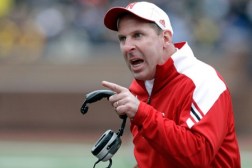
Remember me, Big Ten?
Coach Darrell Hazell has been fired at Purdue. Yes, it was highly commendable how he made lots of friendly gestures in reaching out to the football alums; how well-behaved and polite his kids are; how he preaches morals and good conduct to his players. As a person, Hazell was a very good man. As a coach, he was a charlatan.
We were willing to give him the benefit of the doubt after his first horrible season (2013). The blowout loss at home to then-No. 2 Ohio State on Nov. 2 of that year was an affront to the university, to the Purdue program, to say nothing of all the Purdue football alumni forebears who had to watch such a disgraceful showing. Little did we know that plenty more disgraceful showings were to come in the course of almost four seasons. Those of us who have followed Purdue football for two decades or more know only too well what a disastrous coach Jim Colletto was, but at least the guy could recruit. With Hazell, we have lacked even that silver lining.
It turns out that Hazell was former AD Morgan Burke’s parting “Gift.” The humor is in understanding the double entendre, for the word “Gift” in German – hence the capitalized noun, a constant in that language – means “poison”. In fact, that disastrous hire has permanently tainted Burke’s legacy as an athletics director. Rightfully so, too. This is what happens when you continually hire coaches on the cheap, withhold needed administrative support and resources, then act like you’re going to pay the new head coach real money (actually, not so much, comparatively speaking), only to hire a charlatan who fooled you with one good season at a bottom-feeding MAC program. We saw this scenario before with Turner Gil having one good season at Buffalo, making the gullible think that he was the next Jack Welch. How well did that hire work out of you, Kansas?
To put it another way, Purdue paid Darrell Hazell roughly $1 Million more than they paid Danny Hope per year, even though the former finished with a 9-33 record at that school, while Hope went 22-27 with two bowl appearances. Nothing like paying more for a much worse performance, no?
Thankfully, we now have the prospect of being spared future embarrassments in the seasons to come…provided that new Purdue AD Mike Bobinski makes the right hire. In the college game, hiring the right coach makes all the difference in the world. Just look at Michigan. All of us left that program for dead…or, least for permanent diminished relevance. Then they hired Jim Harbaugh, and in his second year, they are already a national championship contender.
Granted, Purdue is not Michigan, neither in terms of tradition, resources, or recruiting channels. But that is not to say that there is potential to hire a good coach to not just give the program the shot in the arm it needs, but also, immediately give the program the electric shock paddles just to get its heart to beat again.
But who? Several ideas have been tossed out in the comment section of the most recent Hammer and Rails articles. Many of the faithful, for example, seem fixated on Les Miles. Honestly, that would be a pleasing hire to me. He would be effective in shaking up the culture, and would attract lots of eyeballs and thus attract some good recruits. My purpose is to offer an additional idea; not to say it is THE only idea to be considered, but that it is AN idea to be considered. Here it is:
Bo Pelini. There are three major upsides with this possible hire. For one, he is currently coaching at Youngstown State, which is an FCS school. That’s right, he’s not even coaching at an FBS school after Nebraska fired him. It would therefore not be a hard sell for him to come to Purdue for a Power Five FBS job. Indeed, given his current predicament, a salary just slightly higher than Hazell’s might suffice.
Second, Purdue is a Big Ten team, same as his former team Nebraska, who did him dirty. Those idiots fired him for going 9-3. Who in their right mind would do such a thing? Given his reputation for intensity – something Purdue’s program desperately needs, obviously – it would stand to reason that he would not be a “forgive and forget” type. Thus, the opportunity for revenge against those in the conference who wronged him would make Pelini coming to Purdue an even easier sell.
Third, he clearly has recruiting contacts. One would need that in order to be able to win nine games a year in a state that produces zero NFL talent, save for the occasional offensive lineman. His is clearly a name recognized throughout the conference regardless, and that is the most key item.
Indeed, regardless of who becomes the new coach, it is an absolute requirement that he be a recognizable name. We cannot roll the dice with a coach from the MAC again. We already made that mistake. We need a “big name” to show that we truly are committed to not only righting the ship but making sure that it stays on course for the long haul and does not hit a reef again. Bo Pelini would be such a name. If not he, then Les Miles should do just fine, or even Dave Wannstedt, for that matter. If Notre Dame is foolish enough to fire Brian Kelly this year (don’t put it past such a delusional fan base to call for something that monumentally insane, either), then by all means should Purdue empty the bank for him. Morevoer, if such a scenario were to take place, by all means, forget Pelini go all-in on Kelly!
If nothing else, Mike Bobinski ought to heed that last bit of advice, as his young legacy as the new AD at Purdue hangs in the balance with this critical decision. Either Purdue gets a name guy with a proven history, or they will stay in the outhouse forever, reaching for the “flush” handle.
On Morgan Burke and Purdue February 19, 2016
Posted by intellectualgridiron in Sports.Tags: ad, Appalachian State, Arena, athletics, B1G, Big Ten, Brian Kelly, Danny Hope, Darrell Hazell, David Boudia, director, Drew Brees, EKU, Golden Flashes, James Franklin, Jim Harbaugh, Joe Tiller, Kent State, Mackey, Mark Dantonio, Morgan Burke, NCAA, Purdue, Ross-Ade, trustees, Urban Meyer
add a comment
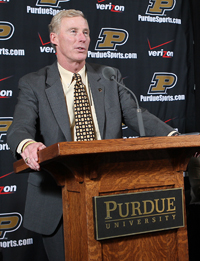 Morgan J. Burke has been the Athletics Director at Purdue University for more than 20 years. On Thursday, Feb. 11, he announced that he would retire from this position, effective June of next year. During his lengthy tenure, he has garnered a reputation amongst his peers as one of the most competent AD’s in major college athletics, especially in terms of finances. With so many AD’s spending money as if their budgets were bottomless pits, Burke has been very fiscally sound, and has enjoyed the deserved reputation as a prudent business manager as a result.
When he took over as the top athletics administrator in 1993, Purdue had the absolute worst athletics program in the Big Ten. Hammer and Rails has an article that puts this in perspective, including that fact that the football program only had five (yes, five) bowl appearances total in its history, and was in year eight of a 12-year bowl game drought. The schools’ baseball, ahem, “stadium” would have been considered poor by high school standards. The swimming and diving teams’ home pool was in some hidden location underground at Lambert Fieldhouse. Ross-Ade Stadium was practically falling apart. In short, the department itself was operating on a shoestring budget with awful facilities and teams badly-performing as a result.
In the span of Burke’s tenure, Ross-Ade received much-needed renovations, including leading the way in building an aircraft carrier-sized press box on the side of one’s football stadium. The football team has enjoyed 12 bowl appearances between 1997 and 2012, including an elusive and prestigious Rose Bowl berth. Mackey Arena has also enjoyed major upgrades, along with being home to a men’s team that has delivered four men’s basketball Big Ten titles and a women’s national championship. For what it’s worth, women’s golf brought home the national title in 2010. A nice, more comprehensive list of all that Burke has done well can be found here.
Moreover, (again, for what it’s worth), women’s soccer, softball, baseball, and tennis all have new facilities. The new swimming and diving pool, opened up ca. 2000, is considered one of the finest college natatoria in the whole country. While not exactly on most people’s radar screens, Purdue has become a diving powerhouse (e.g., David Boudia, 2012 Olympic gold medalist).
And yet, to speak with the Purdue University faithful these days, the firm impression is that the athletics department is in an absolute shambles. Sure, it’s all well and good that the softball, baseball and soccer teams have wonderful facilities, and a fine reflection on the university that the swim teams have a jewel of a pool to call their own. But there are problems afoot with the two highest-profile programs, those being football and men’s basketball.
The latter has been performing very inconsistently as of late, what with promising recruiting classes that fail to live up to their potential. But even worse and more urgent is the absolute disgrace of the football team. Coach Joe Tiller’s teams’ performances started waning during his last few years, especially since the 2005 season. When former assistant coach to Tiller in Danny Hope took over (he had been the head coach at Eastern Kentucky University from 2003 through 2007), things kept declining further (5-7 in 2009, 4-8 in 2010). Coach Hope enjoyed only two bowl appearances after going 7-6 in 2011 and 6-6 in 2012. Ironically, he was fired despite a bowl berth in 2012.
Herein lies a symptom of a systemic problem. Purdue has been NOTORIOUS for not paying its coaches even average market value. Coach Tiller was one of the lowest-paid football coaches in the conference for one, and that did not change when the torch was passed to Coach Hope. In college football, it’s all about the coach and the kind of playing talent that coach is able to recruit. Just see what Brian Kelly has achieved at Notre Dame, in this era’s Sunbelt-dominated era of college football, or how Jim Harbaugh has been turning things around at Michigan to illustrate this crucial point.
Basically, Burke tried to make things work with Coach Hope while giving him a shoestring budget. Coach Hope in turn did what he could with such a dearth of resources, but his performance on the field reflected the fact that he was not getting the type of support he needed to compete effectively in major college football. Firing him became tantamount to killing the messenger.
But there are other dimensions to this problem. Before and during the Coach Hope era, Purdue’s reputation for under-paying its athletic personnel was well-founded and deserved. Even competent, ambitious people who worked on the administrative side of the department would leave for better pay at other schools, even to the intra-conference competition. That especially went for assistant coaches who were worth a thing in the sport; after a few years of building a reputation at Purdue, they would soon leave for greener pastures. As Fox Sports’ Colin Cowherd often reminds us, “[C]oaches do not care about your fight song: PAY them!”
Burke seemed to have gotten that memo when searching for a new football coach in the wake of Coach Hope’s departure. He announced that he was raising additional funds to try to attract a better coaching talent. Eventually, the searched settled on Darrell Hazell, then the head coach at Kent State who had a good year with the Golden Flashes (as an aside, snapping up a MAC coach who has had only one or two good years there into a Power Five Conference team is always a risky roll of the dice). Case in point: while Coach Hope’s base salary was $925,000 a year, Coach Hazell’s base salary was $1,750,000. Better, but still not enough to attract talent on par with, say, James Franklin of Penn State or Mark Dantonio at Michigan State, let alone Urban Meyer or Jim Harbaugh.
Moreover, when the bigger players in the B1G are searching for their new coach, they never seem to have to announce some fundraising effort to be able to offer a big-name, proven winner of a coach a competitive salary. Yet Purdue had to announce such an effort just to be able to pay its coach $1.75 million, which is still sub-average among the Power Five.
Before drilling even deeper to the root problem, let us keep things in perspective for now. Burke has been proven that he is among the best AD’s in the country in terms of two things. One is operations. Having attended the Big Ten wrestling championships, hosted in Mackey Arena on March 3, 2012, I can personally attest that they were carried out flawlessly.
The other is financials. The Big Ten is home to some gigantic athletics departments that include both Michigan and Ohio State, both of whom have a figurative license to print money. Purdue, meanwhile is at a systemic disadvantage in that its athletic department receives ZERO money from the university. Despite that handicap, Burke has led a very financially sound department, with each fiscal year ending in the black.
But Burke’s weakness has been talent acquisition, which, frankly, is 90 percent of his job in the public’s eye. He lucked out with Coach Tiller, who in hindsight had a limited shelf life of effectiveness without Drew Brees. He tried going cheap with Coach Hope after Tiller, and that ended up crippling the program. Although he doubled the head football coach’s salary at Purdue, he has wasted it on Darrell Hazell. Granted, Hazell is a fine man who has raised outstanding kids and has done everything beyond reproach. Moreover, he has done wonderful, marvelous things in reaching out to football alums.
Yet despite being a fine gentleman off the field, Coach Hazell’s on-the-field record has been only 6-30 in three seasons. This dismal performance has led to a damaging effect on Purdue’s athletic and thus academic reputation to average people. It has in turn led to major frustrations on the part of the Purdue alumni and related faithful. Since Burke hired Hazell, a good bulk of this frustration has understandably been laid at the feet of the AD.
Thus, the initial reaction to the announcement of Burke’s eventual retirement: why wait so long when a changing of the guard appears to be in order? Sixteen months seems like a long time to wait to take the program into a new direction. More to the point, is the change desperately in order? Answer: yes and no. A two-decade tenure for an athletics director is long enough. After that lengthy span of time, new blood is needed, with new leadership to take the department in new directions. Given the current, disgraceful abyss of the football program and the inconsistent performance of men’s basketball, that new direction is obviously, desperately needed.
But will a changing of the guard at AD really help beget that? After extensive deliberation and searching of perspectives, I am led to conclude that a new AD alone might not help bring about the change Purdue desperately needs. Perhaps Burke’s ineptitude at hiring a proven, big-name coach was a symptom of his being hamstrung by the Board of Trustees.
Most universities “get it.” That is, they understand that college athletics, and football in particular, are front porches to their universities. Meaning, the trustees of most major universities understand that football is the primary marketing tool, and they thus see the football team as a way of leveraging and building the schools’ entire reputation in the eyes of the general public. Purdue, in contrast, sees athletics as a secondary mission, and has historically chosen to put academics first. While this is noble, it is also short-sighted, given the context of today’s society, where we accept the use of a school’s football team as the primary promotion tool as normal and indeed, expected.
When podunk Appalachian State was vying for three consecutive national titles as the FCS level in football last decade, it was a huge shot in the arm for that school. During a home game in the playoffs in 2007, the university’s president was on the sidelines wearing an ASU football jersey, joyously telling the sideline reporter for ESPN that applications for potential students to attend that university had skyrocketed. Enough said.
Thus we are led to the core problem at hand: why do the members of Purdue’s Board of Trustees fail to grasp this? As long as they fail to understand this basic, modern tenet of university promotion, it might not matter how capable Burke’s replacement at AD will be.
 intellectualgridiron