The potentially existential problem at the University of Texas February 10, 2013
Posted by intellectualgridiron in Politics.Tags: 3M, academia, academic, B1G, Berkeley, Big Ten, brand, Cadillac, Cal, Carrier, Chevrolet, Chevy, critical, culture clash, doctorate, DuPont, education, engineering, equity, Evergreen, Florida, G.E., G.M., GE, General Electric, General Motors, GM, Golden, Great Lakes, Harvard, higher ed, Hoosier, Indiana, institution, Ivy League, leftism, Lockheed-Martin, Magnum, marketable, marketing, Marxism, masters, Michigan, Minnesota, Pac-12, Packard, Penn State, prestige, professor, public, Purdue, R&D, research, school, SEC, secondary, state, Texas, UCLA, undergrad, United Technologies, university, USA Today, UT, vocation, Washington, Wisconsin, world-class
add a comment
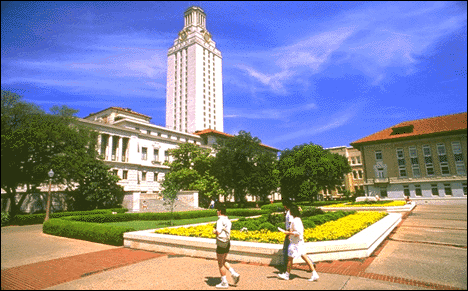 On the surface, it seems there has never been a better time to be a part of a major university, particularly the state-funded type. Education remains in high demand, after all, and those working as full-time academics (extra emphasis on “full-time”) make good money. Individual states take pride in their flagship schools as being centers for world-class research, that some of the most cutting-edge, world-changing advances in technology, from electronics to engineering to chemistry to medicine, have come out of these sorts of universities. Note that I said “some” research, for just as many cutting-edge discoveries have come out of R&D departments in General Electric, General Motors, DuPont, 3M, Magnum Research, Lockheed-Martin, and the like (note that they are all for-profit companies in the private sector!).
But that stipulation aside, these flagship schools are often viewed with some degree of prestige. Pennsylvania, for example, rightly takes pride in the academic excellence at Penn State, as it is regarded as a “public Ivy.” Ditto for the University of Michigan in the Great Lakes State, or for both Indiana and Purdue Universities in the neighboring Hoosier State. The Universities of Wisconsin and Minnesota are also known for quality, world-class research and are thus a source of pride for their respective states. Same can be said for Cal-Berkeley and UCLA in the once-Golden State or for the University of Washington in the Evergreen State. Even the SEC, not necessarily known for its academic prowess overall compared to the Big Ten or even the Pac-12, nevertheless has a good example of a big, state flagship school with good academics (though a recent development, to be sure) in the University of Florida. And yes, the adjective “state” also means “public,” with college tuition being more affordable for in-state students than if said students were to attend private schools for their higher education instead.
So what is the problem? Well, the issue has two large, important dimensions. At the heart of said issue is an existential crisis that seems to be gripping the University of Texas, another great example of a state flagship school that has good academics both at the undergrad level as well as the graduate one. This existential, if not outright identity, crisis is the result of something of a culture clash within the vaunted institution. USA Today reports that opposing factions within the school have very different visions for the direction and purpose of the UT. The conflict basically goes this way: do we focus on the prestigious aspects of the school, or do we make it more accessible? It’s basically a Cadillac vs. Chevy argument. Cadillacs are much nicer and classier, but Chevys will still get you where you need to go without breaking the bank in the process. Both arguments have merit, but which way should the university go?
The prestige/class argument certainly has its place, but has severe limitations. Undergrads usually choose their school based on its academic reputation, yet said reputation comes from research done by faculty and doctoral students. Just because a professor is a leading researcher in his field does not necessarily mean he will be effectively imparting that insight to the undergrads. In fact, in all likelihood, he might farm out that teaching to his teacher’s assistants, themselves concentrating on establishing their own reputations in academia. The only way an undergraduate student would have a course taught be one of these hypothetical leading professors is if they take an arcane course that is directly within the narrow scope of the professor’s arcane research, as Dr. Thomas Sowell points out. Such is often the case at Harvard and the other Ivy League schools, but less so at certain places like Purdue.
This leads us even further into the problem with “prestige.” While some research is very useful in the real world, other research, not so much. If the cutting-edge research is within the fields of engineering, medicine, food science, agriculture, chemistry, computers/electronics, or even business management to an extent, then all those things can translate to useful applications to advance our standard of living in the real world. But if a professor is a leading researcher in sociology, communication, “women’s studies,” or “critical theory” (i.e., Marxism), so what? How does a degree in a field of that sort of related study translate into marketable skills, which, now more than ever, are key to getting a job in a tough economy?
Long gone are the days when just having any old degree will get you a decent-paying job. Employers look for specific skills to make specific contributions to their companies’ productivity. Therefore, if major universities wish to remain relevant, the other argument goes, then they must adapt their teaching curricula to meet these more basic student needs so that said students, once they graduate, can be productive elements of society, and thus truly get their money’s worth.
Specifically, employers are looking for – depending on your industry, and yes, I’m generalizing here – nurses, engineers, chemists (to an extent), I.T. professionals/computer engineers/programmers, and accountants, not to mention HVAC technicians, plumbers, the latter two do not even require a four-year degree insomuch as a vocational certification. Getting a degree in sociology will not help fulfill employers’ needs.
I for one lean towards the latter camp, but coming from an academically-oriented family myself, I fully sympathize with the other side’s point of view. Where I part company with the other side is the blind eye they turn to, if not outright abet, all the side-effects that come with the purely theoretical, no-real-world-application side of academia. To put it bluntly, one does not hear a peep of Marxism, or any other permutation of Leftist philosophy from engineering or medical schools. Perhaps many a chemistry professor might vote for all the local, state and national Democrat lefties du jour, but one hardly hears any of their ideology trickle down into the classroom. Ditto for engineering professors, or even math professors, though one is likely to find some conservatives in those camps and others where part of their profession is making sure that the numbers actually, you know, add up.
That can hardly be said for many courses in communications, English, sociology, “critical theory/studies,” any ethnic study one cares to choose, or even many – though thankfully not all – history courses and pretty else everywhere else within the purview of liberal arts, sadly.
The irony in the existential debate surrounding the University of Texas is that it has the resources to do a mix of both. It has the resources to offer trade-oriented education to the majority of its would-be undergrads, while at the same time offer English, History, Foreign Languages, Math and Science courses to the kids who want to teach in those disciplines at the secondary (i.e., high school level). If kids within the latter category want to continue their studies as actual scholars in those fields, UT ought to have the resources to accommodate that to an extent, as well as continue in the world class research in which the former camp takes so much pride.
A potential problem with this approach is that, yes, it can muddle the brand, and would run the risk trying to make the University of Texas all things to all people, which hardly anybody outside of G.E. and Carrier/United Technologies are capable of doing. Muddying the brand is problematic enough. Packard tried that in the 1930s in order to survive the Great Depression. Rival Cadillac already had the luxury of having the low-priced Chevrolet brand within the larger General Motors conglomerate. As an independent, though, Packard reasoned that it needed to make low-priced models just to survive, but in doing so, it compromised the prestige of the brand. As any marketing professor worth his or her salt will tell you, though, the solution would have been for Packard to come with its own low-priced flanker brand so as to not compromise the brand equity of its famous luxury marque.
Sounds simple in theory, but for higher education, it is not. If UT were to adopt this idea, how could the ‘man on the street’ differentiate the practical vocation-oriented training from the prestigious research that is normally associated with such an institution? Ultimately, it should come down to individual employers’ ability to be able to see how employment candidates from that school can translate the practical knowledge they have learned into applied abilities to benefit the companies, without regard to prestigious research done elsewhere at such a huge school.
This brief exploration of the opposing issues by no means will settle this huge argument in Austin. But approaching market forces might compel the university to adapt some version of this proposed hybrid model, prestige or no prestige. This discussion is surely to be continued.
College Football Week 3 Awards September 17, 2012
Posted by intellectualgridiron in Sports.Tags: Alabama, Arizona, Arkansas, Auburn, awards, Ball State, Boise State, BYU, Cal, California, Charlie Strong, Clemson, college football, Colorado, Connecticut, Duke, Eastern Michigan, Florida, Florida Atlantic, Florida International, Florida State, Fresno State, Gene Chizik, Idaho, Indiana, James Franklin, John L. Smith, Joker Phillips, Kansas State, Kentucky, Louisiana-Monroe, Louisville, LSU, Mack Brown, Mark Dantonio, Mark Richt, Maryland, Memphis, Michigan State, Mississippi State, Missouri, Navy, NCAA, North Carolina, Northwestern, Notre Dame, Ohio State, Oklahoma, Oregon, Pat Fitzgerald, Penn State, Pittsburgh, Purdue, rivals, South Carolina, Stanford, Temple, Tennessee, Texas, Todd Berry, Troy, UAB, USC, Virginia Tech, West Virginia, Western Kentucky, Yahoo!
1 comment so far
It was so much fun. Every Sunday afternoon in the Fall of very recent years, we looked forward to the sportswriters of Rivals/Yahoo.com giving us their take on the good, the bad, and the ugly of the college football games and teams from the previous day. Their awards were very informal yet well to the point, and never failed to produce a number of chuckles and at times a few belly laughs. Those days seem to be gone. Yahoo!’s online sports section has been given a sleek makeover, but in this new format, the weekly awards seem to have been lost by the wayside. Maybe one could account for this because one of their main writers, Tom Dienhart, now blogs for the Big Ten Network. Who knows? The bottom line is, despite my best efforts, I cannot find it anymore. What website that is worth its weight in attracting eyeballs would make such an enjoyable weekly post so hard to find?
With all of this in mind, inspiration hit me last night to take it upon myself to dole out the awards instead. Afterall, I’m an alumnus of a Big Ten program, and have worked with coaches now on a number of “Big-Six” conference teams. It may not be Rivals/Yahoo!, but if you love college football, you might be apt to find this to be the next best thing. I have tweaked some of the awards to suit the unique situations that arise from week to week, but for the most part, the awards are the same. Therefore, I offer the awards for the third week of major college football, and aim to continue to do so until the able writers at Yahoo! ‘get it together’ and resume their Sunday duties.
Wish I were him: Mack Brown, Texas
Glad I’m not him: Mark Dantonio, Michigan State
Lucky guy: Gene Chizik, Auburn
Poor guy: Todd Berry, Louisiana-Monroe
Desperately seeking a wake-up call: Charlie Strong, Louisville
Desperately seeking a P.R. man: Pat Fitzgerald, Northwestern
Desperately seeking sunglasses and a fake beard: Joker Phillips, Kentucky
Desperately seeking … anything: John L. Smith, Arkansas
TEAMS
Thought you’d kick butt, you did: Purdue (beat Eastern Michigan 54-16)
Thought you’d kick butt, you didn’t: Mississippi State (beat Troy 30-24)
Thought you’d get your butt kicked, you did: Idaho (lost to LSU 63-14)
Thought you’d get your butt kicked, you didn’t: Pittsburgh (beat Virginia Tech 35-17)
Thought you’d reach a turning point, you didn’t: Tennessee (lost to Florida 37-20)
Dang, they’re good: Alabama
Dang, they’re bad: Colorado (or Kentucky: take your pick!)
Ya’ know, they’re not so bad: Cal
Did the season start? Penn State
Can the season end? Navy
Can the season never end? Stanford
Play this again: Stanford 21, USC 14
Never play this again: Fresno State 69, Colorado 14
Unbelieveable Irony: Connecticut 24, Maryland 21
What? Ball State 41, Indiana 39
Huh? Notre Dame 20, Michigan State 3
Are you kidding me? Pittsburgh 35, Virginia Tech 17
Oh – my – God: Western Kentucky 31, Kentucky 30
Told you so: Louisville 39, North Carolina 34
NEXT WEEK
Ticket to die for: No. 11 Clemson @ No. 5 Florida State
Best non-Big Six vs. Big Six matchup: Florida International vs. Louisville
Best non-Big Six matchup: BYU @ Boise State
Upset alert: Kansas State @ Oklahoma
Must win: USC vs. California
Offensive explosion: Arizona @ Oregon
Defensive struggle: Temple @ Penn State
Great game no one is talking about: Missouri @ South Carolina
Intriguing coaching matchup: Mark Richt of Georgia vs. James Franklin of Vanderbilt
Who’s bringing the body bags? Florida Atlantic @ Alabama
Why are they playing? UAB @ Ohio State
Plenty of good seats remaining: Memphis @ Duke
They shoot horses, don’t they? Maryland @ West Virginia
What are your thoughts, dear readers? Comments are welcome!

