2012-2013 Bowl Games of Moderate Interest (at best) December 14, 2012
Posted by intellectualgridiron in Sports.Tags: ACC, Air Force, Aloha, Armed Forces, Aztecs, B1G, Ball State, Bayou Bengals, BCS, Bearcats, Beef 'O' Brady's, Belk, Big 10, Big Easy, Big Ten, Big XII, Blue Devils, Bobcats, Bowl, Bowling Green, Bulldogs, BYU, C-USA, Cadillac Chrysler, Cardinals, Central Michigan, Cincinnati, Colin Cowherd, college, conference, Cougars, Cyclones, David Cutcliffe, Duke, ESPN, Ethics, football, Fresno State, game, Georgia Tech, Golden Knights, Hawaii, Hokies, Idaho Potato, Independence, Iowa State, K-car, Liberty Bowl, Little Caesars, Louisiana-Monroe, Louisville, LSU, MAC, Meinecke Car Care, Michigan State, Military Bowl, Minnesota, Mississippi State, Mountain West, Mustangs, NCAA, Notre Dame, Ohio U, Pac-12, Poinsettia, Red Raiders, Rice, Russell Athletics, Rutgers, San Diego State, San Jose State, Scarlet Knights, SEC, SMU, Snow, Sun Belt, Sun Bowl, Texas A&M, Texas Tech, The Herd, Tigers, Toledo, Tommy Tuberville, triple option, Trojans, Tulsa, UCF, USC, Utah State, Virginia Tech, WAC, Western Kentucky, Yellow Jackets
add a comment
Bowl season is almost upon us once again. Yes, friends, things kickoff early as usual, just as they have since roughly 2001. But instead of the New Orleans Bowl doing the honors in getting things started this year, we have the New Mexico Bowl and the Idaho Potatoes Bowl (don’t laugh!) doing said honors this year. The Big Easy Bowl does not commence until Dec. 22, oddly enough.
In any event, I have ranked the bowl games by category, with the major criterion being level of desirability to view, partly on my end, partly on the end of the average viewer who is NOT a certifiable college football addict like yours truly!
The first installment is of bowl games about which I am only moderately interested, at best (all times Eastern Standard):
Idaho Potato Bowl (Boise, Id.), Sat., Dec. 15, 4:30 PM EST
Toledo (9-3) vs. No. 22 Utah State (10-2)
The de facto WAC champ takes on a respectable MAC team that finished 3rd in the western division. The only interesting aspect about this game is that it will be an interesting test to see how strong the MAC truly is against the best of what is seen by most as a traditionally weak conference.
Poinsettia Bowl (San Diego) Sat., Dec. 15, 8:00 PM EST
BYU (7-5) vs. San Diego State (9-3)
The Cougars take on the de facto leader of the Mountain West, in what amounts to a glorified home game for the Aztecs. Despite the numbers not matching, their records have interesting similarities in that both teams lost to at least one Pac-12 team, and both teams also lost to San Jose State (!).
Beef ‘O’ Brady’s Bowl (St. Petersburg, Fla.) Fri., Dec. 21, 7:30 PM EST
Ball State (9-3) vs. UCF (9-4)
Both the Cardinals and the Golden Knights have nearly identical records, with UCF’s extra loss coming to Tulsa in the C-USA championship game. The only interesting aspect to this game is how a MAC also-ran stacks up against the C-USA runner-up. Everybody was bullish on the MAC this year for the apparent strength the conference hath shewn; now it is time to put up or shut up.
Hawaii Bowl (Honolulu, Hi.) Dec. 24, 8:00 PM EST
Fresno State (9-3) vs. SMU (6-6)
This game used to have a little more of a mystique to it when it was called the Aloha Bowl, and was played on Christmas. Just sayin’! That said, it least this game is another glorified home game for Hawaii team, like it is half the time. A Mountain West also-ran vs. a C-USA team barely eligible does seem to be a slight mismatch in the Bulldogs favor. On the other hand, this will be an interesting homecoming for June Jones, albeit on the Mustangs side this time.
Little Caesars Bowl (Detroit), Wed., Dec. 26, 7:30 PM
Western Kentucky (7-5) vs. Central Michigan (6-6)
It used to be they would pit a middle-of-the-road Big Ten team against the MAC champ. Even then, the game was only moderately interesting, and only to the fan bases of the teams that got the bid to the Motor City. Now, with a Sun Belt Conference also-ran against a plodding MAC team, it is even less interesting. But credit the guys at EDSBS for reminding us that, given the game is in Detroit, the players, as a bonus, the players might get deeds to abandoned key real estate in their gift bags!
Military Bowl (Washington, D.C.), Thurs., Dec. 27, 3:00 PM
No. 24 San Jose State (10-2) vs. Bowling Green (8-4)
WAC near-champ vs. MAC also-ran: we know what ESPN Radio’s Colin Cowherd would say; “not interested!” Yes, the Trojans (the SJSU kind, not the USC kind) did take the WAC by storm this year, but it’s still the WAC.
Belk Bowl (Charlotte, N.C.), Thurs., Dec. 27, 6:30 PM
Cincinnati (9-3) vs. Duke (6-6)
A decent Big East team takes on a barely-eligible ACC team. That alone does not make most folks interested. So what in addition to that dismal matchup engages anybody? Answer: the intrigue. Who exactly will be coaching the Bearcats, anyhow? And how will David Cutcliffe prepare the Blue Devils for a bowl game that might actually be winnable for them?
Independence Bowl (Shreveport, La.), Fri., Dec. 28, 2:00 PM
Ohio U (8-4) vs. Louisiana-Monroe (8-4)
Something negative, something positive to be said. The negative is obvious if one knows anything at all about bowl history. The Independence Bowl used to be one of the best matchups in the bowl lineup, pitting a Big XII team against an SEC team in a fairly even match. Even before then, the 1995 Michigan State – LSU matchup was memorable, and the 1997 match between the Tigers and Notre Dame was even more so (both ended in the Bayou Bengals’ favor). Remember the “Blizzard Bowl” between Mississippi State and Texas A&M in late 2000? ‘Twas yet another great example of this great bowl game. It is not anymore, though. Now it pits MAC vs. Sun Belt. The Cadillac has been reduced to a Chrysler K-car. Positive: lookee there, the Bobcats made it to a bowl game after all!
Russell Athletics Bowl (Orlando, Fla.), Fri., Dec. 28, 5:30 PM
Virginia Tech (6-6) vs. Rutgers (9-3)
The Hokies have under-performed all the year, and the Scarlet Knights might be a bit demoralized after losing at home to Louisville and losing out on the BCS in so doing. So which team is going to show up? Scratch that: is either team going to show up?
Meinecke Car Care Bowl (Houston), Fri., Dec. 28, 9:00 PM
Minnesota (6-6) vs. Texas Tech (7-5)
Okay, at least it involves a Big Ten vs. Big XII matchup. The only problem is, one team squeaked by into this game while in a conference that is down this year, and the other is facing leadership turmoil in the wake of Tommy Tuberville’s abrupt departure. On paper, the Red Raiders are the clear favorite, but don’t underestimate the power of demoralization.
Armed Forces Bowl (Ft. Worth, Texas), Sat., Dec. 29, 11:45 AM
Rice (6-6) vs Air Force (6-6)
Both teams squeaked into a bowl game. Which one is happier to be there? The happier team is a bit more focused on preparation, which will make the difference come game time. Seriously; it should be called the “Ethics Bowl,” and the fact that I imply derision in that observation is a very sad commentary on our society. On the other hand, Air Force’s triple option ‘grittitude’ is always a pleasure to see for those of us who like real football.
Liberty Bowl (Memphis, Tenn.), Mon., Dec. 31, 3:30 PM
Iowa State (6-6) vs. Tulsa (10-3)
The Cyclones have had some flashes of brilliance this year. The question becomes, will this be enough to overcome the C-USA champs?
Sun Bowl (El Paso, Texas), Mon., Dec. 31, 2:00 PM
USC (7-5) vs Georgia Tech (6-7)
My bowl pick for “they shoot horses, don’t they?” Why? Because it is pointless. The Trojans come in to El Paso only 7-5 because they have yet to muster up the discipline needed to take things to the next level, while the Yellow Jackets already have a losing season. Still, the offensive contrast should be interesting to watch, if nothing else.
Next installment: Bowl Games of More Interest
College Football Week 14 Awards December 3, 2012
Posted by intellectualgridiron in Sports.Tags: ACC, Alabama, Arkansas State, Army, B1G, Baylor, Big 10, Big East, Big Ten, Big XII, Bo Pelini, championship, Charlie Strong, Charlie Weis, college, Florida State, football, Georgia, Georgia Tech, Gus Malzahn, Kansas, Kyle Flood, Louisville, Mack Brown, Mark Richt, Navy, NCAA, Nebraska, New Mexico State, Nicholls, Nick Saban, Oklahoma State, Oregon State, Pac-12, Rutgers, SEC, South Alabama, South Florida, Stanford, Texas, Texas State, UCLA, West Virginia, Wisconsin
add a comment
(Note: All rankings are week 14 AP polls unless otherwise noted.)
COACHES
Wish I were him: Nick Saban, Alabama
Glad I’m not him: Mark Richt, Georgia
Lucky guy: Charlie Strong, Louisville
Poor guy: Kyle Flood, Rutgers
Desperately seeking a clue: Charlie Weis, Kansas
Desperately seeking a P.R. man: Gus Malzahn, Arkansas State
Desperately seeking sunglasses and a fake beard: Bo Pelini, Nebraska
Desperately seeking … anything: Mack Brown, Texas
TEAMS
Thought you’d kick butt, you did: Oregon State (beat Nicholls 77-3)
Thought you’d kick butt, you didn’t: Stanford (beat UCLA 27-24 in the Pac-12 championship)
Thought you’d get your butt kicked, you did: Kansas (lost to West Virginia 59-10)
Thought you’d get your butt kicked, you didn’t: Georgia Tech (lost to Florida State in the ACC championship)
Thought you wouldn’t kick butt, you did: Texas State (beat New Mexico State 66-28)
Dang, they’re good: Alabama
Dang, they’re bad: South Alabama
Can’t Stand Prosperity: Nebraska
Did the season start? Rutgers
Can the season end? South Florida
Can the season never end? Wisconsin
GAMES
Play this again: No. 2 Alabama 32, No. 3 Georgia 28
Never play this again: No. 15 Oregon State 77, Nicholls 3
What? No. 8 Stanford 27, No. 16 UCLA 24
Huh? Louisville 20, Rutgers 17
Are you kidding me? No. 21 Northern Illinois 44, No. 17 Kent State 37
Oh – my – God: Wisconsin 70, No. 12 Nebraska 31
Told you so: Baylor 41, Oklahoma State 34
NEXT WEEK
Only one regular season game is to be played next week, which is the annual Army-Navy game: a cherished American tradition. Go Armed Forces – God bless our troops!
The End of the Danny Hope Era at Purdue: a postmortem and a forward look November 30, 2012
Posted by intellectualgridiron in Sports.Tags: Adam Rittenberg, athletics, B1G, Bear Bryant, Big 10, Big Ten, Boiler, Boilermakers, CEO, Coach Hope, Coach Tiller, Colin Cowherd, college, Danny Hope, department, dept., Drew Brees, ESPN, football, Gary Nord, Howard Schnellenberger, Illinois, Indiana, Joe Tiller, Kevin Wilson, Matt Light, Michigan, Morgan Burke, NCAA, NFL, Purdue, Tim Beckman, Tom Brady, Wisconsin
add a comment
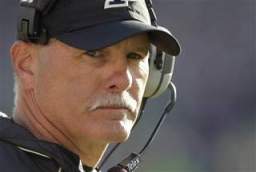 Over the past few days, the word about Coach Danny Hope’s firing has spread like wildfire. In four seasons as Purdue’s head football coach, Hope was 22-27, with no appreciable signs of improvement from when he took over from Coach Joe Tiller at the helm. This particular development had been, according to rumors, that Athletics Director Morgan J. Burke had actually been planned since Purdue’s blowout loss at home to Wisconsin. Be that as it may, the development having been brought to fruition has opened a floodgate of after-the-fact criticism against the man, something I flat-out refuse to join.
Say what you want about Coach Hope: he treated those who played under him as well as those who worked under him more than equitably. He cared for every one of his players as if they were all his sons. Coach Hope and I go back about 15 years, when I first met him at Coach Tiller’s summer football camp for high school players. Starting a year later, I was an aide to him while a student manager on the Purdue team, helping him out on the sidelines during games while he was the offensive line coach under Joe Tiller. In the subsequent years that followed, he went out of his way to make me feel like part of the football family, be it at Eastern Kentucky University – a long story! – or at Purdue as well. I have awesome articles of athletic-themed attire that I shall forever treasure wearing – stuff that he personally gave me.
But I am not the only one ever grateful, ever true to the man now stepping down as head man of the Purdue football team. None other than Drew Brees and Matt Light consider Coach Hope “their coach.” Drew has been quoted as saying that he would run through a brick wall for Hope. Matt Light, former all-pro offensive tackle, not to mention the man who protected Tom Brady’s blind side for a solid decade, has credited Coach Hope with molding him into an NFL lineman.
Bear Bryant was known to say “[i]f anything goes bad, I did it. If anything goes semi-good, we did it.
If anything goes real good, you did it. That’s all it takes to get people to win football games.” With every big win – few as there were – Hope always passed the credit along to his players. When Purdue won in Michigan Stadium for the first time in over four decades, Coach Hope was almost in tears on account of how proud he was of his boys and how well they played.
Moreover, when Hope’s tenure began, on paper, it was a good hire. He was the perfect organizational/cultural fit, having served under Coach Tiller all those years. Moreover, anybody who has met the man could not help but love him, what with his high-energy, high-enthusiasm personality that could brighten up any room. Better yet, he brought in Gary Nord as offensive coordinator. Both learned the coaching ropes together under the legendary Howard Schnellenberger, so obviously they had the pedigree. Between Hope’s high-energy approach towards motivating players and Nord’s abilities with the X’s and O’s, it seemed to be an awesome match. Sadly, things did not turn out that way, as the results clearly show.
The question becomes, why? One plausible explanation is that Hope’s under-performance is the symptom of a bigger issue within Purdue’s athletics dept. One of Purdue’s dirty little secrets is, historically they under-compensate their personnel compared to other Big Ten athletics programs. Anybody with any ambition at all puts in their time, enhances their resumes, then leave for, er, greener pastures, leaving behind good people that stay out of a combination of loyalty (commendable though that may be) and lack of options.
To put things even more bluntly, Purdue is notoriously cheap when it comes to paying its coaches. That could explain Coach Hope’s woes, to an extent. A cursory survey will reveal that Purdue has the lowest football coaches’ salaries of any staff in the B1G. Not good. Hope himself was the lowest-paid head coach in the conference, making only $950,000 this year. Yes, I know, to the vast majority of people, that is a tidy sum. But when you consider that even Tim Beckman of Illinois makes $1.6 million, or even Kevin Wilson of lowly Indiana makes $1.2 million annually, something is dreadfully wrong in Boilerland.
The same problem applies to underpaying assistant coaches. Therefore, the head coach does what he can to bring in assistants, but once they build up their resume, they then go somewhere else where they can make more money. Successful football programs depend in part with coaching continuity. Don’t believe me? Look at what happened to mighty Texas when the bulk of their assistants left, or the slump Florida found itself in for a while. Now imagine the havoc that is wrought on a program like Purdue from lack of such continuity. To quote ESPN’s Colin Cowherd, coaches do not care about your school’s fight song: pay them!
That brings us to the another major point. Morgan Burke right now faces the awesome task of finding a new CEO of the football program to take it in a new, better direction. Certain names have been tossed around here and there, but no matter whom they hire, if Burke does not take a crowbar to the department’s wallet, Purdue will be in the same situation it is in now in three or four years’ time.
Adam Rittenberg, a blogger of espn.com has reported that Burke is putting together a $4.5 million fund for the next coach. If that is true, then maybe, after all these years, it has sunk in that he needs to pay his football coaches substantially more than in the past, distant and recent. Yes, Burke deserves credit for ably managing the athletics department’s bottom line, but that bottom line itself is in jeopardy if the team keeps losing games and the fans vote with their feet in the form of lost ticket revenue. As the saying goes, you have to spend money to make money. Winning games makes money, and to win games, Purdue needs to raise football coaches’ pay (both head coach and assistants) if they want to get anywhere. Let us hope that the rumored $4.5 million is made available soon for the best coaching talent out there. But by that same token, assembling those funds should be a sign that Burke et al. have finally figured out that winning in the Big Ten (or any other “Big Six” conference these days) costs money, and they do deserve some credit for figuring that out, even if belatedly.
Another problem for the program was the offensive strategy combined with a stale culture. Concerning the latter, let us face it: bringing in Coach Hope to replace Coach Tiller was, in some regards, more of the same. The head coach is CEO of the football program. Like a chief executive, his job is to not only set the strategy, but also the culture and tone of the organization. Bringing in Hope was more of the same in that the Tiller influence was able to linger longer than it should. Coach Tiller did a wonderful job of bringing Purdue out of the wretched Jim Colletto era doldrums, but after a while, things became stale. Furthermore, his one-sided “basketball on grass” was becoming less and less effective. Frankly, Drew Brees and his ability to work the on-field magic that he did made Tiller’s offense look far more effective than it really was. The best season Purdue had post-Drew was the 2003 season, where we had a tough, veteran defense combined with Coach Tiller “discovering” something called the running game. Sadly, Coach Tiller never learned from his successes that season, and engaged in a very lengthy panic to where Purdue’s offense continued to dwindle as it became ever-more reliant on the passing game. The more-of-the-same approach, that which worked before but became less effective as the conference overall changed, in turn caused the organizational culture to go stale as well.
Ultimately, Coach Hope’s on-field woes could most likely be attributed to the ongoing quarterback merry-go-round, combined with a poor choice of offensive strategy that was, again, too reliant on the pass. In so many games, I observed too many over-engineered plays that were attempted to be executed by under-skilled personnel. The nature of these plays tended to put the offensive players in too many precarious situations, which could account for why injuries perpetually plagued Hope and his team.
A run-oriented, option-based attack could have rectified this problem. So many fans argue that the passing game is what puts butts in the seats, but I counter in turn that winning is what truly generates enthusiasm for a program, and thus stimulates greater attendance. Three yards and a cloud of dust will sell just as well as the passing game, if you win. The new coach, whoever he may be, will be well-served to heed this advice. Given our current personnel, we could credibly execute a flexbone option attack much like Georgia Tech and Navy currently use. It could buy us time until we bring in personnel that could give us more options in a balanced, pro-style attack that is a proven winning approach with teams throughout the country.
But in the meantime, do not pile on Coach Hope. I will always admire him as a loyal, gracious man. He stood for everything a place like Purdue should support — values, character, sincerity, and integrity. The Boiler Nation would be well-served to never forget that.
College Football Week 13 Awards November 25, 2012
Posted by intellectualgridiron in Sports.Tags: Air Force, Alabama, Arizona, Arizona State, Auburn, B1G, BCS, Big 10, Big Ten, Bill Snyder, Boise State, Brian Kelly, Buckeyes, Charlie Strong, Cincinnati, Clemson, college, Columbus, Commodores, Connecticut, crasher, Dana Holgorsen, Dores, Eastern Michigan, Fighting, Florida, Florida State, football, Fresno State, FSU, Gamecocks, Gators, Georgia, Georgia Tech, Hawaii, Iowa, Irish, Jay Cutler, Jimbo Fisher, Joker Phillips, Kansas, Kansas State, Kent State, Kentucky, Kyle Flood, Lane Kiffin, Liberty Bowl, Los Angeles, Louisville, MAC, Mack Brown, Madison, Michigan, Mississippi State, NCAA, Nebraska, Nevada, Nicholls, Noles, Northern Illinois, Notre Dame, Ohio State, Oklahoma, Oklahoma State, Ole Miss, Oregon State, Penn State, Pete Carroll, Pittsburgh, rival, Ron English, Rutgers, Seminoles, South Alabama, South Bend, South Carolina, South Florida, Stanford, Tallahassee, TCU, Tennessee, Texas, Tigers, Todd Graham, Trojan, UConn, Urban Meyer, USC, Vanderbilt, Vandy, Washington, Washington State, West Virginia, Will Muschamp, Wisconsin
add a comment
(Note: All rankings are current AP [post-week 13, pre-week 14] unless otherwise noted.)
COACHES
Wish I were him: Will Muschamp, Florida
Glad I’m not him: Mack Brown, Texas
Glad it’s finally over: Joker Phillips, Kentucky
Lucky guy: Todd Graham, Arizona State
Poor guy: Charlie Strong, Louisville
Desperately seeking a clue: Dana Holgorsen, West Virginia
Desperately seeking a P.R. man: Urban Meyer, Ohio State
Desperately seeking sunglasses and a fake beard: Kyle Flood, Rutgers
Desperately seeking … anything: Ron English, Eastern Michigan
TEAMS
Thought you’d kick butt, you did: Alabama (beat Auburn 49-0)
Thought you’d kick butt, you didn’t: Nebraska (beat Iowa 13-7)
Thought you’d get your butt kicked, you did: Georgia Tech (lost to No. 3 Georgia 42-10)
Thought you’d get your butt kicked, you didn’t: Washington State (beat Washington 31-28, OT)
Thought you wouldn’t kick butt, you did: Ole Miss (beat Mississippi State 41-24)
Dang, they’re good: Stanford
Dang, they’re bad: South Florida
Can’t Stand Prosperity: Arizona (lost to Arizona State 41-34)
Did the season start? Texas
Can the season end? Kansas
Can the season never end? Florida
GAMES
Play this again: No. 12* South Carolina 27, No. 11* Clemson 17 (notwithstanding Baylor 52, Texas Tech 45, OT)
Never play this again: Fresno State 48, Air Force 15
What? TCU 20, No. 15* Texas 13
Huh? UConn 23, No. 20* Louisville 20, 3OT
Are you kidding me? Pittsburgh 27, No. 18* Rutgers 6
Oh – my – God: Ole Miss 41, Mississippi State 24
Told you so: No. 13* Oklahoma 51, No. 21* Oklahoma State 48, OT
*Week 13 AP rankings
NEXT WEEK
Ticket to die for: No. 2 Alabama vs. No .3 Georgia in Atlanta
Best non-Big Six vs. Big Six matchup: (none)
Best non-Big Six matchup: No. 19 Northern Illinois @ No. 18 Kent State (MAC Championship, Friday night)
Upset alert: No. 7 Kansas State @ No. 23 Texas
Must win: Alabama vs. Georgia in the SEC Championship game (notwithstanding Louisville @ Rutgers)
Offensive explosion: Baylor @ Oklahoma State
Defensive struggle: Cincinnati @ UConn
Great game no one is talking about: Louisville @ Rutgers, Thursday
Intriguing coaching matchup: Mack Brown of Texas vs. Bill Snyder of Kansas State
Who’s bringing the body bags? Nicholls @ No. 16 Oregon State
Why are they playing? South Alabama @ Hawaii
Plenty of good seats remaining: New Mexico State @ Texas State
They shoot horses, don’t they? Kansas @ West Virginia
Rivalry Week in Review:
Give Urban Meyer a ton of credit: Ohio State had nothing to play for this year. Nothing. No matter how well they played this regular season, they were ineligible for any sort of bowl game or any other post-season play, not even the Big 10 Conference championship game. That is too bad, because they currently, er, lead the Leaders division of the conference by a virtual mile (two games, to be exact). Moreover, the team they lead is Penn State, who is ineligible for a much longer stretch of time, sadly, and for even more bizarre reasons. The Buckeyes’ current lead in the conference is three games ahead of the actual eligible member of the Leaders division, that being Wisconsin, whom Ohio State defeated in Madison, Wis., in overtime. As stated earlier, the Buckeyes had nothing to play for this year, and as such could have just lied down and given up early on. Yet Coach Meyer has kept his team focused and hungry every week. Best of all, they capped off an undefeated season by beating arch-rival Michigan 26-21. If these shadows remain unchanged, then the future in Columbus, Ohio is very bright indeed.
Yes, Florida won: But give Jimbo Fisher a ton of credit. He has brought Florida State back to near-football factory status, which has, in turn, brought the Sunshine State Rivalry back to prominence, which is good for football. The Seminoles put up on heckuva fight against the Gators in Tallahassee, but in the end, the latter’s defense proved too much for the former, as Florida triumphed in the end, 37-26. Yet to put things in perspective, this “rivalry” had been rather one-sided since 2004, be it in recent wins on the part of the ‘Noles (31-7 in 2010, 21-7 in 2011), or in consecutive wins (the Gators won all matchups with FSU from 2004 to 2009). The level of play, the overall excitement, and reasonably close score indicate that the one-sidedness has come to an end, at least temporarily. Expect this rivalry to retain its regained intensity in the future years to come!
Speaking of Florida, it looks like Muschamp is “the guy” after all. Folks had left him for dead at the end of last year after he went only 7-6 in his first season as head coach of the Gators. Yet this year, he has lost only one game, has just defeated his No. 10-ranked, in-state rival, and his team is currently ranked No. 4 in the nation. The Gators look to be in good hands after all.
Is the USC-Notre Dame rivalry back? Could be. Brian Kelly has put enough pieces together at Notre Dame to make the team recall the physical squads that made the Irish top contenders for years on end. Meanwhile, Lane Kiffin has gradually been putting pieces back together at USC after years of probation. Notre Dame was downright dormant as a former national power for a decade and a half. Meanwhile, USC was severely weakened by scholarship reductions due to probation, which they have now survived, and are looking to get back to where they were under Pete Carroll’s tenure. Going in to the most recent game, this rivalry, like the previous one mentioned, was also one-sided over the past decade. The Trojans won all but one of these games since 2002, and embarrassed the Irish in South Bend last year, 31-17. This year, Notre Dame stepped up and won in Los Angeles, 22-13, against a Trojan team with a back-up redshirt freshman and a team that has yet to find itself in terms of a necessary level of discipline and consistency. Regardless, though, the game was competitive, and we look forward to more of it in the coming years.
Speaking of one-sided rivalries: The South Carolina-Clemson game is one that has overall been in the latter’s favor, as the Tigers led the rivalry 65-41-4. Nevertheless, with the Gamecocks’ recent win, they have now won the last four games between them and the Tigers. This is the first time South Carolina has repeated this streak since from 1951-1954, and it ties the record for their longest win streak against their upstate rival. Moreover, South Carolina has won five out of the last seven of such games.
Is it too early to say that this is the greatest Vanderbilt team of modern times, if not of all time? Don’t laugh. When is the last time you saw the Commodores go 8-4? In recent memory, Vandy teams showed some signs of brilliance (the Jay Cutler-led squads, for example), but even they struggled to win six games, most of the time falling short of that mark. This team not only surpassed that mark for bowl eligibility, it blew passed it completely. Along the way, they blew out Kentucky, Tennessee, and Wake Forest. Not the most impressive opponents, to be sure, but the fact that they were able to hold off a rapidly-improving Ole Miss should count for something. To be sure, they have proven not to be able to handle the true heavyweights of the conference, losing badly to both Georgia (48-3) and Florida (31-17), and lost the season opener at home to South Carolina (17-13). Still, despite these weaknesses, the ‘Dores are bowl eligible for the second season in a row, something unprecedented in the history of the program. If that is not enough, the team reached other key milestones as well. The evidence speaks for itself. That said, if any doubts remain, last year, Vandy went only 6-6 before losing to Cincinnati in the Liberty Bowl. This year, they are a stronger team, and are 8-4; a bowl win should quell any doubt that they are the greatest Commodore squad of modern times, if not since the program’s inception in 1890.
Here’s something to blow you mind: Iowa and Kentucky, both cellar-dwellers in their respective conference divisions, are the only reasons why there is not some undefeated MAC team out there threatening to crash the BCS. Check it out. Iowa beat Northern Illinois by one point in the season opener, and Kentucky beat Kent State 47-14 in week 2. Want to make things even more interesting? Ask yourself the following question: would either of these “Big Six” teams beat any one of those two MAC teams at this stage of the season?
Oh yeah, and Notre Dame will be playing for the national championship for the first time in 24 years. Yay.
Memo to Big Ten: More is not always better November 21, 2012
Posted by intellectualgridiron in Sports.Tags: ACC, Atlantic Coast Confernce, B1G, Badgers, Big 10, Big East, Big Ten, Blazers, Buckeyes, Buffaloes, Cal Poly, college, Colorado, Cornhuskers, D.C., Dan Wetzel, demographics, football, Hawkeyes, Iowa, Iowa City, Jim Delany, Madison, Maryland, Michigan State, Missouri, Nate Silver, NCAA, Nebraska, New Jersey, New York, North Carolina, Northwestern, Notre Dame, Ohio State, Pac-12, Rutgers, Scarlet Knights, SEC, Spartans, Terps, Terrapins, Texas, Texas A&M, UAB, Utah, Utes, Virginia, Washington, Wisconsin, Youngstown State
add a comment
 More is not necessary better. If one of your favorite products introduces a new product line, will that help the overall brand, or will it detract from productive capacity and quality control resources for the product and you and others already know and love? If your favorite airline adds more routes, instead of enhancing the brand, all it might do is cause more flights to be delayed.
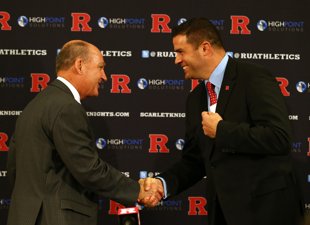
The reason I bring this up is because the news has come out that the Big Ten is inviting both Maryland and Rutgers into their prestigious conference. The invitation obviously benefits these two universities, but how does it benefit the Big Ten? More is not always “more,” as in better. It’s not as if the Big Ten is adding Notre Dame and Texas, in which there would be more great TV games and home games.
The benefits for Maryland and Rutgers are obvious. Neither teams are making much money with their athletics programs (least of all Rutgers), not with the relatively lousy television deals they currently have. By joining the Big 10, that problem instantly vanishes, since that conference has one of the best TV deals in the business. It is not rocket science to figure out why a poor guy wants to marry into a rich family.
Moreover, while those two teams’ conference fit is a geographic stretch, academically it somewhat makes sense. Like almost all other conference members, Maryland and Rutgers are both members of the Association of American Universities, for what that is worth (oddly enough, Nebraska is the only B1G member not yet in that affiliation). Adding these two schools could further enhance the conference’s already solid academic reputation.
But aside from that, how does the Big Ten benefit? From a fan’s perspective alone, this could border on havoc. Think of the traveling distance. Many Big Ten fans travel by the busload to some away games. A band of Nebraska fans traveling to Piscataway, N.J. to see their beloved Cornhuskers play Rutgers would literally be journeying halfway across the country. That’s a huge difference from a more typical conference matchup in which some Wisconsin fans would have but a [roughly] three-hour run to Iowa City to cheer on their Badgers against the Hawkeyes.
Moreover, think of home game schedules for a moment. So few great home games are available year in and year out. Think about how many season ticket-holding fans have to put up with lousy match-ups at home. Wisconsin playing Cal Poly or Ohio State playing Youngstown State at home might be easy wins, but they are horrible games for the fans. Ditto with the Buckeyes playing the Blazers of UAB; yuck! Fans of B1G teams wait patiently from great match-ups, such as the Buckeyes coming in to Camp Randall Stadium in Madison for a night game, or Michigan State coming into Northwestern for a close, hard-fought match-up.
With Rutgers and Maryland now in the mix, those great regional rivalries that fans hunger for are now further in jeopardy in place of a potentially mediocre match-up with these mediocre teams. Again, what has the Big Ten, on balance, to gain from this? The Terrapins’ affiliation with the conference will not make the program improve.
It also messes with traditional rivalries. The Terps have nothing to do with the Spartans, Buckeyes or Badgers. Their rivals are Virginia, North Carolina, etc., all in the Atlantic Coast Conference. Leaving the ACC for the B1G means all those rivalries instantly vanish.
Ah, but adding Rutgers and Maryland into the conference means that the Big 10 can tap into the New York City and Washington, D.C. markets, say the expansion advocates. But people in those markets don’t care about either team, so says Nate Silver, who has a great piece that voices that same concerns written on this page. Silver’s analysis shows that there are low percentages of college football fans in those two large metro areas. Why compromise teams’ schedules for such a diminishing return?
The bottom line is that the Big Ten, arguably most prestigious athletic conference overall in college athletics (notwithstanding football alone, in which the SEC is, at this time, head and shoulders above everyone else), is running a serious risk of diluting their brand.
If you want further proof of this real possibility of brand dilution, look no further than the Pac-12 to see how this move makes no sense. Any benefit of adding Utah and Colorado is marginal at best. The Utes have been mediocre this year, and the Buffaloes have been an outright embarrassment, as they are arguably the worst team in the FBS (see: “Dang, they’re bad,” see: “Can the season end?”). Yes, the Pac-12 has some great teams right now: six of its member teams are, as of his week, ranked in the top 25. But Utah is not among those who are ranked, and, as already mentioned, Colorado is embarrassingly abysmal.
At least when the SEC expanded, it brought in Missouri and Texas A&M; two quality programs. Maryland and Rutgers just dilute the brand, and further weaken an already teetering Big East. Big Ten Commissioner Jim Delany may think that bringing these two teams in will allow for it to reach certain key “demographics,” but not only does Nate Silver show that those demos are not as inviting as they would initially appear, Dan Wetzel of Rivals/Yahoo! points out similar problems. Delany and the rest of the conference leadership need to snap out of this trance before they make a horrible mistake that will ruin the brand.
Kansas State: Shades of 1998 November 18, 2012
Posted by intellectualgridiron in Sports.Tags: 1998, Alabama, Alamo Bowl, AP Poll, Austin, B1G, BCS, Big 12, Big Ten, Big XII, Bill Snyder, Boilermakers, Boilers, Bowl, bowl game, championship, Chicago, Chris Daniels, Cincinnati, Cleveland, Coaches Poll, Columbus, Dallas, Drew Brees, Fiesta Bowl, football, Houston, Jayhawks, K-State, Kansas, Kansas City, Kansas State, Manhattan, Marriott, Missouri, national championship, NCAA, Nebraska, New York, Notre Dame, Ohio State, Orange, Pittsburgh, Purdue, Rose, San Antonio, Sugar, Texas, Texas A&M, Tigers, West Virginia, Wildcats
add a comment
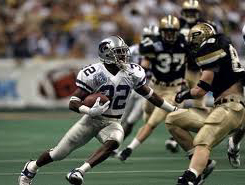 We’ve seen this before. This is not the first time that Kansas State’s national championship run was ruined late in the season. The Wildcats made a similar run in 1998, defeating powerful Nebraska for the first time in 30 years, among other things. But come the Big XII championship game of that year, K-State overlooked a hungry Texas A&M, who snuck up on them and overtook them towards the end of the game. Although that bumped the Wildcats down to only no. 4 in the rankings, it was too late to get a decent consolation prize.
Everyone seemed to assume that K-State was a lock on the Fiesta Bowl (where the BCS national championship was to be held), so other teams got “locked-in” to other BCS bowl games (Orange, Sugar and Rose). With the Wildcats’ unexpected loss, they were left out in the proverbial cold, having to settle for the Alamo Bowl, then given the no. 4 pick for both the Big XII and the Big Ten. One would imagine that they would not be too happy with having to settle for that lesser prize. Purdue, their opponent for the 1998 Alamo Bowl, was, conversely, quite happy to make a return appearance in San Antonio (a fun town for a bowl game, fyi.), having won that bowl game the previous year. Though the Boilers were unranked and Kansas State was still the fourth-highest ranked team in the land, Purdue came in, what made the difference was that Purdue was happy to be there for the Dec. 29 game, K-State not so much.
Despite Coach Bill Snyder’s moderately happy-sounding speech at the kickoff luncheon the day before the game (Dec. 28, 1998) in a convention room of the Marriott Hotel in downtown San Antonio, where he assured both the Wildcat and Boilermaker fans in attendance that “we’re very much looking forward to playing the University of Purdue,” they sure did not give that impression on the field of play in the Alamodome the next evening. After a scoreless first quarter, Purdue drew (if you’ll pardon the expression) first blood in the second with a Drew Brees touchdown pass to Chris Daniels, and we never let up for the rest of the game. Only in the last few minutes did K-State manage to inch ahead of us with a touchdown of their own, but Purdue answered on the very next possession, marching right down the field and put it away for good. The Wildcats did have the last possession of the game, but with only less than a minute or so left in the game, they were unable to muster the necessary score. We triumphed in the end, 37-34. It was our biggest win in probably 20 years.
I say “we” because I was but a freshman student manager on the Purdue team during that game, witnessing all of this first-hand. The point in all of this, given recent developments, is that we’ve seen this scenario with K-State play out before. The Wildcats seem to be on the same path today. The only saving grace for K-State today is that this sudden, season-derailing loss from last night came earlier than when the Big XII championship game would be (there is no such game for this season, given the recent changes in conference membership). Hence, there is still time to salvage things with earning a more prestigious bowl berth than the booby prize of the Alamo Bowl from 14 years ago.
Yet another reason for K-State getting, well, hosed that year is a manifestation of certain perpetual handicaps against the program. Unlike traditional powers including, say, Alabama, Ohio State, Texas, or even Notre Dame, all of whom have strong, national fan bases, Kansas State, although a strong program, lacks that advantage. Strong fan bases equal strong money and clout, something the Wildcats continue to lack. Kansas State University is located in Manhattan, Kan., nicknamed “The Little Apple.” It is in the middle of nowhere, in a state that has the same reputation. It has no major market to tie itself to, unlike the Longhorns, who can not only claim Austin, but also Dallas and Houston. The Buckeyes claim Columbus, as well as Cincinnati and Cleveland. Even Notre Dame can claim Chicago, and to an extent, New York itself. K-State lacks that major market anchor, and that goes a long way towards its overall lack of relative clout. Even a team like West Virginia can claim Pittsburgh as its anchor market. Claiming Kansas City is a stretch for KSU, who must also share the area with the Kansas Jayhawks, along with the Missouri Tigers. Does that leave KSU Wichita? Geography has conspired to make the lack of clout an unsolvable problem for the Wildcats, as far as one can foresee.
But another key difference in scenarios today is that, in the wake of K-State being kicked down to the no. 4 bowl pick for the Big XII Conference in 1998 — much less the overall rankings — shortly thereafter the BCS implemented a rule that a team ranked that highly* would get an automatic berth into one of the BCS “big four,” instead of being relegated to a second or third-tier postseason game. Perhaps the Fiesta Bowl is not out of the question, boys, but you still must pass through the eye of the needle that is Texas in two weeks’ time.
*Although Kansas State was ranked no. 4 in both the AP and Coaches’ Polls, they were actually ranked no. 3 in the BCS.
 intellectualgridiron