America’s Greatest Music: Beyond The Sea, etc. December 25, 2013
Posted by intellectualgridiron in Pop Culture.Tags: album, America's, As In A Morning Sunrise, Atco, Atlantic, Berthold Brecht, Beyond the Sea, big band, Bobby Darin, Charles Trenet, Christmas Eve, Greatest, I'll Remember April, La Mer, Louis Armstrong, Mack the Knife, music, Queen of the Hop, Richard Weiss, Softly, Splish Splash, That's All, Threepenny Opera
add a comment
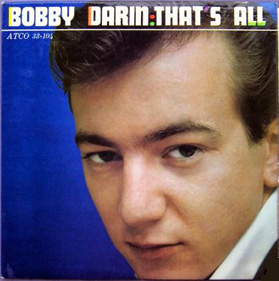 The past five days mark of the 55th Anniversary of some of the best records made over that span of time. Starting on Dec. 19 1958, Bobby Darin and the in-house orchestra at Atco Records (a pop subsidiary label of Atlantic), conducted by Richard Weiss, cut the tracks for the album that arguably would define his career: “That’s All.”
By this time, Darin had already established himself in the teen market with hits such as “Splish Splash” (1957) and “Queen of the Hop” (1958) and “Dream Lover” (1959), but everyone thought he was crazy when we wanted to cut an album for the adult market. Nevertheless, the Atco executives green-lit the project, and in late December of ’58, these key tracks were cut, starting with what would become the biggest record of 1959, “Mack the Knife.”
Recorded on Dec. 19, 1958, this song was written by Bertholt Brecht for his famous “Threepenny Opera” (little known fact: it was originally written in German) 30 years earlier, and Louis Armstrong had already given a bit of new life to the song with a hit of it in 1956. But no matter who came before or later (Dean Martin did a live performance of it in ’59), Darin clearly owns the song with this definitive version, which remains an all-time classic to this day.
That same recording date, Darin also cut “That’s the Way Love Is,” which is also a fine record, and one that does an excellent job of nailing the feeling one feels when a guy has that one special woman in his life and how strangely all that works.
In between this aforementioned span of time, he also cut two other dynamite records, both being strong, jazzy versions of the standards “Softly, As In A Morning Sunrise,” and “I’ll Remember April,” which are great for getting you up in the morning.
But the session was capped off with another definite pop record of the 1950s, and of Darin ‘s career: “Beyond the Sea.” The song was first recorded as “La Mer” by Charles Trenet in 1946, but Darin sang it to the English lyrics we all know and love today. If ever somebody dear to you has been situated overseas, this song is the ultimate morale-booster, and it was recorded on Christmas Eve of 1958, 55 years ago today.
Oh, and the title cut was, ironically, the last track on this album: it’s arrangement is, er, rather unique compared to the more traditional arrangements of this particular standard.
America’s Greatest Music: The Diamond Anniversary of two Artie Shaw Classics November 18, 2013
Posted by intellectualgridiron in Pop Culture.Tags: 75th, anniversary, Artie Shaw, As In A Morning Sunrise, Between a Kiss and a Sigh, Cole Porter, Copenhagen, Deep in a Dream, diamond, Helen Forrest, Ira Gershwin, Oscar Hammerstein II, RCA Bluebird, Softly
add a comment
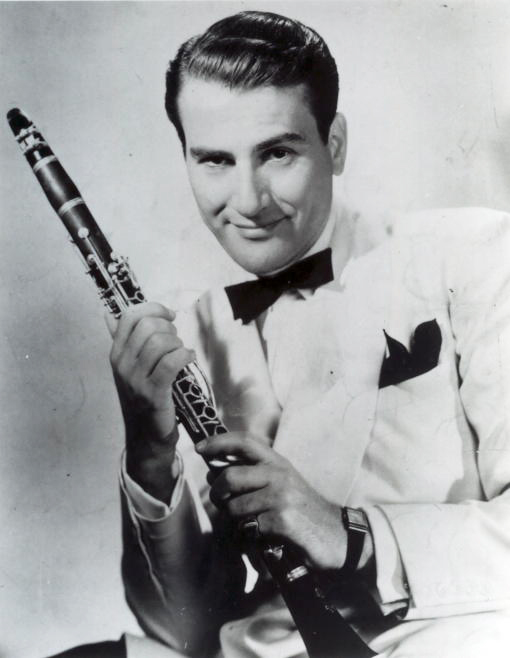
The legendary Artie Shaw and his band recorded two songs 75 years ago today that personified why he was one of the best of the best of that era or of any era.
Seventy-five years ago today, the great Artie Shaw recorded two of his greatest records. No, not the greatest of them all, which of course is his venerable, timeless, “Begin the Beguine”, but these two are quite close to the top.
One of which is “Between A Kiss And A Sigh”,
While the other is “Deep In A Dream”. Both feature the superb lyrics of a young Helen Forrest, who made her major league debut with Shaw’s band before moving on to Benny Goodman at the beginning of 1940.
Both recordings are wonderful in that they personify the difficult combination of music that exudes smoothness while at the same time maintaining a good, bouncy tempo. These two tunes give the sensation of being in a high-brow Art Deco nightclub in the late 1930s, which is always the ideal of where one wants to be for a night on the town!
As far as the lyrics go, they are relatively simple compared to the unmatched eloquence of something penned by, say, Cole Porter or Ira Gershwin. This particularly pertains to the former song, though the latter is not devoid of vivid lyrics. One example:
“The smoke makes a stairway for you to descend: You come to my arms; my this bliss never end!”
What this shows is that even songs that would by themselves not make the cut for the Great American Songbook are still timeless when given the right kind of arrangement and are paired with the right performer. Obviously this is the case with both of these records. But what is also shows is that even if their lyrics cannot match the poignance of Gershwin’s “They Can’t Take That Away From Me” or the vivid metaphors of Porter’s “You’re the Top,” they nevertheless are well-written enough to remind us yet again that when it came to writing songs and making music in general, these tunes were from a time when there was an embarrassments of riches — of great lyrics!
And on top of that, they’re just great records.
But wait, there’s more! In addition to the two aforementioned hits, he recorded a few others on Nov. 17 , 1938 as well, such as his version of “Softly, As In A Morning Sunrise,” the lyrics of which were written by none other than Oscar Hammerstein II in 1928. But in typical Artie Shaw fashion, he scrapped the lyrics this time and concentrated on the music itself.
Disclaimer: Artie Shaw recorded on RCA Bluebird. What they show in the video is a mid-1950s Mercury label. Why, I don’t know. Furthermore, all of these tunes would have been cut and pressed on 78 RPM records, not 45’s, which were not introduced until 1949.
But I digress. The band also recorded one of their versions of “Copenhagen” during this same session.
If that’s not enough, Artie Shaw and his band also cut a nice ditty in “Thanks For Everything”, surely a sentiment we love to share with friends, loved ones, and significant others alike. Naturally, Helen Forrest’s vocals add just the right tough to this track.
America’s Greatest Music: The Man/Gal That Got Away November 14, 2013
Posted by intellectualgridiron in Pop Culture.Tags: A Star Is Born, album, Capitol Records, Frank Sinatra, golden age, Harold Arlen, In The Wee Small Hours of the Morning, Ira Gershwin, Judy Garland, Silver Age, The Gal That Got Away, The Man That Got Away, This Is Sinatra
1 comment so far
This tune is something of a break from most American pop standards spotlighted within this series of blog entries in that it is not from the Golden Age of the Great American Songbook (ca. 1920-1945). Nevertheless, it quickly merited a place in the aforementioned Songbook because of its eloquent lyrics that easily compare to those of said Golden Age. The viewing public first heard this from the hit 1954 film “A Star Is Born,” and was broken by none other than Judy Garland. The fact that is was written by Harold Arlen (music) and Ira Gershwin (lyrics) certainly does not hurt, and indeed, accredits the song all the more (they being two songwriting veterans whose penmanship contributed plenty to America’s Greatest Music)!
What is interesting is that the title must be slightly modified depending on whether the person that is singing this is male for female. When Judy Garland broke the tune, the title was “The Man That Got Away”. Not so with Frank Sinatra, who recorded his own version on the Capitol label shortly after the song became a hit off the silver screen. It could not have been recorded any later than 1955, for that was the year that the album “This is Sinatra” was released. Interesting side-note: “This is Sinatra” was no concept album, unlike his “In The Wee Small Hours Of The Morning” album from the previous year. “This is…” was merely a compilation of hit singles he had over 1953 and ’54, not that such a distinction should detract from the collection of masterworks found in one album!
For my money, Sinatra’s version is the definitive one, though that ought not to detract from Judy Garland’s heartfelt rendition. Whichever your preference may be, few songs better personify the feeling one experiences when the person-of-the-opposite-sex that they thought was “The One” for them has gotten away from them. That alone should be reason enough why this song belongs in the Great American Songbook, Silver Age or no.
America’s Greatest Music: I’ve Got Beginners Luck October 30, 2013
Posted by intellectualgridiron in Pop Culture.Tags: 1937, 1959, America's, classic, Ella Fitzgerald, Fred Astaire, George, Gershwin, gold, Great American Songbook, Greatest, I've Got Beginner's Luck, Ira, music, Shall We Dance, They Can't Take That Away From Me, tin pan alley
add a comment
When deciding on a particular tune to highlight for a blog entry, that decision becomes a particularly keen challenge when trying to decide among tunes that Fred Astaire broke to the public. After all, the tunes that broke out thanks to Fred Astaire’s rendition of them on the silver screen make up a list of upper-echelon legends within the already-hallowed Great American Songbook itself. One such ditty is the George and Ira Gershwin classic “I’ve Got Beginner’s Luck.” Pretty much anything the Gershwin Brothers wrote together was solid gold — some a greater degree of karats than others to be sure — and while this might be, say, 16 karat gold compared to the full 24 karats of “They Can’t Take That Away From Me” or even “Shall We Dance,” it’s a classic among classics nonetheless.
Moreover, can one think of a better tune that encapsulates the lucky feeling that a fellow experiences when happening on that special lady for the first time? Or vice-versa, for that matter? The shame of things is such that, as great as the song as it is, it has been under-performed by recording luminaries over the years, particularly when compared to other Great American Songbook favorites. Ella Fitzgerald did a version of it in 1959, and that is the only non-Astaire example of performance than comes to mind for this particular tune, and more the pity.
Nevertheless, the lyrics have that perfect eloquence that match with other Tin Pan Alley legends, as Fred Astaire himself demonstrated in the great 1937 musical “Shall We Dance.” “…There never was such a smile or such eyes of blue!” Enough said!
America’s Greatest Music – It’s De-Lovely October 25, 2013
Posted by intellectualgridiron in Pop Culture.Tags: 1936, 1956, Anything Goes, Bob Hope, Cole Porter, Eddy Duchin, Ella Fitzgerald, Ethel Merman, Great American, I Get a Kick out of You, I've Got You, It's De-Lovely, Night and Day, Red Hot and Blue, Shep Fields, Songbook, swing era, Under My Skin, Vincent Lopez
add a comment
“It’s delightful, it’s delicious, it’s de-lovely…” Those are some of the most famous lyrics within the body of work of Cole Porter, the last two of which being the title of the in question. Given that it is one of Porter’s most recognizable songs (save for “Night and Day,” “I’ve Got You Under My Skin”, “Anything Goes,” “I Get A Kick Out Of You”, and several others), it merits a very prominent place in the Great American Songbook.
Here’s the catch, though; despite it being a great song, few of us can think of lots of notable recorded renditions of it. Sure, a number of second-tier bands had moderate hits with it in the mid-1930s, but that will not turn lots of heads of music listeners who are not passionate and/or academic about the Swing Era.
The song originated when Cole Porter wrote it in 1936 for the show “Red Hot and Blue.” On the big screen, it was introduced to the masses by Ethel Merman and Bob Hope. Indeed, Merman would record a studio version of the song, which can be heard below. Note that the approach she takes to the song is one that would highlight the potential silliness/gayety of the situation described.
As mentioned earlier, several second-tier bands promptly recorded their respective renditions of the song, including Eddy Duchin, Shep Fields, and Vincent Lopez, whose 1936 version can be heard below:
But one version easily stands out over all, and that is Ella Fitzgerald’s take on the tune from 1956 (which would be the same time of decade when she would tackle the “Cole Porter Songbook” and leave many wonderful records for posterity in so doing). Frankly, nothing compares to this rendition.
Notice, in contrast to Ethel Merman’s approach from 20 years earlier, Ella puts all kidding aside and focuses on the shear passion that this tune can excite, what with being with the right gal (or guy) at the right time, along with the ensuing opportunity to create a magical evening.
America’s Greatest Music: It’s All In The Game October 7, 2013
Posted by intellectualgridiron in Pop Culture.Tags: 1, 1951, 1958, ballad, Calvin Coolidge, Charles Dawes, Dick Chaney, hit song, It's All in the Game, Joe Biden, MGM, Nat "King" Cole, No. 1, records, stereo, Tommy Edwards, vice president
add a comment
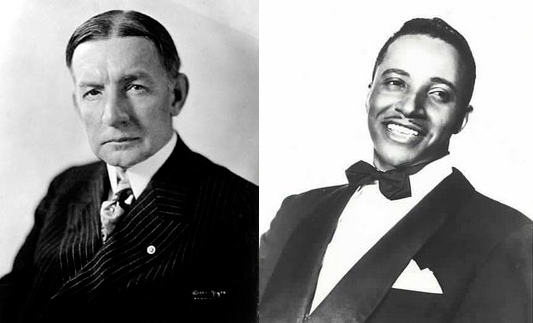
What do these two have in common? On the left is Charles Dawes, who wrote a melody that would, four decades later, become a hit song on two occasions by the same artist, Tommy Edwards, on the right.
In the year 1912, a fellow named Charles G. Dawes penned the melody to a song that would become a decent pop hit 39 years later, and a smash hit 46 years later. Dawes, then 47, would be more famous (okay, not that much more famous) for becoming the 30th Vice President of the United States, second-in-command under the taciturn yet highly effective Calvin Coolidge. But the melody that he wrote eventually was put to lyrics, and the song became “It’s All In The Game.” Unless either Dick Chaney or Joe Biden writes a No. 1 hit for Justin Timberlake, Dawes will hold the record for being the only V-POTUS that also wrote a No. 1 song in any era (the Rock Era, in this case).
Tommy Edwards first recorded a version of the song in 1951, and to the trained ear, it is very reminiscent of a Nat King Cole ballad. Below is that original version:
Seven years later, he breathed new life into the song at a time when his recording career seemed on the wane. But stereo recording was just coming into vogue in 1958. This development provided the right opportunity for the folks at MGM Records to dust off some of Edwards’ old reportoire, and take this older song, and update it to a rock ‘n’ roll ballad. If there any doubts about the new, youthful music aspect, the piano triplets should assuage them! But regardless, the result was pure magic; not only was it a No. 1 hit (55 years ago this week, to be exact), it remains a timelessly endearing love song, and indeed, one of the best records ever produced of any era. Hear for yourself, preferably with a significant other, if they are handy!
America’s Greatest Music: Artie Shaw’s “Non-Stop Flight” and others September 27, 2013
Posted by intellectualgridiron in Pop Culture.Tags: America, American, Artie Shaw, Begin the Beguine, Benny Goodman, Clark Gable, Cole Porter, diamond anniversary, Gowns for Roberta, Great, Greatest, Helen Forrest, Howard Hughes, I Have Eyes, Jerome Kern, lindy hopper, Martin Scorsese, music, Night and Day, Nightmare, Non-Stop Flight, Smoke Gets In Your Eyes, Songbook, The Aviator, What Is This Thing Called Love?, You're a Sweet Little Headache
4 comments
As I stated in my previous AGM entry, there are those occasional recording sessions in history where not just one legendary record is cut, but a whole plethora. Today (Sept. 27) marks the Diamond Anniversary (that’s 75 years, for those of you who are graduates of Indiana University — or the University of Kentucky, for that matter) of one such session undertaken by Artie Shaw and his orchestra. On Sept. 27, he and his band cut, for one, “Nightmare”, a haunting tune which he used, oddly enough, to open all of his live gigs.
But that is not the half of it. In addition to “Nightmare” (also used frequently throughout the Martin Scorsese biopic “The Aviator” about Howard Hughes), Artie Shaw also cut the definitive rendition of “Non-Stop Flight,” a popular staple with Lindy Hoppers to this very day!
Things did not stop there, for Artie Shaw and his band also recorded the Jerome Kern hit “Yesterdays” from his musical “Gowns for Roberta” (the same musical in which Kern also wrote the legendary song “Smoke Gets in Your Eyes”), and thus we have the triple-whammy of one of the greatest of all songwriters writing a song that belongs in — or at least near — the upper echelons of the Great American Songbook, and the record is performed by one of the greatest legends in American Popular Music in Artie Shaw. The quality of music does live up to the billing, too!
Next up we have “What Is This Thing Called Love?” Much like the aforementioned “Yesterdays”, it too is the same sort of “triple-whammy,” except this time it was penned by Cole Porter, not Jerome Kern. Artie Shaw had an incredible knack for scrapping the wonderful lyrics of Cole Porter tunes and rendering them as instrumentals, yet somehow still doing the songs considerable justice (e.g., “Night and Day,” “Begin the Beguine,” “What Is This Thing Called Love?”, just to name a few). No wonder that when Porter finally met Shaw face-to-face in the late 1930s, the first thing he said to the King of the Clarinet was “[H]appy to meet my collaborator”!
For the last two tracks, Shaw brought in Helen Forrest on the vocals to sing a nice little ditty already featured in this blog, “You’re a Sweet Little Headache”. Part of that song can be heard in a scene in the very-underrated 1991 film “The Rocketeer”.
The other tune for which Helen Forrest sang was “I Have Eyes”. Much like the previously-mentioned tune, Benny Goodman recorded it around the same time, during the same year, and Martha Tilton provided the vocals for both. It therefore makes for a fun time for vintage music devotees to compare and contrast the respective merits of both songs and their counterpart recordings!
The Goodman version can be heard below for reference:
While I personally prefer the sound of the reed section in the Goodman rendition, overall I prefer the Artie Shaw version, for its sound is smoother, Shaw’s clarinet is more melodious, Helen Forrest’s vocals “click” a bit more effectively with that tune than Tilton’s for the same song, and the tempo on the Shaw record is much bouncier. Moreover, I say all of this as a Goodman fan! Such is miraculous effect that Artie Shaw had on key records, so relatively many of which were produced 75 years ago today.
Why are all these Artie Shaw records such a big deal? A huge chunk of that answer lies in the fact that he left an indelible impression on our cultural landscape. To wit, as Mark Steyn pointed out in his fantastic obituary piece on Shaw over nine years ago:
“On the eve of World War II, Time reported that to Germans America meant ‘skyscrapers, Clark Gable and Artie Shaw.'”
America’s Greatest Music: A love song “twofer” from 75 years ago today. September 15, 2013
Posted by intellectualgridiron in Pop Culture.Tags: 1938, 75, Al Bowlly, Artie Shaw, Babe Russin, Begin the Beguine, Benny Goodman, Billie Holiday, Cadillac, Casablanca, Claude Thornhill, Columbia, Cozy Cole, diamond anniversary, Dinah Shore, Dinah Washington, Doris Day, Ella Fitzgerald, Forever Young, Frank Sinatra, Haven Gillespie, J. Fred Coots, Lena Horne, Louis Armstrong, Marie, Marlene Dietrich, Martha Tilton, Mel Gibson, Nan Wynn, Nat "King" Cole, Packard, Patti Page, Paul McCartney, Peggy Lee, Ray Noble, RCA Bluebird, Rick's Cafe Americain, Sarah Vaughn, Sid Ascher, Teddy Wilson, The Very Thought of You, Tommy Dorsey, Tony Bennett, Vaughn Monroe, Vocalion, You Go To My Head
add a comment

A 1938 Cadillac is shown on the right and a 1935 Packard (similar to a 1938 model) is shown on the right. This image montage is included for visual reference to some of the text below. Photos by the author.
Sometimes certain recording sessions prove to be particularly fecund, if not downright one for the ages. That was especially the case, for example, when Artie Shaw and his band cut the legendary record “Begin the Beguine,” in addition to other greats such as “Any Old Time,” “Back Bay Shuffle,” “Yesterdays,” and so on, all on July 24, 1938 for RCA Bluebird. It happens that way in recording sessions, sometimes: things just happen to click, and one great record after another is put to acetate for all of posterity to appreciate.
Such turned out not to be the case with the recording session the Billie Holiday undertook 75 years ago today (Sept. 15) for the Vocalion label (a Columbia subsidiary at the time), this being contrary to that which I wrote in this very article earlier. I apologize for misleading the readers, as I did get my discography information incorrect, which led to the inaccurate info. Nevertheless, these are two incredible, timeless records that were produced in 1938, and both just so happened to be the [arguably] definitive versions of two songs that definitely belong in the Great American Songbook.
One is “You Go to My Head.” Written by the relatively obscure duo of J. Fred Coots and Haven Gillespie — interestingly, the same pair that wrote “Santa Claus is Coming to Town”; seriously! — the song itself has been recorded by numerous artists and has become a venerable pop/jazz standard over the course of three-quarters of a century. Nan Wynn and Teddy Wilson (on piano, naturally) took a stab at the song the same year Lady Day cut her version. Marlene Dietrich recorded a version the following year, and in the years since then, luminaries including Frank Sinatra (1946 and 1960), Lena Horne, Doris Day (1949), Charlie Barnett, Bing Crosby, Peggy Lee, Sarah Vaughn, Tony Bennett, Dinah Washington (1954), Dinah Shore, Patti Page (1956), Louis Armstrong (1957), Ella Fitzgerald (of course; 1960), and many others all have a version under their respective, figurative belts.
An outstanding yet relatively obscure version was done live in 1938 by Benny Goodman and his band during a Camel Caravan radio broadcast from Chicago, with Martha Tilton on vocals. Goodman’s sound and ‘take’ on the tune certainly did it justice, as is the case with most Goodman records. But the one that stands out above all is Billie Holiday’s version from that same year (she actually cut this track on May 11, 1938, not Sept. 15, as originally posted).
How could it not? The very first thing the listener hears — and never forgets it when he/she does for the first time — is a fantastic opening tenor sax solo by Babe Russin (a member of Goodman’s band at the time, though the year prior capped off the legendary Tommy Dorsey record “Marie” with another great solo!) that simply oozes Art Deco imagery in the listener’s mind. For best effect, try hearing the record while beholding the styling craftsmanship of, say, a 1938 Cadillac or Packard! Claude Thornhill on piano and Cozy Cole on the drums make for a nice touch, too.
But that’s just the beginning. Holiday’s expressiveness was practically tailor-made for the lyrics, and how they so accurately personify the incredible sensations one experiences of adoring “the one”, the potential significant other, despite how diligently the rational side of our minds tries to remind us of key apprehensions. Hear for yourself!
On a related note is another love song, one just as timeless, and that being “The Very Thought of You.” (And this was recorded on Sept. 15, 1938!) The lyrics focus more so on the pure adoration aspect regarding the feelings one has for a significant other, and how “the one” tends to become the center of one’s focus.
Sid Ascher — later the manager of Tony Bennett — wrote the song in 1934, and sold the rights to the great British bandleader Ray Noble, who cut a fine version of it that year with Al Bowlly providing the vocals. Bing Crosby himself did his own version that same year. Vaughn Monroe recorded his rendition a decade later, and the inclined movie connoisseur can hear a band-accompanied piano instrumental of the song during a scene inside Rick’s Cafe Americain in the 1942 hit film “Casablanca.” Doris Day later sang a version of the song for the 1950 film “Young Man with a Horn.” Ella Fitzgerald, Frank Sinatra, and Nat “King” Cole all have their respective versions (the latter of which is particularly lovely), and Paul McCartney and Tony Bennett recorded a duet of it together.
But as is the case with the previously-examined song, Billie Holiday’s version stands out above the others.
A rather modern, repeated reference to this record can be heard throughout the 1992 film “Forever Young” with Mel Gibson; the song being used as something of a constant, a source of continuity, a bridge to two very different eras and how certain things were meant to stand the test of time, much like the song itself.
 intellectualgridiron