Whither the conferences in major college football? September 8, 2011
Posted by intellectualgridiron in Sports.Tags: ACC, Big 8, Big East, Big Ten, Big XII, Colorado, conferences, football, Jupiter, Miami, NCAA, Nebraska, Oklahoma, Oklahoma State, SEC, solar system, Southeastern Conference, static, SWC, Texas, Texas A&M, Virginia Tech
2 comments
When I teach my course in American government at my community college in Louisville, one thing I have taken to doing early in the course’s term is to hand out a sheet to each student with a list of important rules in physics/economics. My rationale for this is to get the students thinking about the potential consequences of certain actions on the part of government. One such rule I lay out for them is thus: “Nothing is static.” Just try to disprove that rule. After all, nothing is static in the economy, nothing is static in our own interpersonal relationships, the climate is certainly not static — regardless of what the enviro-socialists want us to think — and indeed, nothing is static in the Solar system, not with variations in solar radiation output that have implications for the temperatures on this planet as well as for Mars and the Gallilean satellites around Jupiter.
The recent announcement that Texas A&M will depart the Big XII Conference for the Southeastern Conference come June of next year has reminded me of this rule once again. Though this is not the first move of a D-1A (pardon me, Football Bowl Subdivision) school to shake things up a bit regarding conference affilition, this one move could open the floodgates for radical conference realignment, the likes of which none of us have seen in our lifetime.
Most moves up to this point seemed fairly self-contained. When the Southwest Conference folded after 1995, the top four teams in that conference joined the Big 8, thus giving birth to the Big XII. The other four teams disbersed, many initially ending up in Conference USA, which banded together lots of erstwhile mid-majors and independents. The arrangement within the Big XII was one that on paper made geographic sense, at least longitudinally (much like the erstwhile Pac-10), with Nebraska the anchoring power in the north, and Texas the anchoring power in the south. Furthermore, should Texas have a down year, Oklahoma was eventually strong enough to fill that power gap on the southern end.
The switch-ups we witnessed earlier last decade did not seem to portend major realignment, either. The only thing that Miami, Virginia Tech, and Boston College bolting from the Big East to the Atlantic Coast Conference amounted to was to question whether or not the former still deserved to have a berth in the BCS bowl games.
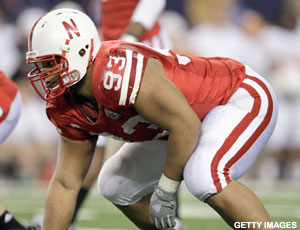 All that was put in jeopardy with Nebraska bolting for the Big Ten after last season. Less consequential was Colorado moving to join the Pac-10, now the Pac-12. As things currently stand, the Big Ten now has 12 teams, and the Big XII has been reduced to nine, or at least will be with the Aggies’ imminent departure. This current state of affairs raises two simultaneous possibilities. For one, many thought that even though the Cornhuskers left for the Big Ten, the Big XII could still limp on, possibly even bring in new up-and-coming teams to fill the void left by the Huskers and the Buffaloes. With A&M soon to leave, the death knell for the Big XII has been all but sounded. Even though, at this moment, Oklahoma and Texas both remain, and Oklahoma State would add increasing credibility, given their up-and-coming status (thank you, T. Boone Pickens), the gradual disintegration of the conference, first at the northern end and now at the southern end leaves many to conclude that more dominos shall inevitably fall.
 One such departure has already pushed Southeastern Conference membership to a future number of 13. Further speculation has been fueled as to whom else the SEC might court. Already, conferences such as the Pac-12 have been making major overtures for the Sooners and the Cowboys to join them. The Longhorns are an even more juicy target for conferences as well, though UT, what with its special brand and its own sports channel in the newly-created Longhorn Network, has the prestige, winning tradition, not to mention geographic advantages to be successful as an independent. Indeed, what we may be witnessing is Texas becoming the Notre Dame of the 21st Century in terms of athletic prestige, winning tradition, privileged status, and ability to attract top recruits.
But, in returning to the point of the SEC’s burgeoning membership, 13 could be a magic number, magic in the sense that it creates the possibly for that number to grow further, not just for the southeastern juggernaut power, but for conferences elsewhere. As mentioned earlier, the possibility persists that Oklahoma and Oklahoma State could end up in the Pac-12, bumping their lucky number up to fourteen. Moreover, it is not inconceivable that Texas could join that new mega-conference as well. USC plus the Sooners plus the Longhorns equals one formidable conference indeed. Iowa State could end up following suit in a different sense by joining the Big Ten (Nebraska is already there, and in-state rival Iowa has been a long-time member). Geographically, that theoretical move is quite logical. Where Kansas, Kansas State, Baylor, Missouri and Texas Tech might end up — again, should the dominoes continue to fall — is anybody’s guess, though the Mizzou Tigers might end up joining the Big Ten as well. That possibility has been broached several times before, in fact. My only reservation against that is, can one conference abide three different teams whose colors are (officially) Old Gold & Black?
While there could be a scramble for a would-be disintegrated Big XII’s table scraps, the Southeastern Conference might try to bring in other powers to join their juggernaut league (Florida State and Virginia Tech have been listed as possibilities). Might such a conference cannibalization prompt the ACC and the Big East to join forces? Given that Texas A&M has turned its back on its long-time rivals and all-too willingly allowed itself to be used by the SEC, perhaps all of us ought to rethink what is possible.
The bottom line in all of these prognostications is that we could be witnessing a radical realignment of teams into mega-conferences, which in turn will have major implications for bowl game affiliations, and even coveted BCS eligibility. If the Sooners and Cowboys end up joining the Pac-12 and that move makes no sense to many on a geographic level, just keep in mind that Texas Christian University — the recent Rose Bowl champs — are about to join the Big East. The new paradigm is that geography is hardly a constraint anymore when it comes to conference affiliation, and it’s all part of the brave new world of NCAA football realignment about to happen before our eyes. What we fans and observers of big-time college football thought were secure affiliations over the past 15 years have turned out to be anything but. Once again, the firm rule about nothing being static has held.
The Aggies to the SEC? September 5, 2011
Posted by intellectualgridiron in Sports.Tags: Big 12 conference, Big XII, football, Longhorn Network, media market, SEC, Southeastern, Texas A&M
2 comments
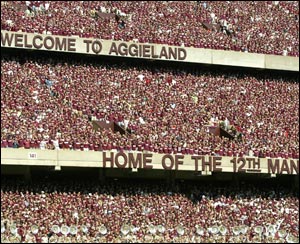 After much speculation and rumor, it is official. Texas A&M is about to leave the Big XII (minus 2) for the SEC. My overall assessment is the A&M is getting used, and seems to be alright with such an arrangement. Indeed, the overall reason for the Aggies’ seemingly hasty move to the Southeastern Conference is one that remains a mystery, including the fairly humorous and insightful sports columnist Jerome Solomon of the Houston Chronicle. Perhaps the haste in arranging this new affiliation can be attributed in large part to the Aggies’ pique at the perception that rival UT got a sweetheart deal by being allowed to establish their own television sports network. In case you’ve been living under a rock for the past year, the new, exclusive channel in question is the Longhorn Network .
To me, the SEC has more to gain from this arrangement than A&M has to gain in return. The Southeastern Conference is acting as though Texas A&M is the most wonderful of additions, and from their standpoint, why not? This move benefits the incumbent schools in the conference in that it gives those programs a much wider in-road to recruit Texas, the greatest football state in the country (indeed, on so many levels, it is the greatest state, period). On that plane of thinking, this move makes a lot of sense. Why shouldn’t one of the flagship schools of the greatest football state in the land be a part of the greatest college football conference? Furthermore, by bringing in A&M to the SEC, the conference has the golden opportunity to open up new media markets, particularly the oh-so-juicy Dallas and Houston markets. The Atlanta market is all well and good, but beyond that, the Jacksonville, Tampa-St. Pete, Birmingham and Nashville markets will only take you so far. With Dallas and Houston, the number of eyeballs you can attract to watch the games on TV — not to mention your potential advertising revenue — has been taken to a whole new level. Oh, and did I mention that more SEC teams can now recruit Texas more heavily?
All these previously noted things are great for the conference itself, but what about the newcomer? The sad state of things is that Texas A&M might very well be getting the short end of the stick. Sure, the SEC acts like they love A&M like the Aggies have never been loved before, and are being welcomed into said conference with open arms. But once the Aggies become a full-fledged member, they shall instantly take a back seat to the majority of teams. As things currently stand, A&M has the potential to compete in the upper echelon of the Big XII (again, minus two) with Texas, Oklahoma, and Oklahoma State. They might even win one of those games, maybe more. But once in the SEC, their level of talent will be below that of Arkansas, and Mississippi State is no gimme, not anymore, at least (not with Dan Mullen doing such a great job in strengthening the program). From there, the rest of the competition only gets more intense. In so many words, for the foreseeable future, A&M shall be relegated to the lower half of their new conference home.
Then there’s recruiting. Already A&M has been losing out on the most prestigious recruits to the Longhorns and the Sooners. Now they must compete for recruits with half of the SEC, possibly more. Fighting Oklahoma State, Texas, and Oklahoma for recruits is difficult enough, but this latest move has opened the floodgates for Alabama, LSU, Georgia, and a host of others to come knocking at those same recruits’ doors. Congrats, A&M: you have just made recruiting your in-state talent all the more difficult.
Given that the SEC will gain more than A&M from this arrangement when all is said and done, it looks as though the Aggies are letting themselves be used. But given how hastily A&M rushed into this conference switcheroo, it seems as though they were only too willing to allow for that. Hence the confusion on the part of many in the media.
About the Author July 18, 2011
Posted by intellectualgridiron in About the Author.Tags: About me, Aggies, Alamo Bowl, author background, autobiography, Cougars, Danny Hope, engineer, football, Houston, Joe Tiller, Kevin Sumlin, Louisville, National College, Outback Bowl, Patrick Murray, Purdue, renaissance man, Rose Bowl, Sarge, Texas A&M
add a comment

My name is Patrick Murray, though many of my friends from college know me as “Sarge”.* This website that I maintain is dedicated to the advancement of knowledge and insight, specializing in the virtues of limited government, as well as of scientific, historical, and pop cultural insights, plus the occasional sports commentary for fun.
I was born in Louisville, Ky., on March 2, 1980. I graduated from high school in Madison, Ind., where I lettered for three seasons in football and track. My undergraduate years were spent at Purdue University, where I majored in Mass Communications with a minor in History (honestly, I felt more like a science and history student masquerading as a comm student!). On the side, I took some courses in German, Latin, Entomology, Oceanography and Paleontology — in other words, fun stuff!
Outside of the classroom at Purdue, I served for three seasons as a student manager on the Purdue football team. That job allowed for me to see almost every stadium in the Big Ten (except for Iowa and Illinois), to say nothing of making some special life-long friends. I have a number of friends who play in the NFL — including Drew Brees, with whom I celebrated my 19th, 20th, and 21st birthday — and I remain an avid football fan to this day. As a manager, I worked directly under Coach Joe Tiller, and during the games, I helped out then-O-line Coach Danny Hope, who later became the current head coach from 2009 thought 2012. I also worked with Coach Kevin Sumlin, who was then the receivers coach (he played at linebacker for Purdue), before going on to give the Houston Cougars program a shot in the arm and then leading the Texas A&M Aggies to become the hot program it is today.
My services with the team also allowed for me to travel to special away games, including a season opener in Los Angeles Coliseum against USC (before the Pete Carroll era, to be sure!) in 1998, and in the Citrus Bowl against Central Florida in 1999. The three bowl games I was a small part of were the 1998 Alamo Bowl in San Antonio, the 2000 Outback Bowl in Tampa, Fla., and of course, the 2001 Rose Bowl in Pasadena, Calif. Those were memorable times.
After I graduated from Purdue, I went straight into business graduate school at the University of Louisville, where I earned my MBA. The next few years found me knocking around in the customer service sector until I just happened to find a teaching opportunity as an adjunct faculty member at the Louisville campus of National College. Finally I was able to find a job more commensurate with my education and talents. At that school, I have taught a number of different business courses, including Intro to Business, Principles of Management, Small Business Management, Operations Management, Purchasing & Materials Management, and, my favorite, Strategic Management. In addition to all of those, I have taught a number of general education courses, such as Public Speaking, Georgraphy, American History (both 1896-1945 and 1945-2000), Political Science, and American Government (needless to say, another one of my favorites to teach!). Starting in the late Spring of 2013, I have also taught computer skills courses (Microsoft Word, PowerPoint, Excel, etc.).
In more recent years, I have elected to fulfill a very latent goal of mine, and that is to become a mechanical draftsman (sometimes known as a CAD operator), if not an outright engineer. I have a design internship under my belt at a materials handling system manufacturer in Jeffersonville, Ind., and worked as a design engineer for a conveyor systems manufacturer on the southern edge of Louisville. In April of 2014, I accepted a position as an on-site project manager for a conveyor systems integrator, and have helped build sorter systems at FedEx Ground facilities in Fort Wayne, Ind., Indianapolis, New Castle, Del., Philadelphia, and Santa Fe Springs, Calif. This job has allowed for me to travel extensively and to engage in extensive learning in so doing.
Assuming that I have failed to establish my renaissance man credentials yet, it is also worth noting that I have given a couple of education seminars on insects to the docents at the Louisville Zoo — an occasion that allowed for me to show my rather extensive exotic insect collection. I also am an avid photographer (I use a Canon 7D), where I specialize in macro nature (particularly insects), aquarium fish, classic cars, and some sports. In addition, I have been a guest on a friend’s radio show on multiple occasions, discussing the Constitution and our Founding Fathers.

* The “Sarge” cognomen started back in June of 1997 — right before my senior year of high school — and was attending football camp at Purdue. The era of Coach Tiller was about to begin, and this camp gave me the opportunity to get to know all the coaches. Part of the camp’s curriculum was for the campers to coalesce into passing league teams, where we had such games for three consecutive nights, four games a night. My team’s coach was Coach Gary Emanuel, Purdue’s once and again current D-line coach. He did not know my name, but noticed I took a rather militaristic approach towards addressing my superiors (e.g., “yessir,” “no, sir.”). Such is the way I was raised. Noticing this, Coach Emanuel started calling me “Sarge,” and the name stuck. When I got on with the team as a manager, all the coaches remembered me, and soon the players too, started calling me by the same cognomen. It was only a matter of time before the cognomen in question spilled out beyond the gridiron to the greater campus.

 intellectualgridiron