Asteroid headed for Earth….sort of. November 7, 2011
Posted by intellectualgridiron in Science.Tags: asteroid, Earth, impact, Jay Melosh, moon, Purdue, science, scientist, YU55
add a comment
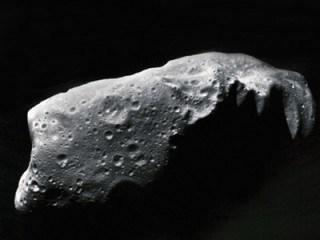 No doubt everyone can breathe a sigh of relief after reading those last two words of the headline. But it is true, sort of. An asteroid that is a quarter of a mile long — bigger than even America’s largest aircraft carrier, is headed towards the near-vicinity of Earth. Officially named YU55, its current trajectory has it flying by the third rock from the Sun on Nov. 8 at a distance of only 202,ooo miles — closer than the Moon (at only 240,000 miles away).
Scientists have been studying this asteroid long enough to be as certain as humanly possible that it will not hit Earth. If it did — Heaven forbid — though, the result would be a possible oceanic impact, with 70-foot tsunami waves 60 miles away, and causing a 7.0 earthquake that that part of the world. So says asteroid impact expert Jay Melosh of Purdue University, my alma mater.
This scenario pales in comparison to the fictional scenario from Armageddon, where that fictional asteroid was the size of Texas, and should it have crashed into the Pacific Ocean, would have caused a tidal wave to wash up to Denver, and enough dust to cloud out the Sun for an epoch. But as Melosh points out, impacts of the relative proportion of the very real YU55 happen about every 100,000 years. The comforting, silver lining in that otherwise rather disturbing thought is that such impacts are survivable, provided that you’re not within, say, 75 to 100 miles of said impact.
In the meantime, though, this close encounter with the asteroid kind gives scientists and lay astronomers alike the golden opportunity to see a huge chunk of extraterrestrial rock up close and personally. Sites for astronomy enthusiasts have been mapping where in the sky YU55 is expected to pass through. But more importantly, a prevailing theory regarding how the Earth took form involves asteroids, specifically that they were responsible for depositing water and minerals on the planet as it was cooling some two or three billion years ago. YU55’s close, though fleeting, proximity will give professional researchers the opportunity to collect telemetric data that will allow for scientists to test this theory. It also lets astronomers take a close look at the class “C” of asteroids, which are very common but not very well understood. No doubt the upcoming astronomical event could help us rectify that problem.
Relativity Theory no longer ‘settled science.’ September 23, 2011
Posted by intellectualgridiron in Science.Tags: Al Gore, As Time Goes By, CERN, discovery, Einstein, Fermilab, light speed, neutrinos, physics, science, scientist, scrutiny, settled science, speed of light, standard, sub-atomic particles, theory, Theory of Relativity
add a comment
This day and age we’re living in
Gives cause for apprehension
With speed and new inventions,
And things like Third Dimensions.
Yet, we get a trifle weary
With Mr. Einstein’s theory….
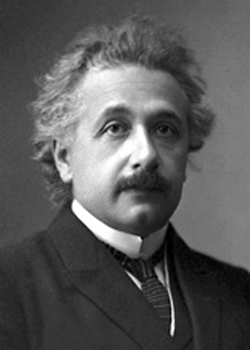 Apparently, not anymore. Albert Einstein’s famous Theory of Relativity, introduced to the world in 1905, caused us to rethink lots of things about physics. Part of the contention within that theory is that nothing can go faster than the speed of light, or 186,282 miles per second. Oh, and it was within that theory that Einstein gave us the famous equation E = mc(squared), or, Energy equals mass times the speed of light, squared. Just thinking about that alone could make one a trifle weary, as Herman Hupfield so eloquently penned 80 years ago.
Basically, it has been a pillar of the very science of physics for over a hundred years that nothing can go faster than the speed of light — Einstein’s theory helped establish that very principle. So, for a little over a century, that principle has essentially been treated as “settled science.”
All that has been turned on its proverbial head with a very recent announcement that scientists at CERN, or the European Organization for Nuclear Research (actually, it stands for “Conseil Européen pour la Recherche Nucléaire,” in case you’re keeping score at home), clocked neutrinos — odd slivers of an atom — travelling a distance of 450 miles in a time 60 nanoseconds faster than light travelling that same span. Needless to say, this announcement has turned more than a few heads in the scientific community, and has invited almost an many skeptics.
One thing that has invited scrutiny is the very nature of neutrinos themselves. As sub-atomic particles, not everything is understood about them. They have been baffling scientists for 80 years (read between those lines, and it’s downright amazing that scientists even knew about neutrinos in the early 1930s). They are nearly mass-less, and the dear reader would be well-served to keep in mind that atoms themselves are mostly empty space.
Phillip Schewe, communications director at the Joint Quantum Institute in Maryland, offered some perspective on these enigmatic particles, saying that the neutrino has almost no mass, comes in three different “flavors,” may have its own antiparticle and has been seen shifting from one flavor to another while shooting out from our sun.
To complicate things further, to say nothing about the validity of these potentially ground-shifting findings, is that different levels of energy, according to some schools of thought, can affect the speed at which neutrinos can travel. Naturally, just mentioning the term “neutrino” can cause the average reader to blink more than once, so to help create understanding about the context of these potentially game-changing scientific measurements, one can resort to Howstuffworks.com to give a rather brief explanation about neutrinos that the non-scientifically inclined can understand. Another explanation on neutrinos on the same website can be found here.
The reason I keep labeling these as “findings” and not an outright discovery is because the very scientists who took the readings are reticent to use that term. Like good, objectively-minded scientists, they actually invite the scrutiny, inviting other scientists to independently verify the data before using the vaunted ‘d’ word. Scientists at the competing Fermilab in Chicago already have announced their intention to run tests to see if the readings can be duplicated.
So have the rules of the game of physics changed? Chances are, there are about to. But seeing things in a broader context, if the idea that nothing can exceed light speed as “settled science” is on the verge of being invalidated, what else could be rendered out of date as a theory in the years to come? Former Vice President Algore has been — very un-scientifically — claiming that “global warming” has been “settled science” practically since he left the Blair House. What’s more, he has denounced anybody who denies that which he claims as tantamount to racists. Seriously. Yet the overall lesson to be learned is, if even Mr. Einstein’s theory is no longer settled science, theoretically, nothing could be. After all, as I myself noted in another recent post, nothing is static, as the science of physics has taught us time and again.
And that is fine. Unbiased science requires constant questioning, not necessarily of obvious, plain-as-day fundamentals (why waste the mental energy and everyone’s time?), but certain long-standing theories could always stand some questioning. If the theories are sufficiently valid, they shall always stand up to scrutiny. If not, they shall go the way of phrenology and alchemy. Plus, on an even brighter note, we could be that much closer to discovering the hidden key to warp speed!
As an aside, the opening poetic stanza is from the ever-famous, ever-timeless song “As Time Goes By,” written by Herman Hupfield in 1931. Rudy Vallee recorded a version of that standard that same year, and to me, it remains one of the best of the countless versions rendered by countless artists over the past eight decades. The only other version that stands above the rest is Dooley Wilson’s famous rendition from “Casablanca” in 1942. That said, Billie Holiday’s 1944 version is not too shabby, either.
 intellectualgridiron