America’s Greatest Music: It’s All In The Game October 7, 2013
Posted by intellectualgridiron in Pop Culture.Tags: 1, 1951, 1958, ballad, Calvin Coolidge, Charles Dawes, Dick Chaney, hit song, It's All in the Game, Joe Biden, MGM, Nat "King" Cole, No. 1, records, stereo, Tommy Edwards, vice president
add a comment

What do these two have in common? On the left is Charles Dawes, who wrote a melody that would, four decades later, become a hit song on two occasions by the same artist, Tommy Edwards, on the right.
In the year 1912, a fellow named Charles G. Dawes penned the melody to a song that would become a decent pop hit 39 years later, and a smash hit 46 years later. Dawes, then 47, would be more famous (okay, not that much more famous) for becoming the 30th Vice President of the United States, second-in-command under the taciturn yet highly effective Calvin Coolidge. But the melody that he wrote eventually was put to lyrics, and the song became “It’s All In The Game.” Unless either Dick Chaney or Joe Biden writes a No. 1 hit for Justin Timberlake, Dawes will hold the record for being the only V-POTUS that also wrote a No. 1 song in any era (the Rock Era, in this case).
Tommy Edwards first recorded a version of the song in 1951, and to the trained ear, it is very reminiscent of a Nat King Cole ballad. Below is that original version:
Seven years later, he breathed new life into the song at a time when his recording career seemed on the wane. But stereo recording was just coming into vogue in 1958. This development provided the right opportunity for the folks at MGM Records to dust off some of Edwards’ old reportoire, and take this older song, and update it to a rock ‘n’ roll ballad. If there any doubts about the new, youthful music aspect, the piano triplets should assuage them! But regardless, the result was pure magic; not only was it a No. 1 hit (55 years ago this week, to be exact), it remains a timelessly endearing love song, and indeed, one of the best records ever produced of any era. Hear for yourself, preferably with a significant other, if they are handy!
Voyager 1 at 35; still making discoveries! December 31, 2012
Posted by intellectualgridiron in Science.Tags: 1, 2, Cassini, Ed Stone, exploration, explore, Gallilean, half-life, Heliosphere, interstellar, Io, Jet Propulsion Laborator, JPL, Jupiter, Kuiper Belt, moon, NASA, Neptune, New Horizons, Pluto, satellite, Saturn, solar, space, system, Voyager, Weekly Reader
add a comment
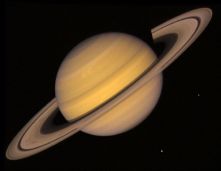
Although this photo was taken by the Voyager 1 probe over 30 years ago, it still remains one of the most iconic images of Saturn in the minds of many people on Earth today.
As the year 2012 comes to a close, it is worth remembering that out in the distant cosmos, the Voyager probes continue to speed along, blazing new trails in so doing. It has been 35 years and counting since they were launched to photograph and analyze the gas giant planets in our solar system in unprecedented detail. Once those primary objectives were completed, the next stage was to explore the outer reaches of our solar system, and then leave it completely to star systems beyond.
All the while, they have left us some indelible images. Voyager 1 first flew by Jupiter in 1979, not only taking better pictures of our system’s largest planet than ever before, but making key discoveries along the way. Not only did it find some new satellites, but its discovery of volcanic activity on the Gallilean moon Io was a find that led us to totally rethink the possibilities of different kinds of geological activity throughout our neighboring planets.
When Voyager 1 flew by Saturn a little over a year later, it gave us many new, detailed photos of Saturn, one of which still remains one of the most iconic images of that distant, large, ringed planets, despite Cassini’s more detailed photos that started to reach us about eight years ago.
So while Voyager 1’s primary mission was completed over three decades ago, it was just warming up compared to its second major set of objectives. Three and and half decades onward, some scientists at NASA’s Jet Propulsion Laboratory in Pasadena, Calif., continue to monitor the probe’s progress, and recently, it has started to make headlines in the scientific community yet again.
Oh, it has a list of decent achievements since 1981, to be sure, yet its recent discovery has really made headlines! Back when I was in the fourth grade, I remember seeing in my Weekly Reader how scientists hoped that the Voyager probes (specifically Voyager 2, but the same goes for ol’ No. 1) would reach the end of the solar system by 2015. At that point, I was thinking “2015? Pluto’s not that much further beyond Neptune, is it?”* Well, it turns out there is a lot in our Heliosphere beyond the planets that we know of. Speaking of which, how many of us knew what the Kuiper Belt was before the Voyager probes boldly went through where no man-made probe had gone before?
Now, Voyager 1 has boldly gone further still. Earlier this month, the scientific community was abuzz about the probe getting its first-ever taste of interstellar space (and ours, too, albeit vicariously!). Ed Stone, a project scientist who continues to monitor Voyager 1 at JPL, has pointed out that while getting closer and closer to actual interstellar space, the probe has discovered something totally new: a “magnetic superhighway!” Yes, this is what the scientists are currently describing this outer edge of the Heliosphere (basically, the part of space that the Sun has any influence over regarding gravitational pull, magnetic/radiation direction, etc.).
One naturally is inclined to ask, how has the probe lasted so long? Would it not have gone dead long ago? Would its, er, battery not have died out? Well, Ed Stone points out that the nuclear fuel used to power the craft has an 88-year half-life. That would be plenty of time to leave the Heliosphere and relay data of what it is like to truly be in interstellar space.
So, as its mission surpasses 35 years and counting, Voyager 1 continues to boldly go to send us data on its new discoveries and exploratory firsts. Any of us interested in studying space shall wait in the coming months and couple of years to see what other firsts the probe will achieve. Happy New Year!
Oh, and just think; in 2015, the New Horizons probe is expected to reach Pluto, and give us unprecedented photos and info from that part of the Solar System!
*The occasion of the Voyager 2 probe being given the main story in my Weekly Reader during my fourth grade year in the early Fall of 1989 was that it just passed up the planet Neptune; a new exploratory achievement for any man-made probe!
 intellectualgridiron