Leftists hijacking Jesus September 25, 2011
Posted by intellectualgridiron in Politics.Tags: Bible, Christian, free will, freeborn, God, Jesus, legalized theft, New Testament, Savior, Ten Commandments, theft, violation
add a comment

This photo was taken at an Anti-Tea Party rally. Apparently there are a lot of people out there that think taxes are not high enough, and that there is not enough government intrusion and regulation in our lives. But all sarcasm aside, this protest sign is disingenuous on a host of levels. Start with the “brown-skinned” premise. Was he as light-skinned as northern Europeans and their descendants in the western and southern hemispheres? Most likely not. But the fact that Jesus and was a semite does not make him “brown-skinned,” especially not compared to those of sub-Saharan African ancestry. Sorry, but those are the facts.
The “free health care” angle is also disingenuous. Yes, Jesus cared for people; the New Testament has many wonderful accounts of Jesus healing the sick, helping the crippled walk and helping the blind see. But He did those things: he did not farm it out to somebody else, and did not take credit for what others did. Those who advocate nationalized healthcare do so mostly on the grounds of “compassion,” but like other government programs in the name of such “compassion,” such advocates over look the obvious fact that it is very easy to be “compassionate” when you are doing so with other people’s money. Jesus did not need other people’s money to administer his own free health care. Rather, Christ’s very actions demonstrate the effectiveness of do-it-yourself conservatism.
Saving the best for last, it is about time somebody tackled this undue association of “socialism” with Our Lord and Savior. Christ was a Jew, by his own admission. As a practicing Jew, he was expected to abide by the Ten Commandments — they were handed down by His father, after all. Commandment No. 8 could not be simpler: Thou shalt not steal. When a thief violates this commandment he (or she) is essentially redistributing wealth/income. The only difference between what a thief does and what governments do in the name of wealth redistribution (which, hello, is what socialism — and liberalism — is all about) is merely a matter of legality. When Jesus suggested that the wealthy ought to sell their possessions and give the bulk of those proceeds to help the poor, he never mentioned a thing about the wealthy being forced to give up their wealth. If they were/are to do so, they do so on their own accord, out of their own free will. To force them by any means would be to violate our Heavenly Father’s rule of allowing people to exercise their free will, which in itself is a reminder that our status as freeborn citizens is a birthright given by our Lord.
The irony in all of this is that many people who advocate big government liberalism are already wealthy, and are well-aware that government will not tax their wealth, only their income (which, in many of their cases, is practically nil). Taxing income is the biggest entry barrier towards other people attaining their own wealth. In addition to this blatant phoniness, they enlist the help of liberals who are not wealthy by playing on their half-baked ideas of Christianity, while ignoring the faith’s true message.
The above sign might make for a clever sound bite, but it remains an obfuscation of the fact that Christianity and liberalism/socialism are two opposite things, and you cannot adhere to both at the same time, for doing so would be in violation of Commandment Number One. Simply put, those who worship the small “g” (government) violate that commandment handed down by the big “G” (that would be God).
What is truly interesting is that the very same folks who try to hijack Jesus into their secularist ideology make up the very same factions who attempt to surpress Christianity in the public square at every opportunity. This is yet another example of how the respective religion and ideology are, in the end, very much opposed to one-another as Doug Giles not-so-subtly points out.
While I’m at it, what mainstream conservative has been referring to B. Hussein Obama as a “brown-skinned, anti-war socialist” anyhow? Do I detect yet another strawman argument from the left? Note to libs: that was a rhetorical question.
Relativity Theory no longer ‘settled science.’ September 23, 2011
Posted by intellectualgridiron in Science.Tags: Al Gore, As Time Goes By, CERN, discovery, Einstein, Fermilab, light speed, neutrinos, physics, science, scientist, scrutiny, settled science, speed of light, standard, sub-atomic particles, theory, Theory of Relativity
add a comment
This day and age we’re living in
Gives cause for apprehension
With speed and new inventions,
And things like Third Dimensions.
Yet, we get a trifle weary
With Mr. Einstein’s theory….
 Apparently, not anymore. Albert Einstein’s famous Theory of Relativity, introduced to the world in 1905, caused us to rethink lots of things about physics. Part of the contention within that theory is that nothing can go faster than the speed of light, or 186,282 miles per second. Oh, and it was within that theory that Einstein gave us the famous equation E = mc(squared), or, Energy equals mass times the speed of light, squared. Just thinking about that alone could make one a trifle weary, as Herman Hupfield so eloquently penned 80 years ago.
Basically, it has been a pillar of the very science of physics for over a hundred years that nothing can go faster than the speed of light — Einstein’s theory helped establish that very principle. So, for a little over a century, that principle has essentially been treated as “settled science.”
All that has been turned on its proverbial head with a very recent announcement that scientists at CERN, or the European Organization for Nuclear Research (actually, it stands for “Conseil Européen pour la Recherche Nucléaire,” in case you’re keeping score at home), clocked neutrinos — odd slivers of an atom — travelling a distance of 450 miles in a time 60 nanoseconds faster than light travelling that same span. Needless to say, this announcement has turned more than a few heads in the scientific community, and has invited almost an many skeptics.
One thing that has invited scrutiny is the very nature of neutrinos themselves. As sub-atomic particles, not everything is understood about them. They have been baffling scientists for 80 years (read between those lines, and it’s downright amazing that scientists even knew about neutrinos in the early 1930s). They are nearly mass-less, and the dear reader would be well-served to keep in mind that atoms themselves are mostly empty space.
Phillip Schewe, communications director at the Joint Quantum Institute in Maryland, offered some perspective on these enigmatic particles, saying that the neutrino has almost no mass, comes in three different “flavors,” may have its own antiparticle and has been seen shifting from one flavor to another while shooting out from our sun.
To complicate things further, to say nothing about the validity of these potentially ground-shifting findings, is that different levels of energy, according to some schools of thought, can affect the speed at which neutrinos can travel. Naturally, just mentioning the term “neutrino” can cause the average reader to blink more than once, so to help create understanding about the context of these potentially game-changing scientific measurements, one can resort to Howstuffworks.com to give a rather brief explanation about neutrinos that the non-scientifically inclined can understand. Another explanation on neutrinos on the same website can be found here.
The reason I keep labeling these as “findings” and not an outright discovery is because the very scientists who took the readings are reticent to use that term. Like good, objectively-minded scientists, they actually invite the scrutiny, inviting other scientists to independently verify the data before using the vaunted ‘d’ word. Scientists at the competing Fermilab in Chicago already have announced their intention to run tests to see if the readings can be duplicated.
So have the rules of the game of physics changed? Chances are, there are about to. But seeing things in a broader context, if the idea that nothing can exceed light speed as “settled science” is on the verge of being invalidated, what else could be rendered out of date as a theory in the years to come? Former Vice President Algore has been — very un-scientifically — claiming that “global warming” has been “settled science” practically since he left the Blair House. What’s more, he has denounced anybody who denies that which he claims as tantamount to racists. Seriously. Yet the overall lesson to be learned is, if even Mr. Einstein’s theory is no longer settled science, theoretically, nothing could be. After all, as I myself noted in another recent post, nothing is static, as the science of physics has taught us time and again.
And that is fine. Unbiased science requires constant questioning, not necessarily of obvious, plain-as-day fundamentals (why waste the mental energy and everyone’s time?), but certain long-standing theories could always stand some questioning. If the theories are sufficiently valid, they shall always stand up to scrutiny. If not, they shall go the way of phrenology and alchemy. Plus, on an even brighter note, we could be that much closer to discovering the hidden key to warp speed!
As an aside, the opening poetic stanza is from the ever-famous, ever-timeless song “As Time Goes By,” written by Herman Hupfield in 1931. Rudy Vallee recorded a version of that standard that same year, and to me, it remains one of the best of the countless versions rendered by countless artists over the past eight decades. The only other version that stands above the rest is Dooley Wilson’s famous rendition from “Casablanca” in 1942. That said, Billie Holiday’s 1944 version is not too shabby, either.
Buddy Holly still timeless at 75 September 13, 2011
Posted by intellectualgridiron in Pop Culture.Tags: Adams, AT&T, Beach Boys, Beatles, Big Bopper, Bill Haley, Bo Diddley, Brian Wilson, British Invasion, brothers, Brunswick, Buddy Holly, canon, Carl Perkins, Chuck Berry, Cobra Starship, Coral, Crickets, Day the music Died, Decca, Don McLean, Elvis, Everly, Every Day, Founding Fathers, Franklin, Gary Busey, Hamilton, influence, J.P. Richardson, Jefferson, Jerry Lee Lewis, Linda Ronstadt, Little Richard, Madison, Miss American Pie, Oh Boy, Ollie Vee, Peggy Sue, Richie Valens, Ringo Starr, Rock n Roll, Rockabilly, That'll be the Day, Walk of Fame, Washington, Zooey Deschanel
add a comment
Last week (September 7, to be exact), marked the would-be 75th anniversary of Buddy Holly’s birth. In case you have been under a rock, though, for the past 52 years, Buddy Holly has been dead for that long, having died in a plane crash in the wee morning hours in a frozen Iowa cornfield. It is not uncommon for rock stars to burn briefly but very brightly. But the degree of brightness to which Buddy Holly shone as a star eclipsed most others in his day, and influenced countless others in the years that followed.
Buddy Holly is rightfully recognized as one of Rock ‘n’ Roll’s “Founding Fathers.” The most notable of our nation’s Founding Fathers each made their own unique contribution as our nation was born. Washington, for example, was the most gifted leader and capable administrator. Adams was one of the leading advocates in Congress for independence. Jefferson was the philosopher-statesman who was able to articulate the American experience and the rights of all men. Hamilton was the sharpest financial mind, Madison was the most detail-oriented, and Franklin was the most pragmatic, hence the most practical of an already-practical bunch.
When it comes to the founding generation of rock music, the unique contributions in that field manifest themselves as well. Some examples would include Bill Haley, who inaugurated the era; Chuck Berry, who combined blues music and folk themes for his own inimitable style; Little Richard, who found the holy grail of rock with his freight train-style tempo; Jerry Lee Lewis, who changed our paradigm of what a piano was meant to do; Carl Perkins, who owned the Rockabilly sub-genre; Elvis, who sang our kind of songs the way we wanted them to be sung; then there’s Buddy Holly, arguably the most timeless artist of a bunch who recorded music that remains timeless after more than five decades, and the most pioneering in a rare group of accomplished pioneers.
The music speaks for itself. “That’ll Be the Day” — the first record this author ever recalls hearing in his life — was his only Number One hit State-side, but he and his group The Crickets recorded a slew of other songs that helped define the era as well. In just 18 months, Buddy Holly and the Crickets had 27 Top 40 hits.
Just try to avoid tapping your feet to “Oh Boy,” or joining The Crickets in call-and-response fashion to the lyrics that make up the title. Same thing goes for “Rock Around with Ollie Vee“, “I’m Looking for Someone to Love” (the flip-side to “That’ll Be the Day,” fyi), with a guitar solo that would even make Ted Nugent proud.
Same thing goes for “Rave On.” Speaking of which, “Rave On” personifies the “hiccup” vocal style the Holly pioneered (that is, he introduced it to Rock, as it was already long-standing in Country-Western singing). But that just scratches the surface of Holly’s firsts. A full decade before Jimi Hendrix made a name for himself playing his Fender Stratocaster, Holly had already given the Fender Strat guitar a mystique all its own. Compared to the warm tones of most Gibson hollow-bodies, Holly’s Fender Strat had a distinctly piercing tone, which one can readily recognize in Ollie Vee or, better yet, “Blue Days, Black Nights”, both of which were recorded during a session for the Decca label in Nashville in 1956.
As an aside, there is often confusion on the part of many with regard to Buddy Holly vs. “The Crickets.” “What’s the difference?”, or some variation thereof, is the top FAQ. The historical evidence on hand does nothing to alleviate that confusion, as the group recorded on two different labels — both Decca subsidiaries at the time — and due to contractual quirks had to essentially split their name in two. Examples are shown below.

Source: author’s personal collection
Despite the separation of names, it was all illusory: on both labels, the complete group of Buddy Holly & The Crickets were performing the songs. Speaking of which, it is on that note that Holly’s pioneering is most pronounced. Putting things into context is the key to understanding this important point, for this was a time when solo artists and groups alike sang songs written and produced by others. Not Buddy Holly and the boys, though. They were the most notable first four-piece band (two guitars, a bass and drums) who wrote their own songs, then performed them their own way. In so doing, they created a template that rock bands of all sub-genres have followed for more than fifty years.
Holly was also one of the most influential artists of all time. The Beatles not only drew inspiration from Holly and his group, they even drew inspiration from The Crickets’ group name — wanting to follow along the insect-themed name in tribute to their own favorite group. The band that defined the genre in the 1960s, that ushered in the “British Invasion”, cut their teeth covering Holly’s hits. Indeed, as one article in particular points out, it was Holly who led an “American Invasion” into Britain in the 1950s.
But that does not even scratch the surface of Holly’s lasting influence. An excellent LA Times piece puts it in nearly-poetic words:
“Listen to Me” opens with Stevie Nicks happily rocking atop the Bo Diddley beat of “Not Fade Away” and includes the Fray handling “Take Your Time,” Ringo Starr shuffling through “Think It Over,” Chris Isaak crooning “Crying Waiting Hoping” and Cobra Starship reimagining “Peggy Sue.” Beach Boys mastermind Brian Wilson, who said “Buddy Holly’s sweet voice and his trademark hiccup always intrigued me,” layers his signature harmonies into the title track.
Zooey Deschanel sweetly follows in Linda Ronstadt’s footsteps on “It’s So Easy.” That’s one of three Holly songs Ronstadt — with Asher producing — brought back to the radio airwaves in the mid-’70s, a time when it wasn’t universally hip to revisit the ’50s rock canon.”
Keep in mind that Holly accomplished all of this before he died tragically at age twenty-two. As long as the issue of youth has been mentioned, it is to that very end that notable artists are serious about keeping Holly’s music relevant in the minds of the young people of today. Such is the reason why this anniversary coincides with a recently-released tribute album to Holly. Other tributes have coincided with the birthday in question. Sept. 7 was declared “Buddy Holly Day” in Los Angeles, where he was posthumously given a star on the Walk of Fame.
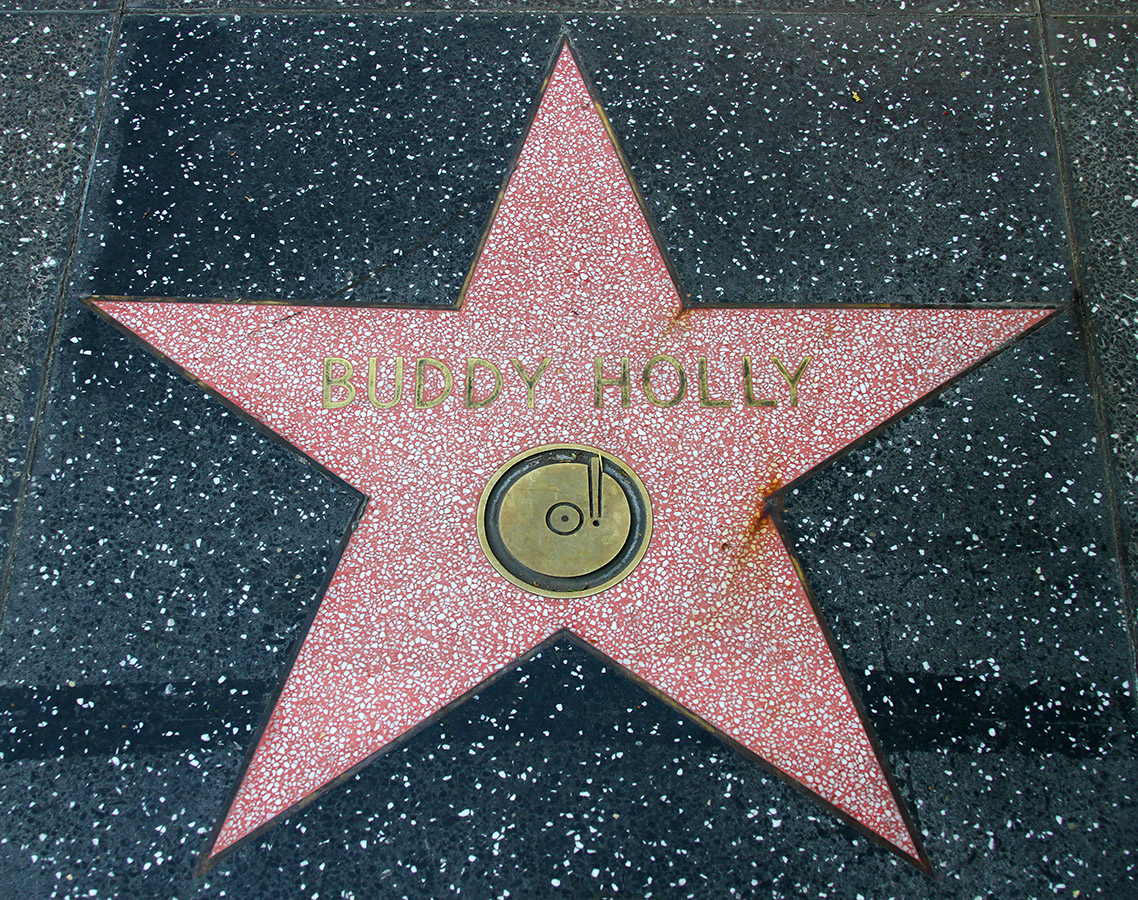
Buddy Holly’s star of fame on a sidewalk in Hollywood is, interestingly, right next to the famous Capitol Records studio building. Photo by author, Jan., 2015.
His widow Maria Elena was there to witness the unveiling, along with Don and Phil Everly (a.k.a., the Everly Brothers, who were friends of Holly, as well as fellow performers), and, appropriately, Gary Busey, who was nominated for an Academy Award for portraying him in The Buddy Holly Story (1978).
Evidence of the timelessness of Buddy Holly’s music is everywhere, not just in recordings such as “Listen to Me” or “Words of Love,” but others as well. AT&T even used “Every Day” (the flip-side to “Peggy Sue”) in one of their recent commercials.
Holly, along with Richie Valens and J.P. “The Big Bopper” Richardson, left this world on Feb. 3, 1959, in what became known as “The Day the Music Died” (even his death inspired a number-one hit song – who can forget Don McLean’s “Miss American Pie“?*). But given Holly’s lasting influence and timelessness, perhaps the name of that fateful date should be seriously called into question.
*For the sake of clarity, “Miss American Pie” was the name of the plane that crashed in 1959, taking the lives of Holly, Valens and Richardson.
Whither the conferences in major college football? September 8, 2011
Posted by intellectualgridiron in Sports.Tags: ACC, Big 8, Big East, Big Ten, Big XII, Colorado, conferences, football, Jupiter, Miami, NCAA, Nebraska, Oklahoma, Oklahoma State, SEC, solar system, Southeastern Conference, static, SWC, Texas, Texas A&M, Virginia Tech
2 comments
When I teach my course in American government at my community college in Louisville, one thing I have taken to doing early in the course’s term is to hand out a sheet to each student with a list of important rules in physics/economics. My rationale for this is to get the students thinking about the potential consequences of certain actions on the part of government. One such rule I lay out for them is thus: “Nothing is static.” Just try to disprove that rule. After all, nothing is static in the economy, nothing is static in our own interpersonal relationships, the climate is certainly not static — regardless of what the enviro-socialists want us to think — and indeed, nothing is static in the Solar system, not with variations in solar radiation output that have implications for the temperatures on this planet as well as for Mars and the Gallilean satellites around Jupiter.
The recent announcement that Texas A&M will depart the Big XII Conference for the Southeastern Conference come June of next year has reminded me of this rule once again. Though this is not the first move of a D-1A (pardon me, Football Bowl Subdivision) school to shake things up a bit regarding conference affilition, this one move could open the floodgates for radical conference realignment, the likes of which none of us have seen in our lifetime.
Most moves up to this point seemed fairly self-contained. When the Southwest Conference folded after 1995, the top four teams in that conference joined the Big 8, thus giving birth to the Big XII. The other four teams disbersed, many initially ending up in Conference USA, which banded together lots of erstwhile mid-majors and independents. The arrangement within the Big XII was one that on paper made geographic sense, at least longitudinally (much like the erstwhile Pac-10), with Nebraska the anchoring power in the north, and Texas the anchoring power in the south. Furthermore, should Texas have a down year, Oklahoma was eventually strong enough to fill that power gap on the southern end.
The switch-ups we witnessed earlier last decade did not seem to portend major realignment, either. The only thing that Miami, Virginia Tech, and Boston College bolting from the Big East to the Atlantic Coast Conference amounted to was to question whether or not the former still deserved to have a berth in the BCS bowl games.
 All that was put in jeopardy with Nebraska bolting for the Big Ten after last season. Less consequential was Colorado moving to join the Pac-10, now the Pac-12. As things currently stand, the Big Ten now has 12 teams, and the Big XII has been reduced to nine, or at least will be with the Aggies’ imminent departure. This current state of affairs raises two simultaneous possibilities. For one, many thought that even though the Cornhuskers left for the Big Ten, the Big XII could still limp on, possibly even bring in new up-and-coming teams to fill the void left by the Huskers and the Buffaloes. With A&M soon to leave, the death knell for the Big XII has been all but sounded. Even though, at this moment, Oklahoma and Texas both remain, and Oklahoma State would add increasing credibility, given their up-and-coming status (thank you, T. Boone Pickens), the gradual disintegration of the conference, first at the northern end and now at the southern end leaves many to conclude that more dominos shall inevitably fall.
 One such departure has already pushed Southeastern Conference membership to a future number of 13. Further speculation has been fueled as to whom else the SEC might court. Already, conferences such as the Pac-12 have been making major overtures for the Sooners and the Cowboys to join them. The Longhorns are an even more juicy target for conferences as well, though UT, what with its special brand and its own sports channel in the newly-created Longhorn Network, has the prestige, winning tradition, not to mention geographic advantages to be successful as an independent. Indeed, what we may be witnessing is Texas becoming the Notre Dame of the 21st Century in terms of athletic prestige, winning tradition, privileged status, and ability to attract top recruits.
But, in returning to the point of the SEC’s burgeoning membership, 13 could be a magic number, magic in the sense that it creates the possibly for that number to grow further, not just for the southeastern juggernaut power, but for conferences elsewhere. As mentioned earlier, the possibility persists that Oklahoma and Oklahoma State could end up in the Pac-12, bumping their lucky number up to fourteen. Moreover, it is not inconceivable that Texas could join that new mega-conference as well. USC plus the Sooners plus the Longhorns equals one formidable conference indeed. Iowa State could end up following suit in a different sense by joining the Big Ten (Nebraska is already there, and in-state rival Iowa has been a long-time member). Geographically, that theoretical move is quite logical. Where Kansas, Kansas State, Baylor, Missouri and Texas Tech might end up — again, should the dominoes continue to fall — is anybody’s guess, though the Mizzou Tigers might end up joining the Big Ten as well. That possibility has been broached several times before, in fact. My only reservation against that is, can one conference abide three different teams whose colors are (officially) Old Gold & Black?
While there could be a scramble for a would-be disintegrated Big XII’s table scraps, the Southeastern Conference might try to bring in other powers to join their juggernaut league (Florida State and Virginia Tech have been listed as possibilities). Might such a conference cannibalization prompt the ACC and the Big East to join forces? Given that Texas A&M has turned its back on its long-time rivals and all-too willingly allowed itself to be used by the SEC, perhaps all of us ought to rethink what is possible.
The bottom line in all of these prognostications is that we could be witnessing a radical realignment of teams into mega-conferences, which in turn will have major implications for bowl game affiliations, and even coveted BCS eligibility. If the Sooners and Cowboys end up joining the Pac-12 and that move makes no sense to many on a geographic level, just keep in mind that Texas Christian University — the recent Rose Bowl champs — are about to join the Big East. The new paradigm is that geography is hardly a constraint anymore when it comes to conference affiliation, and it’s all part of the brave new world of NCAA football realignment about to happen before our eyes. What we fans and observers of big-time college football thought were secure affiliations over the past 15 years have turned out to be anything but. Once again, the firm rule about nothing being static has held.
The Aggies to the SEC? September 5, 2011
Posted by intellectualgridiron in Sports.Tags: Big 12 conference, Big XII, football, Longhorn Network, media market, SEC, Southeastern, Texas A&M
2 comments
 After much speculation and rumor, it is official. Texas A&M is about to leave the Big XII (minus 2) for the SEC. My overall assessment is the A&M is getting used, and seems to be alright with such an arrangement. Indeed, the overall reason for the Aggies’ seemingly hasty move to the Southeastern Conference is one that remains a mystery, including the fairly humorous and insightful sports columnist Jerome Solomon of the Houston Chronicle. Perhaps the haste in arranging this new affiliation can be attributed in large part to the Aggies’ pique at the perception that rival UT got a sweetheart deal by being allowed to establish their own television sports network. In case you’ve been living under a rock for the past year, the new, exclusive channel in question is the Longhorn Network .
To me, the SEC has more to gain from this arrangement than A&M has to gain in return. The Southeastern Conference is acting as though Texas A&M is the most wonderful of additions, and from their standpoint, why not? This move benefits the incumbent schools in the conference in that it gives those programs a much wider in-road to recruit Texas, the greatest football state in the country (indeed, on so many levels, it is the greatest state, period). On that plane of thinking, this move makes a lot of sense. Why shouldn’t one of the flagship schools of the greatest football state in the land be a part of the greatest college football conference? Furthermore, by bringing in A&M to the SEC, the conference has the golden opportunity to open up new media markets, particularly the oh-so-juicy Dallas and Houston markets. The Atlanta market is all well and good, but beyond that, the Jacksonville, Tampa-St. Pete, Birmingham and Nashville markets will only take you so far. With Dallas and Houston, the number of eyeballs you can attract to watch the games on TV — not to mention your potential advertising revenue — has been taken to a whole new level. Oh, and did I mention that more SEC teams can now recruit Texas more heavily?
All these previously noted things are great for the conference itself, but what about the newcomer? The sad state of things is that Texas A&M might very well be getting the short end of the stick. Sure, the SEC acts like they love A&M like the Aggies have never been loved before, and are being welcomed into said conference with open arms. But once the Aggies become a full-fledged member, they shall instantly take a back seat to the majority of teams. As things currently stand, A&M has the potential to compete in the upper echelon of the Big XII (again, minus two) with Texas, Oklahoma, and Oklahoma State. They might even win one of those games, maybe more. But once in the SEC, their level of talent will be below that of Arkansas, and Mississippi State is no gimme, not anymore, at least (not with Dan Mullen doing such a great job in strengthening the program). From there, the rest of the competition only gets more intense. In so many words, for the foreseeable future, A&M shall be relegated to the lower half of their new conference home.
Then there’s recruiting. Already A&M has been losing out on the most prestigious recruits to the Longhorns and the Sooners. Now they must compete for recruits with half of the SEC, possibly more. Fighting Oklahoma State, Texas, and Oklahoma for recruits is difficult enough, but this latest move has opened the floodgates for Alabama, LSU, Georgia, and a host of others to come knocking at those same recruits’ doors. Congrats, A&M: you have just made recruiting your in-state talent all the more difficult.
Given that the SEC will gain more than A&M from this arrangement when all is said and done, it looks as though the Aggies are letting themselves be used. But given how hastily A&M rushed into this conference switcheroo, it seems as though they were only too willing to allow for that. Hence the confusion on the part of many in the media.
Dinosaur tracks found in Australia August 24, 2011
Posted by intellectualgridiron in Science.Tags: Antarctica, Australia, continents, dinosaur, Dinosaur Dreaming, Downunder, Emory University, fossil, Hadrosaur, Mesozoic, Therapod, trace fossil, track
add a comment
Australia is traditionally a relatively latecomer when it comes to dinosaur discoveries. The first dinosaurs discovered were Iguanodon and Megalosaurus in England in the early 1820s. We found herds of Hadrosaurs outside of Philadelphia in the 1840s (the significant finds out west started in the 1870s). Compared to all that, the first dino finds Downunder not coming until the 1900s and 1930s seem quite recent. It does not help things that Australia, even during the Age of Reptiles, did not have all of its land accessible to dinosaurs, as much of the present-day continent was covered by a shallow sea. But it also was connected to both Antarctica and South America during this era, and as such, the part of Australia not covered by said shallow sea (try saying that three times fast!) was a crossroads of sorts for a number of species.
Despite the decent diversity of dinosaurs found in Australia, the actual number of species found Downunder are relatively few, for a number of geological reasons, one of which has already been mentioned. But any dino discovery in Australia is significant because of its crossroads status, but also because it can give us clues to dinosaur migratory patterns as well as potential behavioral patterns during a unique time of when A) Australia was located further south than it is today, and B) despite the southern part of the continent’s almost polar latitudinal position during this time, a huge saving grace was that a major warming period occured at that same period, about 105 million years ago.
Hence the significance of the discovery of dino tracks along the coastline of Victoria dating to that time. A research team led by Emory University Paleontologist Anthony Martin discovered what appear to be Therapod tracks from Australia’s polar period. Keep in mind that dinosaurs were not discovered in Antarctica until the late 1980s — pre-dating the ground-breaking documentary on dinos hosted by Christopher Reeve in 1985. But given that geologists surmised that the continents were at one time joined together, there were thoughts that finding dino fossils at the bottom of the world would be a matter of time.
Martin also found the first dinosaur trace fossils of a burrow in Australia back in 2006, so his track record for these finds is well-established. This current find was in a location called Dinosaur Dreaming. With a name like that, it sounds like Paleontologists ought to do more digging in that point on the map!
What is Federalism? August 21, 2011
Posted by intellectualgridiron in Politics.Tags: Articles of Confederation, Bill of Rights, commerce, Constitution, federal government, Federalism, Founding Fathers, George Mason, George Washington, limited government, power divided, regulation, Samuel Adams, separation of powers, Seventeenth Amendment, sovereignty, Tenth Amendment, Thomas Jefferson
add a comment
What is Federalism? It is, quite simply, a system of government that involves shared and divided power between a governing central authority and constituent political units — in this case, individual states. In other words, the Federalist system requires that some defined, limited powers be delegated to the central government while the rest be delegated to the states. This concept was central to our nation’s founding during the Federal Convention of 1787, and is just as crucial today, as a critical mass of our fellow citizens have forgotten this key concept, thus leading to our country’s existential crisis.
In the beginning, America’s government on a national level consisted only of the Congress, then a differently-composed body from the Congress that became part of the federal government that was later to be designed. From 1777 through 1788, the guiding document for the Congress was the Articles of Confederation, whose very title shows that America was a confederacy at that time, not a federal republic. But the Articles failed because they were too weak. The 13 states that declared independence from Great Britain had to be brought together very quickly in order to keep an army in the field and to keep it fed and clothed. At this they almost merited a failing grade, since General George Washington constantly found his army to be under-fed, his soldiers’ payments chronically late, and horribly clothed.
After the war, even bigger problems arose, since the Articles of Confederation brought the states together too loosely, particularly when it came to settling states’ debts or having a stable currency, to say nothing of lack of uniform commercial regulation from state to state. It therefore comes as no wonder that the “several states” were in economic chaos by the 1780s, some 150 years before the Great Depression of the 1930s. Enough key people realized the problems with the Articles had to be corrected, first at Annapolis, Md., in 1786, and a year later at Philadelphia in 1787.
One myth that pervades some people on the right side of the political spectrum is that the Framers convened in Philadelphia in 1787 to cut government down and make it weaker. The opposite is actually true: they got together in that city and year to strengthen government. That said, it would rankle those on the other side of the political spectrum that they did not strengthen it for the sake of amassing more power or control for themselves, let alone create a modern European-style welfare state, but rather, they saw it was a means of creating a more stable system that would encourage a stronger economy. A stronger government meant the ability to regulate interstate commerce and have the only power to coin money — two powers absent from the previous government (Reference Article I, Section 8). Basically, the Constitution — pre-1791, at least — was originally meant to be a blueprint that would allow for more people to secure for themselves the blessings of liberty by being able to earn their own money more easily than before.
Through much rigorous debate during the Federal Convention of 1787, a federal system of government was decided upon, where there would be a government at the highest level with a relatively few defined powers, and the broader powers would be deferred to the “several states.”
One example of shared power is, alas, no more. The original way in which the new Congress was composed was one of the most sterling examples of Federalism, and how power separated was indeed power checked. The method of people directly electing their representatives in the lower chamber has been in place since 1788. But the way United States Senators were elected was quite different. The original method of their appointment was election via state legislatures. Such election was predicated on the idea that once elected, the members of the Senate would respect state sovereignty, and not allow for the federal government to usurp power from the states. The 17th Amendment to the Constitution, ratified in 1913, made it so that senators were elected to Congress directly by the individual voters instead of the state legislators. Effectively, this turned Senators into “supercongressmen,” and were no longer operating under any constraints to respect state sovereignty with their pieces of legislation, unless the voters stipulated such, yet they never did until a critical mass of voters in some states have made that a priorty in very recent years. An archived article by Bruce Bartlett goes further into this important issue.
Federalism is not without its occasional peculiarities, to be sure. To ensure that states would be given equal representation on one hand and given proportional representation on another, the Congressional make-up as we know was fashioned whereby the lower chamber would satisfy the latter concern, and the upper chamber of Congress (the Senate) would satisfy the former. Article I is very explicit in that each state, no matter how big or small, shall be represented in the upper chamber by two senators; no more, no less. Today, the average Congressional district represents a little over 700,000 people, yet the state of Wyoming, just slightly over half a million in population, has two senators.
True, some delegates initially did call for a national government, not a federal government, but after the requisite debate, that particular proposal for overhauling the central authority of government in the U.S. was quickly rejected. Much debate and compromise took place before it was agreed upon by the majority of delegates that powers between a central government and state governments should be shared. Such a mutual conclusion was the happy median between those who wanted a stronger central authority and those who wanted to preserve more vestiges of the older confederacy.
When the Federal Convention concluded on Sept. 17, 1787, two opposing camps sprang up, practically overnight — the Federalists (those in favor of the Constitution’s ratification) and the Anti-Federalists (those who opposed the Constitution’s ratification on the grounds that it gave too much power to the central government). A large majority of states had to ratify the document to make it the supreme law of the land (effectively, this meant nine states out of 12, since Rhode Island did not send any delegates at all to the convention).
Many prominent patriots such as George Mason, Patrick Henry, Thomas Jefferson, and Samuel Adams were Anti-Federalists, fearing that their efforts to secure independence would come to naught if the central government were delegated such a degree of power. The Anti-Federalists were understandably concerned that without additional built-in checks on Congressional power, their worst fears of a central government amassing more and more power at the expense of everyone’s liberty would come to pass. The solution proposed by prominent Federalists such as James Madison — the acknowledged “father” of the Constitution and one of its key authors — was to add a Bill of Rights to the Constitution to ensure that rapacious politicians would be prohibited from passing laws that would infringe on our God-given liberties. The Bill of Rights, of course, consists of the first 10 amendments to the Constititution, and was ratified in December of 1791, during George Washington’s first term as president. In it, one particular amendment — the Tenth — stands out as an enduring testament to the principle of Federalism and to the importance of shared powers and the respect of state sovereignty. It simply reads:
“The powers not delegated to the United States by the Constitution, nor prohibited by it to the States, are reserved to the States respectively, or to the people.”
Translation, for those of you who went to public school (or graduated from IU): If it doesn’t specifically say that the central government has the power to do something, then the central government lacks the power to do that one thing, and if that one thing is to be done, it is up to the states (or even the counties) to take care if it in their own way.
The Tenth Amendment reminds us of something implicit though crucial to Federalism. Given that it is predicated on shared powers between the central government and the states, it compels its citizens to prioritize as to what government can effectively do nationally vs. locally. Since one of the most basic jobs of government is to protect its citizens from theft and violence, that job on a state and county level amounts to “law and order,” while on the national level, it means providing for the national defense. When it comes to “establish Post Offices and Post Roads” as is enumerated in Article I, Section 8, that means that it’s quite alright for the federal government to build national roads (interstates, anyone?) and post offices, but the states can build their own roads on their own dime, too.
If ever We the People are to solve America’s current existential crisis of whether we are to perpetuate America as we know it, or to degenerate into another bloated welfare state like western Europe, the former cannot be achieved without the explicit acknowledgement of what Federalism is and why our Founding Fathers intended for the central government to remain strong enough to provide economic and military stability on a national level, but to leave the rest of the minutiae to the states. It worked before, and shall work again. As we are witnessing today, there can be no substitute.
Mayor Michael Nutter to black youths: “You have damaged your own race.” August 18, 2011
Posted by intellectualgridiron in Politics.Tags: black community, black youth, civility, classroom, community college, degeneracy, Michael Nutter, professional, tattoo
1 comment so far
It’s about darn time that somebody said this. As a community college instructor, the majority of students I have had in my business and general education classes have been African American. Many are single mothers. Many, regardless of sex, have tattoos (a fine example they are setting for their children!). The college where I teach has had to enact new classroom regulations over the years to bring some semblence of civility, such as the banning of wearing of hats in class, as well as the banning of clothing that is, er, too revealing, or too unprofessional in general. The wearing of hoods is also banned. I applaud these regulations, as they promote civility, but also set the expectations for what it takes to provide a more professional appearance, something important if the students wish to get a job once they graduate. Some students get it without having to be told, and much to their credit. Others quickly get it once they see the importance of what these rules are trying to instill. Others need to be reminded several times, as nobody has ever shown them before the basic tennants of civility.
Much has been said about the difficulty many African Americans, particularly the youth, have had in finding work. Over the past several months, black unemployment has been almost twice the national average, around 16 percent. While those who prefer to deal in hysteria are quick to cite ‘racism’ as the reason behind this statistic of great concern, the real reasons, from my own personal observations, are more basic. Many young black people are not attractive candidates for hire because of their unprofessional appearance and demeanor, something that Nutter tried to bring to their collective attention in a recent speech. Given that Mayor Nutter himself is African American, he can say these things with impunity without retribution from the self-appointed, politically correct thought police.
The point of mentioning this is, if the hyper-degeneracy within the black community is to be erradicated, ultimately such needed erradication will have to come from within. That approach always works the best, as it is ultimately the most self-reliant solution, in perfect accord with the “little platoons” that Alexis de Tocqueville observed was secret to America’s strength. Kudos to Democrat Mayor Michael Nutter of Philadelphia for saying what desperately needs to be said.
Here is a clip that covers the high points of his speech:
Leave it to the brilliant Dr. Thomas Sowell, however, to broaden the scope of the problem and put it into a context that ordinary people can readily understand. His angle of attack is the different behavioral patterns will lead to different degrees of success, or degeneracy, depending on how constructive or destructive that behavior may be. If you’re new to columns by Dr. Thomas Sowell, he often follows up with subsequent articles on the same subject, such as this fine example, which reminds us that racism is a two-way street, contrary to the politcally-correct mantra that it goes only one way.
Cowboys and Aliens: An awesome film August 14, 2011
Posted by intellectualgridiron in Pop Culture.Tags: Aliens, Cowboys, Daniel Craig, Harrison Ford, Indiana Jones, James Bond, Jon Favreau, movie, Olivia Wilde, western
add a comment
 Many reviews have not been the most flattering about the recently released film Cowboys & Aliens. The average rating has been around 2 stars — not terrible (“turable,” if you’re Charles Barkley), but not necessarily good, either. After seeing the film, my conclusion is that the 2-star treatment is an error, for it merits a better assessment than that.
Full confession time: I had actually been anticipating the release of this movie for most of the year, practically since I first saw the posters for it around December or January. The title itself sounded intriguing — aliens in a wild west setting. Then I found out the top-billed cast, and it hit me. Director Jon Favreau came up with the right ingredients that when combined — at least, on paper — would make for one of the coolest ideas for a movie in recent memory.
What are the ingredients? The setting, the top cast, and the story itself. The setting is obvious, and has already been covered. What about the cast? The two big names are Daniel Craig and Harrison Ford. What is Daniel Craig known for playing these days? Why, he’s the latest James Bond, with Casino Royale and Quantum of Solace already under his belt, and Bond 23 due to be released in 2012. What is Harrison Ford best known for playing? Puh-leaze: Indiana Jones!
With all of this in mind, how do things add up? As mentioned previously, it adds up — again, on paper — to the coolest idea in recent memory: James Bond and Indiana Jones team up to fight aliens in the old west. Can a movie idea get any more awesome? I submit ‘no.’
From there, things can only go in two directions: either the movie lives up to such expectations of awesomeness, or it flops completely. Usually, a film that potentially cool sounds too good to be true, and that was my primary concern going in to see it. The concern was alleviated within the first minute. Craig definitely brings his swagger and brutality that he used to portray Bond, and Harrison Ford brings his A-game as well. One scene was particularly tantalizing in that it made many a movie buff wonder ‘what if James Bond did try to take on Indiana Jones?’ Craig plays a desperado trying to remember who he is and what he was doing. His fighting style and cowboy tough guy talk definitely remind folks ‘in the know’ of 007. Meanwhile, there certainly are times where Ford’s occasional glances and smirks are as if he inadvertantly let Indy seep into this role of Civil War army officer-turned-tyrannical town overlord (think Indiana Jones with a dark side).
So why the relatively low reviews? Lots of critics expect every film they see to have the dramatic value of MacBeth or Death of Salesman, and when it does not deliver under such a false premise, then the film is to be panned. Moreover, lots of critics do not understand some of the pre-requisites of westerns. The beauty of the film is that it is a western first, a sci-fi flick second (albeit a close second). As a western, you know going in that there are going to be cliches, and heaven knows, the film is rife with them. If that bothers any would-be viewer, then he or she is apt to detract a star or two from their own personal rating. But if they are of no consequence to others, then the others will be more apt not to be distracted from the film’s overall awesomeness.
As a western, it also delivers satisfaction. A lone stranger with a more-than-checkered past comes into town. The town’s overlord dislikes him, to say the least (Why, you ask? Watch the film!), until all hell breaks loose, well, you get the rest. Like most westerns, the emphasis is on actions, not words, though to be sure, the film is not without the occasionally choice dialog.
The object of the story is even somewhat cliche, that of disparate forces having to band together to overcome a foe with a host of advantages. The action sequences are pure awesomeness, and the ending is very satisfactory, as is the character development taking place throughout the film. Moreover, Olivia Wilde (who played Quorra in Tron: Legacy) does well as an unexpected helper in the protagonist’s cause, and it was a nice touch to see Adam Beach (who played the part of Ira Hayes in Flags of our Fathers), whose character becomes a needed ambassador as the story unfolds.
If you’re looking for a good movie for a “Saturday (or Friday) night out with the boys” occasion, this film is perfect. It is perfect for a father taking is son and son’s friends* for a fun time, or for a band of college buddies getting together for movie night. If this film were made and released during my undergrad days, the boys and I would still be talking about it today: it delivers that well. James Bond and Indiana Jones team up to fight aliens in the old west. A movie like that is so awesome, it’s worth repeating.
*Bear in mind that with a PG-13 rating, there is some violence — mostly modern western-style shooting violence, etc., so it is always wise for parents to exercise discretion accordingly.
Newly discovered planet is darker than coal August 11, 2011
Posted by intellectualgridiron in Science.Tags: discovery, extrasolar, new planet, planet, pulsar, TrES-2b
add a comment
 According to this article, more than 500 extra-solar planets have been discovered since 1995. That does not count one of the first-ever extrasolar planets discovered back in 1992; a planet roughly four times the size of Earth, orbiting a pulsar. But it does not matter how many new planets are discovered, it’s always a neat development. What makes this one stand out consists of a couple of things. For one, it is another gas giant, much like Jupiter. But unlike Jupiter, which orbits about 483 million miles from the Sun, on average, this one, TrES-2b, orbits a mere three million miles from its star. To put things further in perspective, Mercury’s mean distance from the Sun is about 36 million miles. Furthermore, unlike Jupiter, whose alternating color stripes make it one of the most visually distinct planets in the solar system — its size notwithstanding — TrES-2b is, according to reports, “blacker than coal.”
 intellectualgridiron