Classical Music guide addendum December 14, 2011
Posted by intellectualgridiron in Pop Culture.Tags: Boccherini, Brahms, Carl Philipp Emanuel, Couperin, Gabrieli, Gershwin, Gottschalk, Ives, Johann Christian, Mendelssohn, Penderecki, Schoenberg, Schubert, Telemann, Wilhelm Friedemann
add a comment
Buddy Holly still timeless at 75 September 13, 2011
Posted by intellectualgridiron in Pop Culture.Tags: Adams, AT&T, Beach Boys, Beatles, Big Bopper, Bill Haley, Bo Diddley, Brian Wilson, British Invasion, brothers, Brunswick, Buddy Holly, canon, Carl Perkins, Chuck Berry, Cobra Starship, Coral, Crickets, Day the music Died, Decca, Don McLean, Elvis, Everly, Every Day, Founding Fathers, Franklin, Gary Busey, Hamilton, influence, J.P. Richardson, Jefferson, Jerry Lee Lewis, Linda Ronstadt, Little Richard, Madison, Miss American Pie, Oh Boy, Ollie Vee, Peggy Sue, Richie Valens, Ringo Starr, Rock n Roll, Rockabilly, That'll be the Day, Walk of Fame, Washington, Zooey Deschanel
add a comment
Last week (September 7, to be exact), marked the would-be 75th anniversary of Buddy Holly’s birth. In case you have been under a rock, though, for the past 52 years, Buddy Holly has been dead for that long, having died in a plane crash in the wee morning hours in a frozen Iowa cornfield. It is not uncommon for rock stars to burn briefly but very brightly. But the degree of brightness to which Buddy Holly shone as a star eclipsed most others in his day, and influenced countless others in the years that followed.
Buddy Holly is rightfully recognized as one of Rock ‘n’ Roll’s “Founding Fathers.” The most notable of our nation’s Founding Fathers each made their own unique contribution as our nation was born. Washington, for example, was the most gifted leader and capable administrator. Adams was one of the leading advocates in Congress for independence. Jefferson was the philosopher-statesman who was able to articulate the American experience and the rights of all men. Hamilton was the sharpest financial mind, Madison was the most detail-oriented, and Franklin was the most pragmatic, hence the most practical of an already-practical bunch.
When it comes to the founding generation of rock music, the unique contributions in that field manifest themselves as well. Some examples would include Bill Haley, who inaugurated the era; Chuck Berry, who combined blues music and folk themes for his own inimitable style; Little Richard, who found the holy grail of rock with his freight train-style tempo; Jerry Lee Lewis, who changed our paradigm of what a piano was meant to do; Carl Perkins, who owned the Rockabilly sub-genre; Elvis, who sang our kind of songs the way we wanted them to be sung; then there’s Buddy Holly, arguably the most timeless artist of a bunch who recorded music that remains timeless after more than five decades, and the most pioneering in a rare group of accomplished pioneers.
The music speaks for itself. “That’ll Be the Day” — the first record this author ever recalls hearing in his life — was his only Number One hit State-side, but he and his group The Crickets recorded a slew of other songs that helped define the era as well. In just 18 months, Buddy Holly and the Crickets had 27 Top 40 hits.
Just try to avoid tapping your feet to “Oh Boy,” or joining The Crickets in call-and-response fashion to the lyrics that make up the title. Same thing goes for “Rock Around with Ollie Vee“, “I’m Looking for Someone to Love” (the flip-side to “That’ll Be the Day,” fyi), with a guitar solo that would even make Ted Nugent proud.
Same thing goes for “Rave On.” Speaking of which, “Rave On” personifies the “hiccup” vocal style the Holly pioneered (that is, he introduced it to Rock, as it was already long-standing in Country-Western singing). But that just scratches the surface of Holly’s firsts. A full decade before Jimi Hendrix made a name for himself playing his Fender Stratocaster, Holly had already given the Fender Strat guitar a mystique all its own. Compared to the warm tones of most Gibson hollow-bodies, Holly’s Fender Strat had a distinctly piercing tone, which one can readily recognize in Ollie Vee or, better yet, “Blue Days, Black Nights”, both of which were recorded during a session for the Decca label in Nashville in 1956.
As an aside, there is often confusion on the part of many with regard to Buddy Holly vs. “The Crickets.” “What’s the difference?”, or some variation thereof, is the top FAQ. The historical evidence on hand does nothing to alleviate that confusion, as the group recorded on two different labels — both Decca subsidiaries at the time — and due to contractual quirks had to essentially split their name in two. Examples are shown below.
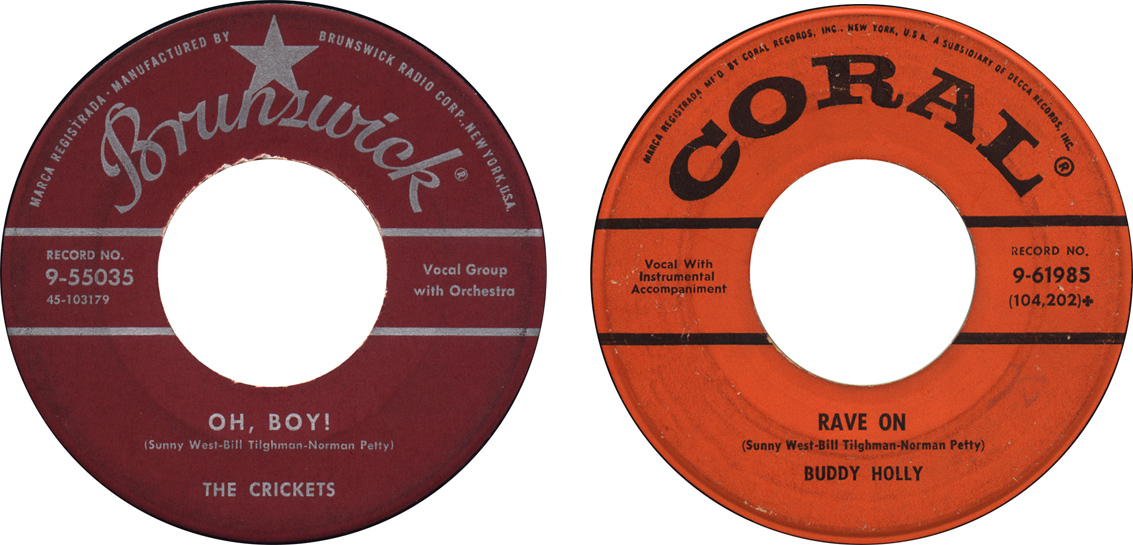
Source: author’s personal collection
Despite the separation of names, it was all illusory: on both labels, the complete group of Buddy Holly & The Crickets were performing the songs. Speaking of which, it is on that note that Holly’s pioneering is most pronounced. Putting things into context is the key to understanding this important point, for this was a time when solo artists and groups alike sang songs written and produced by others. Not Buddy Holly and the boys, though. They were the most notable first four-piece band (two guitars, a bass and drums) who wrote their own songs, then performed them their own way. In so doing, they created a template that rock bands of all sub-genres have followed for more than fifty years.
Holly was also one of the most influential artists of all time. The Beatles not only drew inspiration from Holly and his group, they even drew inspiration from The Crickets’ group name — wanting to follow along the insect-themed name in tribute to their own favorite group. The band that defined the genre in the 1960s, that ushered in the “British Invasion”, cut their teeth covering Holly’s hits. Indeed, as one article in particular points out, it was Holly who led an “American Invasion” into Britain in the 1950s.
But that does not even scratch the surface of Holly’s lasting influence. An excellent LA Times piece puts it in nearly-poetic words:
“Listen to Me” opens with Stevie Nicks happily rocking atop the Bo Diddley beat of “Not Fade Away” and includes the Fray handling “Take Your Time,” Ringo Starr shuffling through “Think It Over,” Chris Isaak crooning “Crying Waiting Hoping” and Cobra Starship reimagining “Peggy Sue.” Beach Boys mastermind Brian Wilson, who said “Buddy Holly’s sweet voice and his trademark hiccup always intrigued me,” layers his signature harmonies into the title track.
Zooey Deschanel sweetly follows in Linda Ronstadt’s footsteps on “It’s So Easy.” That’s one of three Holly songs Ronstadt — with Asher producing — brought back to the radio airwaves in the mid-’70s, a time when it wasn’t universally hip to revisit the ’50s rock canon.”
Keep in mind that Holly accomplished all of this before he died tragically at age twenty-two. As long as the issue of youth has been mentioned, it is to that very end that notable artists are serious about keeping Holly’s music relevant in the minds of the young people of today. Such is the reason why this anniversary coincides with a recently-released tribute album to Holly. Other tributes have coincided with the birthday in question. Sept. 7 was declared “Buddy Holly Day” in Los Angeles, where he was posthumously given a star on the Walk of Fame.
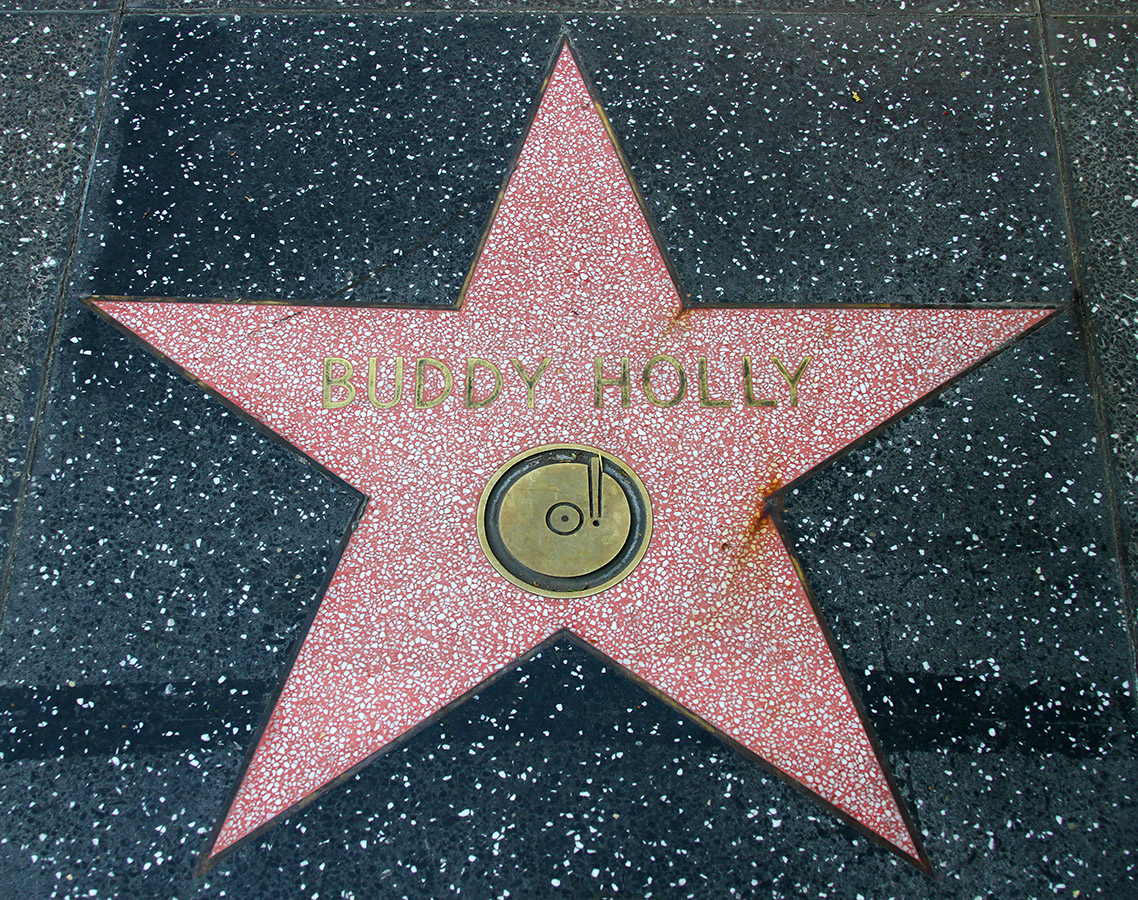
Buddy Holly’s star of fame on a sidewalk in Hollywood is, interestingly, right next to the famous Capitol Records studio building. Photo by author, Jan., 2015.
His widow Maria Elena was there to witness the unveiling, along with Don and Phil Everly (a.k.a., the Everly Brothers, who were friends of Holly, as well as fellow performers), and, appropriately, Gary Busey, who was nominated for an Academy Award for portraying him in The Buddy Holly Story (1978).
Evidence of the timelessness of Buddy Holly’s music is everywhere, not just in recordings such as “Listen to Me” or “Words of Love,” but others as well. AT&T even used “Every Day” (the flip-side to “Peggy Sue”) in one of their recent commercials.
Holly, along with Richie Valens and J.P. “The Big Bopper” Richardson, left this world on Feb. 3, 1959, in what became known as “The Day the Music Died” (even his death inspired a number-one hit song – who can forget Don McLean’s “Miss American Pie“?*). But given Holly’s lasting influence and timelessness, perhaps the name of that fateful date should be seriously called into question.
*For the sake of clarity, “Miss American Pie” was the name of the plane that crashed in 1959, taking the lives of Holly, Valens and Richardson.
Cowboys and Aliens: An awesome film August 14, 2011
Posted by intellectualgridiron in Pop Culture.Tags: Aliens, Cowboys, Daniel Craig, Harrison Ford, Indiana Jones, James Bond, Jon Favreau, movie, Olivia Wilde, western
add a comment
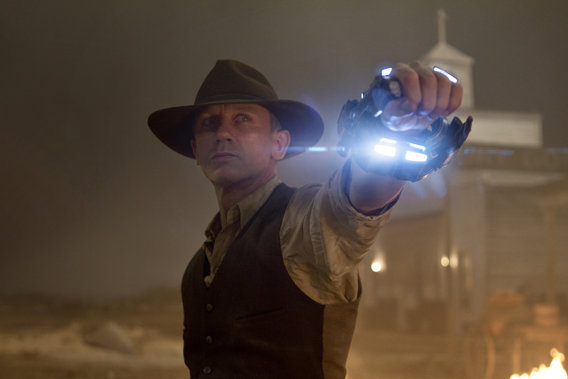 Many reviews have not been the most flattering about the recently released film Cowboys & Aliens. The average rating has been around 2 stars — not terrible (“turable,” if you’re Charles Barkley), but not necessarily good, either. After seeing the film, my conclusion is that the 2-star treatment is an error, for it merits a better assessment than that.
Full confession time: I had actually been anticipating the release of this movie for most of the year, practically since I first saw the posters for it around December or January. The title itself sounded intriguing — aliens in a wild west setting. Then I found out the top-billed cast, and it hit me. Director Jon Favreau came up with the right ingredients that when combined — at least, on paper — would make for one of the coolest ideas for a movie in recent memory.
What are the ingredients? The setting, the top cast, and the story itself. The setting is obvious, and has already been covered. What about the cast? The two big names are Daniel Craig and Harrison Ford. What is Daniel Craig known for playing these days? Why, he’s the latest James Bond, with Casino Royale and Quantum of Solace already under his belt, and Bond 23 due to be released in 2012. What is Harrison Ford best known for playing? Puh-leaze: Indiana Jones!
With all of this in mind, how do things add up? As mentioned previously, it adds up — again, on paper — to the coolest idea in recent memory: James Bond and Indiana Jones team up to fight aliens in the old west. Can a movie idea get any more awesome? I submit ‘no.’
From there, things can only go in two directions: either the movie lives up to such expectations of awesomeness, or it flops completely. Usually, a film that potentially cool sounds too good to be true, and that was my primary concern going in to see it. The concern was alleviated within the first minute. Craig definitely brings his swagger and brutality that he used to portray Bond, and Harrison Ford brings his A-game as well. One scene was particularly tantalizing in that it made many a movie buff wonder ‘what if James Bond did try to take on Indiana Jones?’ Craig plays a desperado trying to remember who he is and what he was doing. His fighting style and cowboy tough guy talk definitely remind folks ‘in the know’ of 007. Meanwhile, there certainly are times where Ford’s occasional glances and smirks are as if he inadvertantly let Indy seep into this role of Civil War army officer-turned-tyrannical town overlord (think Indiana Jones with a dark side).
So why the relatively low reviews? Lots of critics expect every film they see to have the dramatic value of MacBeth or Death of Salesman, and when it does not deliver under such a false premise, then the film is to be panned. Moreover, lots of critics do not understand some of the pre-requisites of westerns. The beauty of the film is that it is a western first, a sci-fi flick second (albeit a close second). As a western, you know going in that there are going to be cliches, and heaven knows, the film is rife with them. If that bothers any would-be viewer, then he or she is apt to detract a star or two from their own personal rating. But if they are of no consequence to others, then the others will be more apt not to be distracted from the film’s overall awesomeness.
As a western, it also delivers satisfaction. A lone stranger with a more-than-checkered past comes into town. The town’s overlord dislikes him, to say the least (Why, you ask? Watch the film!), until all hell breaks loose, well, you get the rest. Like most westerns, the emphasis is on actions, not words, though to be sure, the film is not without the occasionally choice dialog.
The object of the story is even somewhat cliche, that of disparate forces having to band together to overcome a foe with a host of advantages. The action sequences are pure awesomeness, and the ending is very satisfactory, as is the character development taking place throughout the film. Moreover, Olivia Wilde (who played Quorra in Tron: Legacy) does well as an unexpected helper in the protagonist’s cause, and it was a nice touch to see Adam Beach (who played the part of Ira Hayes in Flags of our Fathers), whose character becomes a needed ambassador as the story unfolds.
If you’re looking for a good movie for a “Saturday (or Friday) night out with the boys” occasion, this film is perfect. It is perfect for a father taking is son and son’s friends* for a fun time, or for a band of college buddies getting together for movie night. If this film were made and released during my undergrad days, the boys and I would still be talking about it today: it delivers that well. James Bond and Indiana Jones team up to fight aliens in the old west. A movie like that is so awesome, it’s worth repeating.
*Bear in mind that with a PG-13 rating, there is some violence — mostly modern western-style shooting violence, etc., so it is always wise for parents to exercise discretion accordingly.
Captain America: A Great American Film August 5, 2011
Posted by intellectualgridiron in Pop Culture.Tags: Captain America, Chris Evans, Hayley Atwell, hero, Hugo Weaving, movie, movies, patriotism, period piece, superhero, theatre, Tommy Lee Jones, world war 2, WWII
1 comment so far
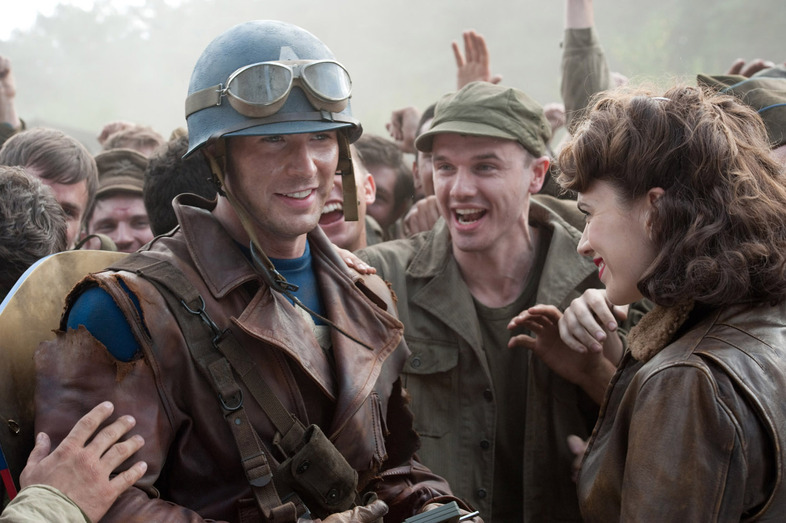 If you have not seen Captain America in the theatres yet and are looking for a good film to see this weekend, look no further. This is a film that delivers. To offer a small confession, I have seen more than a few superhero flicks in the theatres since the New Millenium began, and on the whole, I have not been disappointed by them (Hulk from 2003, however, is another matter entirely!). Upon hearing the news that Captain America was to be released in the theatres this summer, I was more than interested, given my past moviegoing experiences for such fare, as well as with my admiration for the character and his patriotic attitude.
Moreover, as somebody who is a sucker for period pieces, I was all the more enthusiastic about seeing the film, since it takes place during WWII. One of the great things about such movies in recent years is, given the high level technology and sophisticated techniques of filmmaking, each period piece tries to out-do each other with providing details of authenticity of past times, from the architecture to the clothing fashions to the cars and music of those respective eras. The WWII-era backdrop in this movie is both nostalgic and convincing, so much so that it could show many of us who were born way after that time why that period was looked on as the “good ol’ days” by those who lived it.
Chris Evans plays the main character, who starts out in the story as Steve Rogers, one’s classic image of a 90-pound weakling, who, despite his skrawny body and sickly appearance, is nevertheless driven by a deep sense of patriotism and duty to one’s country. Furthermore, despite these glaring weaknesses, he’s also resilient — somebody who quickly gets up no matter how many times he gets knocked down. Rule no. 1 of any movie story is that the audience must be able to sympathize with the main character. If you’re a red-blooded American, you cannot help but love Steve Rogers. As Captain America, the hero is quite formidable yet still sympathetic.
Obviously, his weaknesses prevent him from passing physical muster for military service, despite trying to enlist several times. This determination catches the eye of an immigrant scientist — played by Stanley Tucci — who is conducting a secret military experiment, offering him a chance to help his country in a special way. Rogers takes the chance, and the story really takes off from there.
On the other side, the arch-villain Red Skull is played convincingly by Hugo Weaving. No doubt moviegoers would instantly recognize him for his memorable work as Agent Smith in The Matrix trilogy. FYI, he also supplied the voice for Megatron in the Transformers trilogy, so clearly Weaving has had experience in these sorts of roles!
The love interest is supplied by a charismatic British intelligence agent played by Hayley Atwell. The romance that eventually develops between her and Captain America has an appealingly old-fashioned feel, as if it were straight out of a real 1940s movie. Tommy Lee Jones turns in yet another reliable performance, this time as a tough army commander, and the rest of the supporting cast is solid, too.
I was especially pleased to learn before attending the film’s showing that the movie was directed by Joe Johnston, whose previous credits include The Rocketeer, which I still contend is one of the most underrated movies of the 1990s. One of the reasons I am so fond of that film is that it takes place in 1938 Los Angeles, and shows the sumptuous art deco architectural interiors of that time, the classic propeller airplanes, the 1930s cars of all sorts of makes and models, the period attire (gotta love those double-breasted suits and fedoras!), not to mention that 1938 was the height of the Swing Era, and I was able to identify at least three different Artie Shaw tunes.
Suffice it to say, Johnston pays just as close attention to detail with the WWII period trappings of Captain America that he did to that similar period in The Rocketeer. If the viewer were to pay a few extra bucks for a 3-D showing, he or she would be all the more apt to be immersed in that era, particularly the artwork, the wartime propaganda posters, the clothes (always the clothes!), the cars, and more.
My only criticism of the film is that I found it rather light on contemporary recordings in its soundtrack. I was able to make out I’ll Remember April by Woody Herman and Jersey Bounce by Benny Goodman, but that’s it. As a long-time Goodman afficionado, I can vouch that Jersey Bounce is a decent record, and since it was recorded in 1942, it’s quite appropriate, but Benny and his band did other records of the time that were even a bit more peppy that could have provided the right mood and contemporary backdrop during some other scene, namely Yours Is My Heart Alone from 1940. Surely they could have squeezed in Glenn Miller’s American Patrol (1942) some place, or an early ’40s Artie Shaw ballad, say Moonglow (1941), or even Stardust (1940) during one of the more tender scenes between Evans and Atwell.
Much credit is due to whomever chose to have the movie take place in the era when the character Captain America was created. World War II provides the perfect patriotic setting where the true essence of the character can be appreciated by viewers of all ages. In subsequent decades, namely the 1960s, the bleeding-heart comic book writers essentially perverted the character by superimposing their post-modern claptrap onto this paragon of patriotism, as Mark Steyn so eloqently observed.
They say that the numbers don’t lie. That is especially the case when it comes to box office receipts. It is no secret that Hollywood has been guilty of producing more than a few anti-American (or, at least anti-U.S. military/CIA) films in the recent years. Ben Shapiro offers a laundry list of examples, such as the Bourne Ultimatum, Lions for Lambs, Shooter, Grace is Gone, Rendition, and The Torturer. He could have also added Jarhead and Syriana to that list. No doubt this sort of muddying of the moral waters appeals to post-modernists and other supposed sophisticates.
Yet the average public has chosen to favor other sorts of films, which explains why superhero movies have done so well at the box office since the beginning of the New Millenium. X-Men grossed $157 Million by late 2000. Spider-Man grossed $403 Million by late summer of 2002. X2 tallied almost $215 Million by early fall of 2003, Batman Begins tallied $205 Million by October of 2005, Superman Returns rang up $200 Million by late October of ’06, and The Dark Knight set a record with $533 Million in box offices receipts. In just a couple of weeks, Captain America already has brought in $130 Million in domestic sales alone. The message is clear: people like to watch movies where good and evil are easily defined. Captain America not only delivers on that message alone, but it delivers with an unabashedly patriotic message that America stands for ideals that are worth fighting and dying for, and does so with fantastic period panache. If you’re a red-blooded American, this film will give you your money’s worth.
 intellectualgridiron