Revisiting “Halloween is Grinch Night” October 30, 2024
Posted by intellectualgridiron in Pop Culture.Tags: dr-seuss, Friz Freleng, Grinch, Hal Smith, Halloween, Hans Conried
add a comment
With the season of All Hallow’s Eve in full-swing, it gives us late-stage Gen-Xers and first-wave Millennials the occasion to pause and reflect on the great Halloween shows we enjoyed as kids. One such special show worth revisiting is “Halloween is Grinch Night”. Note that some vague spoilers are forthcoming.
The short TV movie (25 minutes long) from 1977 is highly entertaining, has a couple of legendary cast members, and offers plenty of fertile ground for discussion within the broader world of Dr. Seuss.
The very concept of the story is a highly intriguing one. Early on in the special, it becomes clear that the Grinch is the titular…villain? But wait, 20 years earlier, in the Seuss story that birthed the legendary character, he starts out as a bad guy, but sees the light in the end and becomes good. In the process, he saves the day…granted by cleaning up the mess he himself created, but everyone is better off for it since he is now friendly instead of antagonistic. The same thing applies to the timeless animated adaptation of the story from 1966.
Yet in this fine Seussian animated film, the Grinch is a villain again. What gives? Perhaps the best way to explain it is to look at the setting in a broader context. The Whoville of “Halloween is Grinch Night” looks markedly different from its layout in its Christmas counterpart story. So do the features of Mount Crumpet. Other geographic features make this setting distinct from the earlier story. Even the very color palette of the landscape is distinct from the original story setting.
So, to answer the natural question of “what gives”, the best surmise is that this is some parallel dimension to the Whoville of Yuletide. In this dimension, the Grinch has not yet realized that “perhaps Christmas means a little bit more”, and there sadly is no indication that he’ll ever come to such an epiphany. Moreover, this alternate-dimension Grinch revels in “Grinch Night”, an evening where he can unleash a vast array of spooks on Whoville, specters who form a ghoulish gala called the “Grinch Night Ball”, where the Grinch himself is the man of the hour.
How “Grinch Night” is triggered in the story is creatively explained as only Dr. Seuss, who wrote the film’s teleplay, could articulate. In clearly a Fall setting (red-colored leaves falling on the ground), a very strong, near-hurricane-like “sour-sweet” wind starts blowing. Mind you, the audience has no way to verify that the wind actually smells “sour-sweet”. You simply take the characters’ words for it as they describe it while they experience it. This wind in turn sets in motion a Rube Goldberg device in nature, causing one group of wild animals to agitate another group, until the agitated ruckus echoes up Mount Crumpet to the Grinch’s lair, where he himself, apparently, gets perturbed. The apparent agitation puts him in the mood for Grinch Night. Again, surmises.
In any case, the dialog is vintage Suess. The author is adept as ever at making non-sensical words sound eloquently poetic. Some of such Seussian poetry is most adeptly expressed by two legendary voice actors, one being Hal Smith. His credits include voicing Flintheart Glomgold in “Ducktails”; Owl in some of the Winnie the Pooh animated films; even Goofy-as-Jacob Marley in “Mickey’s Christmas Carol”, and many other roles in animated films and shows. Meanwhile, the Grinch himself was voiced by Hans Conried, whom the readers might better recall as the voice of Captain Hook from Disney’s “Peter Pan” from 1953. Captain Hook became the Grinch in part because Boris Karloff, the original voice of the Grinch from 1966, was by 1977 eight years under the sod.
If that is not enough, two of the film’s three producers were Seuss, along with Friz Freleng, the accomplished director of so many Looney Tunes and Merrie Melodies cartoons.
Perhaps most fascinating about this TV movie, though, is a look into Dr. Suess’ unique take on ghouls and goblins. Even the bats — an inseparable icon of Halloween — as shown in different settings within the story, are decidedly, uniquely Seussian in their visual appearance.
Clearly Dr. Seuss relished the opportunity to portray Halloween spooks in his own unique way. The latter part of the film shows many a cutscene where Suess’ imagination ran delightfully wild, and the audience is all the more entertained as a result. The musical soundtrack will stay in your mind for a long time to come as well, helping you to associate it with the month of October itself, similarly to how songs from the Christmas Grinch have become part of that holiday season.
The only unfortunate aspect of this special is that the Grinch does not seem to show any character development. Whereas in the prime dimension, the Grinch eventually sees the light and thwarts his own nefarious scheme in the process, in this alternate dimension, the Grinch is thwarted from throwing his “Grinch Night ball” this time, but vows to try again when the next opportunity arises. Meanwhile, this version of the Grinch is even too much for his dog Max, who quickly finds a more loving home elsewhere. Too bad for the Grinch, but good for Whoville, who is spared a night of ghoulish harassment.
Of the many Dr. Seuss animated films/adaptations dating back to 1942 (which started with the Warner Brothers cartoon adaptation of “Horton Hatches the Egg”), this one merits a place near the top of the heap. Is it as legendary or poignant as the original Christmas Grinch adaptation from 11 years earlier? No, but of all the many Seuss films over so many decades, this one is one of the greatest visual feasts for the eyes, and a delightfully unique contribution to timeless Halloween animated specials. Thus it is worth a re-watch this Halloween, and worth sharing with your kids, too.
Remembering “Major League” during its 35th Year October 11, 2024
Posted by intellectualgridiron in Pop Culture, Sports.Tags: baseball, Bob Uecker, Bullet Bob Hayes, Charlie Sheen, Chelcie Ross, Cleveland, comedy, Corbin Bernsen, Dennis Haysbert, film, Gaylord Perry, Harry Doyle, Indians, Jake Taylor, James Gammon, Jobu, Lou Brown, Major League, MLB, movies, Pedro Cerrano, Roger Dorn, Sports, Tom Berenger, Wesley Snipes, Willie Mays Hayes
add a comment
With baseball postseason in full-swing, it is worth taking a moment to reflect on the greatest baseball movie of all time, in the year that marks its 35th anniversary. Of course I am talking about “Major League”. Considering that the Ind…I mean, the Guardians are still in the playoffs as of this writing, it’s all the more fitting and proper to reflect on this great comedic film.
Considering how well the sport of baseball lends itself to good sports movies, what with its mile-deep lore and diehard fans’ predilections to romanticize the game, it would almost be considered sacrelige to place a vulgar comedy as the best of the baseball flicks. The writer of the movie, David S. Ward, was himself a life-long Indians fan. Since the MLB team in Cleveland was showing no signs of relief from struggle any time soon – nor would they for several more years – he set out to essentially make a fantasy storyline about how the team could actually evolve into a winning franchise. He reasoned that the only way such a far-fetched scenario would be remotely credible was by making the movie a comedy.
So why place such a comedy at the top spot of movies about baseball? Three reasons come to mind. For one, the story covers many realistic baseball scenarios both on and off the field. Second, the cast is outstanding, with a good mix of veterans and newcomers, much like that of a winning baseball team. Third, the script is as flawless as it is memorable, if not more than a bit salty.
Believe it or not, despite the comedic aspects of the film (which are legion), the many situations portrayed fairly accurately reflect what one is to experience in a professional clubhouse. Ex-major leaguer Trevor May breaks down all the realistic aspects of the story, which are surprisingly numerous.
The players who show their station in life based on their choice of transportation to arrive at spring camp? That rings true. Having veterans trying to prove they are not hobbled by injuries from previous seasons? That checks out correctly. Rookies that struggle with holes in their game (e.g., Willie Mays Hayes, a contact-hitting speedster, continually hitting pop-ups, or slugger Cerrano unable to hit a curveball) is also covered. The movie also thoroughly covers the ace pitcher as he struggles with control of the ball. Let us not forget the pervasive fear of finding a red tag in your locker, “which means that the manager wants to see you because you just died and went down to the minors” in the words of veteran catcher Jake Taylor. Such a fear speaks deeply to anyone with experience in the pro baseball ranks.
If that’s not enough, in contrast to the out-of-control pitching of the young, up-and-coming ace, is Harris, the salty veteran pitcher, almost a thinly-guised Gaylord Perry, who keeps Crisco on his chest and Vagisil on his hip to give him “another two to three-inches drop on [his] curveball”.
Of course, baseball is notorious for its many superstitions, and the movie personifies that like none other with Cerrano’s legendary voodoo idol, Jobu. The Cuban slugger even converts his locker into his own private shrine to his one-of-a-kind Caribbean totem.
Veterans who take the rookies out to dinner? Check. The manager giving a speech to properly set the tone at the beginning of the season? That also checks the box.
What else checks the boxes? Let’s see: whirlpool machines in the locker rooms; players on the team making tongue-in-cheek commercials; and teams rallying behind a symbol, positive or negative, at midseason all speak to real experiences of baseball teams through the ages.
With realistic scenarios within the game covered, let us turn our attention to the thespians who brought the characters to life. Such a look at the cast reveals how outstanding a fit each actor was for his/her role. Tom Berenger brings an understated gravitas to veteran catcher Jake Taylor, who was plagued by problems with his knees late in his career, along with self-inflicted problems in his past personal life vis-a-vis womanizing escapades that he later resolves to move past as he struggles to keep those previous mistakes in the past. Charlie Sheen, a up-and-comer at the time (he did previously join Berenger as part of the cast of “Platoon”), brings the right amount of flare to his role as Rick “Wild Thing” Vaughn in his journey of growth from out-of-control reliever to become the team’s ace pitcher. Wesley Snipes, before he became a household name, was another newcomer who delivered great comedic timing as the team’s rookie lead-off hitter/speedster. And who can forget Dennis Haybert? Long before he became a spokesman for Allstate Insurance, he was Pedro Cerrano, delivering a decent Cuban accent along with an incredible ability to hit the long ball – provided that the pitch is not a curveball.
Aside from Berenger, other veteran actors “bring it” in their roles, too. Corbin Bernsen succeeds in playing Roger Dorn, a preppy, overpriced 3rd baseman with fielding issues. Venerable character actor Chelcie Ross shines as the aforementioned Harris, who becomes the unlikely provocateur of Cerrano.
And who can forget the late James Gammon as Lou Brown? Gammon’s performance is the stuff of legend. So convincing is he in this role, along with his distinctly low, gravely voice, that it becomes impossible to envision a more convincing prototype of the grizzled, dyed-in-the-wool baseball manager.
Speaking of legends, part of the icing on the proverbial cake is the great Bob Uecker as radio play-by-play announcer Harry Doyle. Not a more perfect man could have been found for the role, for Uecker combined years of actual radio announcing experience – he was the voice of the Milwaukee Brewers for decades – with TV acting experience as well. All he had to do in the role was be himself – with a little extra snark mixed in for good measure.
Finally, there’s the script itself. No sports movie exists with a more flawless, or quotable script. Any man whose blood is red can rattle off at least a few lines without much prompting. To wit:
“Aw, I don’t know…”; “Hold it, hold it, hold it…”; “Hats for bats”; “Come on, Dorn, get in front of the damn ball! Don’t get this olé bull—-!”; “I’m deeply moved!”; “Ees very bad to steal Jobu’s rum.”; “Aw, I couldn’t cut in the Mexican Leagues.”; “Interesting…”; “I think you can go get him now.”; “Good! I like that kind of spirit in a player.”; “ALRIGHT! Knock that —- off!”; “Me, I’m for wasting sportswriters’ time. So, I thought we could all hang around and give them all a nice big —-burger to eat!”; “Personally, I think we got hosed on that call”. “You can close the book on Keltner (thank God!).”; “That’s all we got, one g—d— hit?”; “Uh-oh, that’s it, I don’t think this one has the distance!”; “Haywood’s a convicted felon, isn’t he Monty?…Well, he should be.”; “Yo, bartender, Jobu needs a refill!”…
And of course, “Ju-ust a bit outside!”
All that is just a taste, to be sure.
If all that is not enough, the final act of the movie has some of the finest situational baseball drama of any film, all the while offering a practically perfect payoff in the end. One need not be a die-hard baseball fan to love the flick. To this very day, it ranks as one of the greatest “guy movies” of all time. Many of us have been with a group of friends who, while hanging out together with time to kill, elect to do so by watching a movie. When trying to agree on what watch, if “Major League” is suggested, few are apt to reject it. The reasons listed above go a long way to explain why.
Random notes:
*The white car that Roger Dorn pulls up in at the start of spring camp is a 1975 Excalibur Series III Phaeton. The Excalibur brand began in the 1960s as an offshoot of Studebaker. The cars themselves were styled after the 1928 Mercedes SSK. By the 1970s, they came with Corvette-tuned Chevy 327 engines under the hood, providing 300 horsepower for a car that weighted only 2,100 pounds, which is lighter than most cars today.
*The Volkswagen Beetle that Willie Mays Hayes arrives in for spring training not only has a subtle two-tone paint job (along with gangster walls on the tires), but also a custom grille styled after that of a Rolls-Royce. Such was a popular custom feature on VW bugs back in the 1970s, which lends some intrigue to Hayes’ unspoken backstory.
*Speaking of the character played by Wesley Snipes, the name “Willie Mays Hayes” is a combination of two legendary athletes. The first one is quite obvious – Willie Mays – but the latter, less so. The last name of “Hayes” is a reference to “Bullet Bob” Hayes, who, for a stretch in the 1960s, was the fastest man in the world, hence Snipes’ character’s own fleetness of foot. Indeed, while Mays continued to build on his legendary career, Bob Hayes won gold medals at the 1964 Summer Olympics in both the 100m dash and the 4x100m relay. The same year, he was drafted by the Dallas Cowboys and went on to a prominent career in the NFL, becoming the only person to this day with both an Olympic gold medal and a Super Bowl ring. Quite a legacy in one name for the role Snipes adeptly played in this film.
Best Version of “White Christmas” December 16, 2022
Posted by intellectualgridiron in Pop Culture.Tags: 1942, 1947, Bing Crosby, Darlene Love, Drifters, Irving Berlin, White Christmas, WWII
add a comment
Let’s play a game. It’s [loosely] called “name the best version of (fill-in-the-blank Christmas song)”. After all, there are but so many Christmas songs out there, some 200 years old (or older), some 150+ years old, some 80+ years old, some 65-ish, some more recent than that. The point is, myriads of recording artists have cut their own versions of many of these songs for almost 125 years. What makes things interesting is that each singer/group/ensemble has had their own “take” on them. So, whose “take” is the best? Let us explore that answer.
Why not start with Irving Berlin’s venerable “White Christmas”? Yes, the man who wrote an estimated 1,500 songs over the course of his 101 years on this Earth, including “God Bless America” and many legendary songs from the Golden Age of the Great American Song Book (“Cheek to Cheek”, “Blue Skies”, “Puttin’ on the Ritz”, “Easter Parade”, “Alexander’s Ragtime Band”, to name but a few) also gave us “White Christmas”. It is altogether fitting and proper to take a look at this sing, since this year marks the 80th anniversary of its official release to the world.
The context behind the origins of “White Christmas” are multi-layered. Just as Margaret Mitchell’s Civil War-era novel “Gone With The Wind” was a smashing success during the Great Depression, so was “White Christmas” at the dawn of America’s direct involvement in WWII. While accounts vary as to exactly when Berlin actually wrote the song (within the years 1940 or ’41), it has been established that the first public performance of the song was indeed by Bing Crosby on his NBC radio show The Kraft Music hall, on Christmas Day of 1941, only 18 days after Pearl Harbor and 17 days after FDR asked Congress to declare war on Japan.
The song made a larger debut on-screen the following year in 1942 when it was featured in the now-classic movie “Holiday Inn”. Crosby not only sang the song in the film, but also, as was customary at the time, recorded a studio version of the song on the Decca label as part of an accompanying album of songs from the movie. He was accompanied by the Ken Darby Singers and the John Scott Trotter Orchestra when they made this recording on May 29, 1942. It took them only 18 minutes to produce a rendition that satisfied everyone.
While the popularity of the 1942 movie Holiday Inn did eventually help propel record sales (it did top the charts by end of October of ’42), a stronger social undercurrent helped make the song legendary. With America having officially joined the fight against the Axis powers after Pearl Harbor, the population was mobilized onto a war footing at an unprecedented scale and pace. Yes, America had been mobilized a generation earlier in the First World War, but this new mobilization made the Allied Expeditionary Forces of old, and the industry supporting it, pale in comparison.
Within months after the fateful events of early December of 1941, many an able-bodied American man would be enlisted into service and deployed to many a spot abroad, or at least, far from home, from the deserts of North Africa to the Aleutian Islands, to air bases in England, to naval flotillas patrolling the South Pacific, and many spots in between.
The song thus spoke to them, and to their families at home, of simpler times, or deep nostalgia. The right mix of melancholy and comforting images of home during the Holidays resonated deeply with listeners during WWII, and the Armed Forces Network was flooded with requests to play this song during that time.
In its first year of recording and release, Bing Crosby’s first version of this song stayed at the top of the charts for 11 weeks. Sales carried well into early 1943, and Decca re-released the song for Christmas seasons of 1945 and ’46. For Holiday Inn, the song won the Academy Award for Best Original Song of 1942.
Ironically, the version with which most of us are familiar is Crosby’s re-recording of the song in 1947, also accompanied by both the Trotter Orchestra and the Darby Singers. The addition of the flutes and a slightly more pronounced celesta helps make it audibly different from the first version without being too overtly different.
Readers may or may not be aware that Crosby’s 1942 and ’47 renditions combined add up to the greatest-selling record of all time: more so than any record by Elvis, The Beatles, Michael Jackson, Elton John, or anybody. By 1968, sales had reached 30 Million alone. After much research, the Guinness Book of World Records concluded in 2007 that the record had sold at least 50 Million copies, though some estimates reach as high as 100 Million.
Twelve years after the song’s and the hit flick Holiday Inn’s initial release, Paramount was finally able to make a follow-up film for both, simply calling it “White Christmas”. It proceeded to become the most successful movie of 1954. While not as strong a film as its 1942 predecessor, it nevertheless has earned its place as a Christmas classic movie in its own right. That it was filmed in then-cutting-edge “VistaVision” has helped it translate well onto HDTV screens today. Naturally, the finale number was the movie’s namesake.
To broaden the scope: in the 80 years since it was first recorded, “White Christmas” has been cut more than 500 times, making it the most-recorded Christmas song. As mentioned in the beginning, many artists have offered their own “take” on it. For example, while Clyde McPhatter & The Drifters’ version [also] from 1954 is always a fun listen, it still is not has great as Bing’s original version.
That said, a solid runner-up is Darlene Love’s rendition on the also-classic album, Phil Spector’s “A Christmas Gift For You” from 1963. As the first track of this perennially strong album, Love’s rendition packs much more of a virtual “punch” than people usually expect from the song, aided in part by Spector’s “Wall of Sound” audio effect, but also by the singer’s soulful efforts. Also notable of this version is that it includes the prelude verse that many other artists skip singing.
The real question is, which is really better, Bing’s 1942 version, or the 1947 remake? Most folks would likely side with the latter, since that is the one with which they are familiar. One cannot blame them, for that version is wonderful and timeless. My vote is for the 1942 version: the one that started it all. It has a sharpness that the remake lacks, and the historian in me reflects on how it spoke to people’s hopes, fears, and comforts as we were beginning to take on a worldwide menace on an unprecedented scale.
The lasting legacy of Crosby’s 1942 version is grander than one might expect. Its success on the charts legitimized the market for Christmas music. To be sure, more than a few excellent versions of Christmas songs were recorded before this landmark cut, including notable examples by Benny Goodman, Tommy Dorsey, and Glenn Miller. But Crosby, paired with Berlin’s incredible contribution to the Great American Christmas Songbook, finally opened the recording industry’s eyes to the potential goldmine they were sitting on with regard to recording music for the Christmas season. In short, Crosby and Berlin, with White Christmas, paved the way for the bulk of popular Christmas music we have to enjoy today.
Revisiting “A Jolly Christmas With Frank Sinatra” December 12, 2022
Posted by intellectualgridiron in Pop Culture.Tags: Frank Sinatra, Capitol, Vaughn Monroe, Christmas, Nelson Riddle, Gordon Jenkins, Sammy Cahn, Jule Styne, Mistletoe, Holly, Waltz, Jolly
add a comment
Five score and seven years ago today, the greatest pop singer of the 20th Century was born. Francis Albert Sinatra would go on to have a recording career that would span almost six decades, and cut iconic records from at least five of them (more on that some other time).
Moreover, this anniversary of his birth makes things all the more fitting and proper that we should revisit his unforgettable Christmas album, “A Jolly Christmas with Frank Sinatra”, recorded and released 65 years ago in 1957.
In a previous article, I already made the case why this is one of the three greatest Christmas albums of all time. Now it is time to go deeper still, and look at two very iconic recordings within this album. A number of factors can make a record “iconic”. One very key factor in this case is that Sinatra introduced two new songs that are now part of the great American Christmas Songbook.
The first of which is “Mistletoe and Holly” (track 3 of the album). Even today, listeners of all ages can instantly recognize this classic recording, what with its distinct intro of the harmonious plucking of the violin strings, paired with mild percussion for a distinctly staccato effect. But when one pays attention to the lyrics, one can also discern the song’s staying power: it lists many cherished traditions with which most of us associate Christmastime in America. “Tasty pheasants” (a fancy variation on the venerable Christmas turkey); Christmas presents; “countrysides covered with snow”; Kris Kringle; Grandma’s pies (speaking to family cooking/baking traditions); over-eating (who has not indulged a bit rich foods over the Holidays?); “[M]erry greeting from relatives you don’t know” (rather self-explanatory); “carols by starlight”; decorating one’s Christmas tree; “folks stealing a kiss or two” (who among us has not heard of spates of marriage proposals around Christmas?).
No doubt that everyone sensed this track would be a hit, which is likely a major factor in its featuring in Sinatra’s famous Christmas special with Bing Crosby that same year.
Meanwhile, “The Christmas Waltz” has its own backstory. This now-iconic song was written by the dynamic duo of Sammy Cahn and Jule Styne in 1954, at Sinatra’s behest. Nine years earlier (1945), this same duo gave to American culture “Let It Snow! Let It Snow” Let It Snow!”, first recorded by the great Vaughn “Foghorn” Monroe on RCA Victor that same year. In 1954, Sinatra wanted a new Christmas song to pair on a single with his new version of “White Christmas”. At first, Cahn balked at the request, but Styne was persuasively emphatic, knowing how dogged Sinatra was in turn. While the two were working on the song together, inspiration hit them that nobody had written a “Christmas waltz” before. Stine had a waltz melody he had previously put together, allowing the framework for Cahn to get to work on a fitting set of lyrics to match. Sinatra would record this first version of “The Christmas Waltz” in August of that year, arranged by the great Nelson Riddle.
For the timeless 1957 album, though, Gordon Jenkins took the reins for both arranging and conducting. “The Christmas Waltz” (track 5 of the album in question) was modified accordingly, and admittedly for the better. This 1957 arrangement gives Sinatra more freedom to express his “honesty” in his lyrics, and the recording overall provides the perfect combination of nostalgia, fun, and just a drop of poignance to set everything off immaculately, in the same way that a pinch of salt in baked goods makes them paradoxically sweeter still. The lyrics themselves are a paean to Christmas nostalgia (they seriously have us as “Frosted window panes…”). As an aside, the music effect of the violins right before Sinatra opens with the first lyrics provide a source of never-ending fascination. Listen in a certain way, and they violin strings are played in such a way that some of the notes sound as if they were played on a pipe organ instead. These notes are strengthened further by the ambient undertones of the harp. Upon further review, how could this album not be considered Jenkins’ magnum opus of arrangement?
They say that imitation is the highest form of flattery. Thus, the many cover versions of this song speak volumes to its timelessness and popularity. Over the years, starting with Peggy Lee in 1960, the song has also been covered by notable artists such as Doris Day, Jack Jones (who also covered “Mistletoe and Holly” the same year, 1964), Bing Crosby, Pat Boone, Robert Goulet, The Osmonds, the Carpenters, Johnny Mathis, Andy Williams, Kathie Lee Gifford, Anita O’Day, Margaret Whiting, Rosemary Clooney, Don McLean, Natalie Cole, Helen Reddy, Barry Manilow, Clay Aiken, Kristin Chenoweth, Harry Connick Jr., even John Travolta. But none have come close to Sinatra’s original rendition.
To be sure, and interestingly, Mel Torme’s version from 1992 is unique in that Sammy Cahn wrote a new full set of additional lyrics as a personal gift to the singer.
A few interesting bits of trivia tie both of these great tracks from this legendary album together. They were both issued as the A and B side of the same 45 RPM single together (Capitol F3900) at the same time that the album itself was released. Both tracks also feature vocal backing by the Ralph Brewster Singers, who just so happened to include a bass singer by the name of Thurl Ravenscroft. Nine years later, Ravenscroft would make his own notable contribution to the American Christmas Songbook by singing “You’re a Mean One, Mr. Grinch” for the 1966 MGM animated adaption of Dr. Seuss’ own iconic Christmas curmudgeon. The reader might also recall him as the voice of Kellogg’s Frosted Flakes’ Tony the Tiger for more than 50 years, but that is neither here nor there.
All that aside, these two songs, along with others in the album (how can one not love his oh-so catchy version of “Jingle Bells“?) more than merit “go-to” status for a jolly Christmas indeed, from the time of its initial release to 65 years later, or any Christmastime thereafter.
Best Christmas Records of the Swing Era December 17, 2020
Posted by intellectualgridiron in Pop Culture.Tags: Benny Goodman, big band, Bing Crosby, Bunny Berigan, Christmas, Gene Krupa, Glenn Miller, Larry Clinton, Paul Whiteman, recordings, records, songs, Swing, Tommy Dorsey, Vaughn Monroe
add a comment
“Jingle Bells” by Benny Goodman (1935)
Hands-down the best version of “Jingle Bells” ever. Okay, so this version lacks lyrics. Fine. Since when does “best” mean “perfect”? Benny Goodman and his band cut this track on July 1, 1935, in the same incredible session in which they also recorded “King Porter Stomp” (the tune that launched the Swing Era), “Sometimes I’m Happy”, and “Between The Devil and the Deep Blue Sea”. Interestingly, while these last three songs are all Fletcher Henderson arrangements, “Jingle Bells” was arranged by Spud Murphy. This track shows that ol’ Spud, too, was quite adept arranging, for it’s fit to be the perfect killer-diller for an opening or closing number on a live [Christmastime] gig. Yes, also like the other three tracks, this record, too, includes a memorable Bunny Berigan trumpet solo. Berigan was clearly at the top of his game at this time, and produces a solo that sounds eternally youthful, complete with his key-changing modus operandi that he occasionally allowed to surface.
Not to be ignored are some classic Gene Krupa staccato drum punctuations at just the right time, and Art Rollini’s tenor sax solo is a fine, nay integral contribution as well.
Granted, this song is not always given to such an upbeat swinging tempo, but BG demonstrates, it works incredibly well, and provides further proof that Bunny Berigan was the G.O.A.T. of jazz trumpeters, and that Goodman was the King of Swing.
Interesting Fact: RCA Victor paired this track as the flip side to Dorsey’s “Santa Claus is Comin’ to Town” (Victor 25145B and 25145A, respectively).
“Santa Claus Came In The Spring” by Benny Goodman (1935)
Goodman and his band cut this record on Sept. 27, 1935 in Hollywood, during the last few days of their historic engagement at the Palomar Ballroom in Los Angeles. Their original one-month engagement almost doubled in light of their sudden and smashing success. And to think that all it took was the playing of “King Porter Stomp”!
Unlike BG’s version “Jingle Bells” from earlier the same year, this record has lyrics, with vocals provided by Joe Harris. One appealing feature of many for this record is that the lyrics were written by none other than Johnny Mercer.
Moderately uptempo, Gene Krupa’s classic staccato/syncopated drum beats are there for all to hear and enjoy. His liberal use of cymbals during Bunny Berigan’s muted trumpet solo (Berigan’s last recording with the band before leaving it) is an awesome touch, too.
This sublime, semi-obscure Christmas record is a sheer delight, and it highlights Goodman’s versatility as the King of Swing.
“Santa Claus is Comin’ To Town” by Tommy Dorsey (1935)
Recorded on September 26, 1935, when this ever-popular song was only a year old on paper. It is also hands-down the best version of this song. Don’t believe me? Give it a listen. Dorsey’s band was always highly versatile, and this record in particular demonstrates how adept they were on the hard-swinging end of the spectrum. No “Sentimental” ballads here, no sir. Featuring the vocal talents of both Cliff Weston and Edythe Wright, they take turns in covering all the verses, even the prelude to the main verse that we all know and love. Great solos from all the sections abound. Even Dorsey’s rhythm guitarist has his own solo, which was a rarity for the time (though not unheard of). No matter how much you love this song before hearing this version, you’ll love it all the more after hearing this one.
“White Christmas” by Bing Crosby (1942)
All versions of this beloved Christmas song began with this one. Bing first sang it in the wonderful 1942 film “Holiday Inn”, featuring songs written by Irving Berlin, who wrote it in the context of WWII and American servicemen longing for home as they were sent abroad to combat existential evils of the day.
No matter how many talented artists have offered their own “take” on the classic, none have topped Bing Crosby’s rendition(s) of it. Indeed, there are two versions, with the 1947 re-make the [ironically] more famous of the two. But make no mistake about it, the original 1942 version – a studio recording version cut in tandem with the film, as was customary of the era – is the stronger version, if not by much.
Combined, both versions amount to the greatest selling record of all time, topping Elvis, the Beatles, Michael Jackson, and any other multi-platinum recording artist. According to the Guiness Book of World Records, the two combined records have sold an estimated 50 Million copies. How very appropriate for someone who created the template for the legendary recording soloist and who exuded class (and subtle humor) in the process.
“Let It Snow! Let It Snow! Let It Snow!” by Vaughn Monroe (1945)
There is a general sentiment among many folks that the original is often the best. While that is not always the case, it nevertheless often is, as Bing Crosby’s aforementioned version of “White Christmas” clearly attests. So it is the case with Vaughn Monroe’s version, which frankly defines the song itself. Noted songwriters Jule Steyn (music) and Sammy Cahn (lyrics) collaborated on this piece in Hollywood during a heat wave in 1945 as they envisioned cooler conditions. Yes, Mel Torme wrote “The Christmas Song” that same year in the same area under similar circumstances, except he thought it up by the side of a swimming pool.
The song itself feels as though it was “built” for the big band treatment, and “Foghorn” Monroe delivers well in that department. Moreover, his distinctive baritone vocals do the lyrics justice, too. Just as the Christmas season feels incomplete without giving Nat King Cole’s “The Christmas Song” and Bing’s “White Christmas” a few good listens, so too is Christmastime incomplete without hearing Monroe’s “Let It Snow” a few times as well. He closed out the Swing Era well with this one.
Fun Fact: Both movies “Die Hard” and sequel “Die Harder” begin closing credits with a later version of Monroe’s “Let It Snow”, a rendition likely recorded in the late 1960s prior to the bandleader’s untimely death in 1971.
“Silent Night” by Bing Crosby (1935)
Many people are familiar with Crosby’s 1947 re-recording. While this version is all well and poignant, what most people don’t know is that Crosby cut an even stronger, even more poignant version 12 years earlier. This is arguably the best version of one of the most beloved Christmas carols of all time. Both Bing and the Guardsmen Quartet that accompanies him have you believing the song by its end, even notwithstanding the use of a rarely-utilized alternate third verse.
“What Will Santa Claus Say” by Louis Prima (1936)
This song is vintage Louis Prima in his youthful prime. It delivers his characteristic exuberance, albeit in a sufficiently refined manner. The youthful energy is clearly there in any case, and in the process, he has delivered a great, one-of-a-kind, swinging Christmas song for [eight decades and counting of] posterity to enjoy.
Fun fact: Also in 1936, Prima wrote the legendary swing song “Sing, Sing, Sing”, which Benny Goodman elevated to immortal status the following year.
“Winter Weather” by Benny Goodman (1941)
Make no mistake, this vintage of Goodman is considerably different, for good or ill, from his gutsy, hard-swinging Mid-Thirties vintage years. Big Band itself evolved to a more polished, less energetic (in most cases) form by this time, and it shows in this record. Still, it’s a fine track all the same, and Peggy Lee’s and Art London’s vocals are perfect for the piece.
“Happy Holidays” by Bing Crosby (1942)
Another wonderful Irving Berlin song that came out of the sublime film “Holiday Inn” from the same year, this one has also given rise to many cover versions. Yes, Crosby broke this one as well.
“Jingle Bells” by Glenn Miller (1941)
To be sure, this rendition is not nearly as strong as Goodman’s from 1935, but Miller had such a mass appeal with his arrangements that this version nevertheless deserves a place in the rankings. What really makes this version stand out is the alternate lyrics-verse proferred by Ernesto Carceres, a saxophonist in Miller’s band at the time.
“Parade of the Wooden Soldiers” by Larry Clinton (1939)
Long before The Crystals recorded their version of this song for Phil Spector’s “A Christmas Gift For You” album (1963), and even longer before Harry Connick Jr. recorded his own version of said song (1993), Larry Clinton led the way in offering a version for the Big Band Era. But he was not the first outright. Far from it. The English lyrics to what was originally an instrumental character piece (composed by Leon Jessel in 1897) were written by Ballard MacDonald in 1922. Paul Whiteman and his Orchestra cut his own (instrumental) version of the song the following year, he being one of three major bands to record it along between 1922 and ’23. But in the Swing Era, it was Larry Clinton’s rendition that was the period’s representing version of this oddly-placed song in the Christmas music repertoire (perhaps the song’s association with toys and thus gift-giving is what associates it with the holiday season in the mind of the public).
Other Christmas Records by Bing Crosby, 1942-1945:
There is little argument in saying that Bing Crosby’s [singing] voice has become practically synonymous with the Christmas season itself. His aforementioned versions of “White Christmas” and “Silent Night” clearly are a large reason for that, but he recorded a number of other fine, timeless Christmas songs as well during the last few years of the Big Band Era. Those include:
Adeste Fideles (1942)
God Rest Ye Merry Gentlemen
I’ll Be Home For Christmas
Santa Claus is Comin’ to Town (with the Andrews Sisters)
Jingle Bells (1945)
This version, while not a strong and swinging arrangement like that of Benny Goodman’s from 1935, is nevertheless delightful. Indeed, it surpasses Glenn Miller’s rendition in its peppiness, and also contributes well as a piece of the bookend of an era as it came to a close.
Bobby Darin’s “Mack the Knife” at 60 December 19, 2018
Posted by intellectualgridiron in Pop Culture.Tags: 1958, 1959, Ahmet Ertegun, Atco, Atlantic, Bertold Brecht, Bobby Darin, Brian Setzer, Cole Porter, Dean Martin, Decca, Dick Clark, Ella Fitzgerald, Frank Sinatra, George Gershwin, Hoagy Carmichael, Ira Gershwin, Irving Berlin, Jerome Kern, Jerry Wexler, Johnny Mercer, Kevin Spacey, Kurt Weill, Lotte Lenya, Louis Armstrong, Macheath, Mack the Knife, Michael Buble, Richard Wess, Satchmo, Simon Cowell, That's All, Threepenny Opera, Tony Bennett
add a comment
Sixty years ago today – Dec. 19, 1958 – more music recording history was made. Specifically, Bobby Darin cut his biggest hit, “Mack The Knife”. Released first as a single and later on his career-defining album “That’s All”, it was a song that would help define an era just as said era was coming to an end.
The song itself was not new. For that matter, neither was the musical style in which it was recorded. This alone would be an odd juxtaposition in a time when newer car styles and newer technologies were rapidly entering society. Yet this record would go on to win the Grammy for Record of the Year for 1959; in the fall of 1959, it stayed No. 1 on the charts for nine consecutive weeks. Some polls hold it up as the fifth-ranked song of the 1955-1959 Rock Era, despite the song clearly not being rock. And it all started with one legendary recording session 60 years ago today.
The actual, written song was already 30 years old when Darin recorded it on the Atco label, which was an Atlantic Records subsidiary. Indeed, the record’s producers were Atlantic’s usual suspects of Ahmet Ertegun (its founder), brother Neshui Ertegun, and Jerry Wexler.
Kurt Weill wrote the melody and poet/writer Bertold Brecht wrote the original lyrics for “Moriat” (its original title) as part of their musical drama “Die Dreigrosschenoper”, or “The Threepenny Opera” in English. In the musical play, an organ grinder sings the song which tells the tale of Mackie Messer, a murderous criminal who in turn was based on the Macheath character from John Gay’s “Beggar’s Opera” from 1728. So yes, it’s all very derivative.
The word “Messer” means “knife” in German, hence the easy transition from Mackie Messer to Mack the Knife. And yes, the original lyrics to “Moriat” were indeed auf Deutsch.
An English-language version of the opera was first offered to the public five years later (1933), with translated lyrics by Gifford Cochran and Jerrold Krimsky. The production had a run of only ten days. In 1954, though, another English-language production of the Threepenny Opera was staged, and it enjoyed an off-Broadway run of six years. Mark Blitzstein used his own English translation of the murder ballad of Mack the Knife, and these lyrics became the standard we know and love today.
Louis Armstrong actually beat Darin to the punch in having a pop hit with this song, recording his rendition in 1956, and giving it his typical Dixieland-inspired flavor. But despite Satchmo’s first-mover advantage, the song today is associated with Darin, and rightly so.
This is not to say that the song’s success came easily. Recording it was not even an easy sell. Dick Clark advised Darin not to record the song because he feared its perception as an opera song would alienate rock n’ roll-oriented audiences. But rather than repel such audiences, it attracted them instead. Moreover, while Darin’s traditional young target demographics embraced his more mature music, the parents of the young audiences were reassured by the record’s strong Big Band sound (shouts to Richard Wess, who directed the orchestra for this track and indeed, the whole album), and enjoyed the record, too, as a result. In short, this timeless track appealed to a massive range of the buying public, which clearly was a leading factor in its stunning success.
Other notable names soon jumped on the bandwagon with their own versions of “Mack the Knife”, such as Ella Fitzgerald recording a live rendition in 1960, and Dean Martin doing a nice, live version the previous year. Frank Sinatra recorded it with Quincy Jones as part of his 1984 album “L.A. is My Lady”, yet he himself confessed that Bobby Darin did the better version. Other notables offering their respective takes on the tune include Tony Bennett, Brain Setzer, Kevin Spacey, and, not surprisingly, Michael Bublé. Bill Haley and His Comets recorded an instrumental version of the tune in 1959, which would be the last track the legendary singer and group would cut for the Decca label. Other notable acts have recorded variations and instrumentals of the song over the years.
One sterling example of the song’s timeless appeal: superstar music judge Simon Cowell once named “Mack the Knife” as the greatest song ever written. That is a stretch, to say the least, considering the bodies of work of Hoagy Carmichael, Cole Porter, Irving Berlin, Johnny Mercer, and Jerome Kern, to say nothing of George and Ira Gershwin. But on the other hand, it’s refreshing to hear a current superstar with a credibly discerning ear remind us of what a great song “Mack the Knife” is. It might not be the best ever, but it surely ranks up there.
Cool trivia: both Louis Armstrong and Bobby Darin give a nod to actress Lotte Lenya in their respective versions. Lenya was Kurt Weill’s wife, and she introduced the song during the first productions of Die Dreigrosschenoper.
These three Christmas records are 60, and they still sound great! December 19, 2018
Posted by intellectualgridiron in Pop Culture.Tags: 1958, Alvin, Billy Ray Cyrus, Boots Randolph, Brenda Lee, Burl Ives, Chip, Chipmunks, Christmas, Dale, Danny and the Juniors, David Seville, Decca, Dwight Yoakum, Dynamite, Grady Martin, Grateful Dead, Holly Jolly Christmas, Jimmy Buffet, Johnny B. Goode, Johnny Marks, Kelly Clarkson, liberty, Little Miss, Little Queenie, Luke Bryan, Lynyrd Skynyrd, Rock and Roll is here to stay, Rockin' Around the Christmas Tree, Rosemary Clooney, Ross Bagdasarian, Rudolph the Red Nosed Reindeer, Run Run Rudolph, Simon, song, Theordore
add a comment
This year, 2018, marks three Christmas songs that have become classic hits over the decades.
The Chipmunks Song
One of the three is “The Chipmunk Song”, the title alone sounding confusing to those unaware of its context. First of all, let us be clear on who The Chipmunks were. No, in this case, they are not Chip & Dale (that was always my default assumption regarding The Chipmunks back when I was, say, five years old!), rather the other Chipmunks, Simon, Theodore and Alvin. They were the brainchildren of one David Seville (which was his stage name: his mother knew him as Rostom [Ross] Bagdasarian), a singer-songwriter, the latter part through which he had hits spanning the whole 1950s. For example, he wrote “Come On-A My House” in 1950, which Rosemary Clooney had a million-selling hit with the following year and launched her career in the process.
By 1958 he had come up with an idea for a novelty record after experimenting with different playback speeds on a tape recorder. That idea manifested itself into a No. 1 hit in the Spring of that year with “Witch Doctor”. Liberty Records released it under Bagdasarian’s new stage name, David Seville. The tune is a duet consisting of Seville’s real voice and an accelerated version of it, the latter being the genesis of The Chipmunks characters. “Witch Doctor” went on to sell 1.5 million copies in 1958, and Seville realized he had the opportunity to expand his chipmunk character into a trio. The names for the three new characters all came from the names of the executives at Liberty: Simon (Waronker), Theodore (Keep), and Alvin (Bennett).
This new trio debuted with an even bigger smash hit, “The Chipmunk Song”, which sounds generic on the surface, until you hear it and realize how timelessly familiar it is (“We can hardly stand the wait; Please, Christmas, don’t be late”). So yes, the title might not suggest it, but it’s a timeless Christmas classic.
Such a status came almost instantly: it was released on Nov. 17, 1958, and was No. 1 in America by the week of Dec. 13, and would remain at the top of the charts for the rest of the month, selling 4 million copies in this inaugural run. At the first-ever Grammy Awards in May of 1959, it won three such coveted awards; Best Recording for Children, Best Comedy Performance, and Best Non-Classical Engineered Song.
Seville himself reaped an outsized share of the benefit of such a huge hit, since he wrote the song, provided all of the vocals, and even produced the record itself. Its success allowed for him to launch an entertainment franchise based on this rodent trio. Indeed, Seville/Bagdasarian founded and owned Chipmunk Enterprises, which was the business end of said entertainment franchise, which in turn allowed for him to scream at Alvin (on his records) all the way to the bank until his premature death in 1972 from a heart attack in his Beverly Hills home at age fifty-two.
Rockin’ Around the Christmas Tree
Unlike the first entry, the second entry leaves nothing to confusion from a generic title, for it makes no bones about what it is and the season for which it is intended. “Rockin’ Around the Christmas Tree” By Brenda Lee, a.k.a., Little Miss Dynamite, a nickname she earned because of her short stature – 4’-9” – and her 1957 hit “Dynamite”. She had already started recording Country hits on the Decca label in 1956 at age 12, and in December of that year, had a minor Christmas hit with “I’m Gonna Lasso Santa Claus”.
The years 1958 through 1962 were her peak period of fame and recording success, having two No. 1 hits alone in 1960, for example (“I’m Sorry” and “I Want to be Wanted”), with other big successes coming with “Sweet Nothin’s” and “All Alone Am I” that same year.
But her biggest hit was, yes, a Christmas song, the aforementioned “Rockin’ Around the Christmas Tree” from sixty years ago this month. The song was written by Johnny Marks, who already had “Rudolph the Red-nosed Reindeer” to his name (written in 1949 ten years after his brother-in-law wrote the story about the red-nosed titular character as an assignment for the Montgomery Ward department stores) and four years later would write “A Holly Jolly Christmas”, which by Christmas of 1964 would forever be associated with Burl Ives.
Unlike “The Chipmunks Song”, which was practically an instant hit, “Rockin’…” was a delayed hit. Despite the memorably twangy guitar by Grady Martin and the raucous-sounding sax by Boots Randolph, it only sold 5,000 copies upon its first release. It was released a second time in 1959 and did not do much better. Not until two years later (again, 1960), when Lee had her banner year with her aforementioned hits, did Decca re-release “Rockin’ Around the Christmas Tree”, and it exploded as a hit, eventually selling 5 million copies.
It remains a perennial favorite by folks of all ages six decades later, and is obviously the record by which Lee is best known to this day, not to mention a favorite to sing in grade-school music classes for 60 years and counting.
Interestingly, the record is a deceptively seminal one. That is, it was one of the first to use what became known as the “Nashville sound”, which at its core consisted of a string section overlayed with legato vocals, combined to make up the musical background of a recording.
Run Run Rudolph
Last but not least, the third entry is the hardest-rocking of all. But this one is by Chuck Berry, so one would expect nothing less! And yes, there is a tie-in with the previous entry, and not just with the year, either! Just as Johnny Marks (to quote sportscaster Brent Musburger, “there’s that man again!”), who, as mentioned earlier not only wrote “Rudolph the Red-Nosed Reindeer” in 1949 and later wrote “Holly Jolly Christmas” in 1962, in addition to “Rockin’ Around the Christmas Tree” in 1958, also wrote “Run Run Rudolph” (well, the lyrics, at least) as a follow-up to his 1949 classic that very same year.
Musically, the credit goes to Marvin Brodie, and some of Berry’s signature, nay, inimitable guitar riffs on his Gibson ES-335 echo that of “Johnny B. Goode”.
More to the point, this rocking Christmas classic is actually a close musical copy of a hit Chuck Berry had earlier that year in “Little Queenie”. Indeed, one could easily transplant the lyrics of the former and superimpose them on the latter. Hear for yourself:
Ironically, “Run Run Rudolph” peaked at only No. 69 in 1958, but it remains a perennial favorite anyhow. Its popularity does not manifest itself so much in record sales, as its appeal in other areas: the numerous cover versions this tune has invited over the decades. For example, Luke Bryan, Whitney Wolanin, and Justin Moore have all made cover versions of this timeless rocker within the past 10 years alone. Other previous covering artists included Lynyrd Skynyrd, Billy Ray Cyrus, The Grateful Dead, Kelly Clarkson, Jimmy Buffet, Dwight Yoakum, and that’s just the short list. This (admittedly) random selection does nevertheless beg a question: what do all these country artists within said list want to want to do with a 12-bar blues riff? Food for thought.
So as we continue to enjoy these hits at this month’s Christmas parties, let us pause to appreciate their timelessness and how well they have endured over the course of six decades. If nothing else, it’s further proof that, as Danny and the Juniors famously said, “Rock and Roll is Here to Stay”, especially at Christmastime.
Three Disney Cartoons from 1937 November 19, 2017
Posted by intellectualgridiron in History, Pop Culture.Tags: 1937, cartoon, Donald Duck, Duck Soup, Marx Brothers, Mickey Mouse, silly, symphony, Walt Disney
add a comment
Before the year 2017 comes to a close, let us take the time to observe the 80th anniversary of three particular cartoons that Walt Disney produced.
One is “The Clock Cleaners,” a nice cartoon from 1937 starring Mickey Mouse, Donald Duck, and Goofy. The title obviously tells us what the occupation is of the three protagonists. The cartoon consists of the three involved in various perilous circumstances, often with slapstick results. Especially funny is seeing Goofy getting clobbered by a mechanical mini-Statue of Liberty because he was between it and the bell the automaton was supposed to ring instead. Classic.
There are two very inventive aspects to this cartoon. One is the postering match Donald finds himself in with a large quill spring that has become undone and seems to have assumed a mind of its own. This animated spring seems to be able to speak at one point. The sounds it emits sound like speech, but very much processed through electric instruments. This was no small feat of sound effects given that the recording industry was still decades away from synthesized sound.
The other inventive aspect to this cartoon is the feeling of height. The three characters are all high aloft, washing the face and other parts of a clock at looks like Big Ben adorned with mechanized characters in statue form timed to strike a huge bell at given intervals. It is not an animated film for the acrophobic. Let’s us not get started on the lack of safety harnesses that would be prevalent at such a job site today. Regardless, that Disney was able to achieve this sensation in audiences in that era of animation is nothing short of remarkable.
Just as remarkable is Disney’s Silly Symphony cartoon “The Old Mill”, released this month (November) in 1937. By this time, Mickey and Donald were quickly growing in popularity, and as such, Walt Disney was not emphasizing the Silly Symphonies like he did earlier in that decade. This one is typical of the later Silly Symphonies in that he used it to test advanced animation techniques. It shows, and it delivers.
There is no dialogue at all in this animation. Rather, it is a tone poem, using the music from the song “One Day When We Were Young” from the operetta “The Gypsy Baron” by Johann Strauss II. What we see are a community of animals, living in and around an old abandoned mill. We the audience are to observe how these animals deal with rapidly deteriorating conditions during a harsh summer thunderstorm.
The cartoon starts out on a pleasant note, with a summer sunset in the background as we are introduced to the animals living in the abandoned mill. We see a pair of bluebirds at the bottom level with the mother of the two tending to a nest. Further up we see a pair of doves, then an owl, a group of mice, and in the rafters, a colony of bats, who instinctively know that it’s time to wake up and leave for their nightly flight.
Outside, with the sun having completely set, we are treated to frogs in the nearby pond finding each other and building up to a serenade, supported by crickets in the nearby field. All that ends once a stiff wind descends. The frogs, instantly sensing the coming storm, quit the ribbiting and hop under a giant lily pad together to hunker down and ride out the storm.
Back inside the mill, the strong winds are about to wreak havoc on the inhabitants therein. A single, deteriorated rope is all that holds back the entire mechanism from engaging. The force of the wind becomes too much, the rope breaks, and the poor mother bird is in for a horrific ride going around repeatedly on a large gear wheel. All that saves her from sudden death is that a gear tooth on the massive gear driving said wheel is missing. Further up, we see the owl dealing with the movement of shafts, and later, with increased leaks in the roof as more shingles are blown off. The doves and mice are left to ride out the storm together.
Soon, though, the violence of the storm is too much for the old, abandoned mill. The denouement is reached when a lightning bolt causes a mill fan blade to break, causing things to come to a sudden halt. At the same time, collateral damage causes the whole structure to sag, creating a “new normal” for the animal inhabitants. But at least the mechanical workings and resultant havoc have ceased, and the audience feels a sense of relief in the process. The storm eventually passes, as do the clouds. At dawn, the bats return to their rafter domicile, and the bluebird parents bring more worms to their nest, as the eggs have now hatched. It’s a new day.
The true beauty of this animated short is in the details. Walt Disney used his multiplane camera to the utmost, creating an incredibly realistic sense of depth. One of the first things we the audience see at the beginning of the cartoon is a spider web, with all its strands realistically shimmering in the twilight. The textured details of the exterior of the mill are also works of art. One can practically feel the texture of the aged timber, inside and out, battered by the elements and the wooden shingles that are torn off the roof during the height of the storm. The mill’s dithering reflection on the pond is also worth much merit, and even the glow in the eyes of the nocturnal animals lend all the more touches of realism that Disney strove so hard to achieve.
Moreover, the musical effects are incredibly inventive. The use of wind passing through old, decaying shrubbery and bending stalks to convey expressive sounds from woodwinds showed impressive musical creativity. That was but one element of timing used to produce certain dramatic and emotional effects. It was beyond fitting and proper that the U.S. Library of Congress selected this film for preservation in the National Film Registry, finding it “culturally, historically, or aesthetically significant.” Can’t it be all of the above?
The third cartoon worth exploring is “Lonesome Ghosts”. Ostensibly a Mickey Mouse cartoon, in reality it also features Donald and Goofy. It is arguably the most famous cartoon from 1937, and deservedly so. The three this time are teamed up as Ajax Ghost Exterminators. Not exactly in a booming business, they enthusiastically embrace the hire to drive out four ghosts who hang out in a decrepit, abandoned mansion. Little do these “exterminators” know that they were “hired” by the ghosts themselves.
Indeed, the ghosts in question are plain bored. Having chased the living far away from the house already, they want to lure these supposed exterminators into the haunted house for their own personal amusement. Once Mickey, Donald, and Goofy arrive, these ghosts pull off a number of pranks on them. Slapstick and hilarity inevitably ensue.
One innovative aspect of this cartoon is the portrayal of ghosts. Instead of the traditional portrayal of ghosts as spooky, ethereal spirits, these four are portrayed with many anthropomorphic qualities, albeit in cartoon, caricature form (all the better for the humor of the cartoon). Complete with very human vices and habits (e.g., cigar-smoking, idly playing cards, improper grammar), all of them engage in fashion satire by wearing derby hats, something that had fallen out of favor for roughly 15 years by that time. The irony comes with their last, biggest prank on the humorously beleaguered trio. This prank culminates in them crashing into a wall of the basement, causing them first to be covered in molasses, then immediately thereafter by flour. The immediate visual effect – abetted by the heroes’ struggle to free themselves from the mess – causes the unsuspecting poltergeists to recoil in horror at the impression that they have stumbled upon real ghosts. Without delay, and with deliciously ironic horror, they find the quickest route out of the dilapidated house, crashing through everything in their path like bulls through a china shop. They even crash through windows in the desperate haste to flee. The last thing we see of these poltergeist pranksters is their footprints in the snow, made in real time. Mickey, Donald, and Goofy thus savor the moment of switching from being the victims of their pranks to being able to live up to the title of their occupations.
Another innovative aspect of this animated short is the subtle, cultural references in the ghosts’ pranks. Their mid-story march includes waving pajamas on a cane as if it were a flag, while the remaining three march behind playing drum and fife, to the strains of the popular Revolutionary War melody “The Girl I Left Behind Me” in an atonal, minor key. Anybody with a grasp American history would quickly appreciate the satire therein. Immediately, the ghosts follow up with a mocking dance line that hints at that of a turn-of-the-century minstrel show. Goofy’s mirror scene with one of the ghosts wonderfully echos the Marx Brothers scene from “Duck Soup” (1933) that clearly inspired this series of gags.
Perhaps the biggest irony of all is the cartoon’s release date. The theme of the cartoon is perfect for Halloween, yet it was released in theaters on Christmas Eve of 1937, just three days after the general release of Disney’s legendary, ground-breaking, and otherwise pioneering “Snow White and the Seven Dwarfs”. The year 1937 would thus prove to be a very fecund one indeed for Walt Disney.
Fats Domino, New Orleans’ Founder of Rock, dies at 89 October 28, 2017
Posted by intellectualgridiron in Pop Culture.Tags: 1955, 1956, Atlantic, Blue Monday, Blueberry Hill, Blues Brothers, Fats Domino, Imperial, JaMarcus Russell, Jerry Wexler, Lawdy Miss Clawdy, Lloyd Price, New Orleans, The Fat Man
add a comment
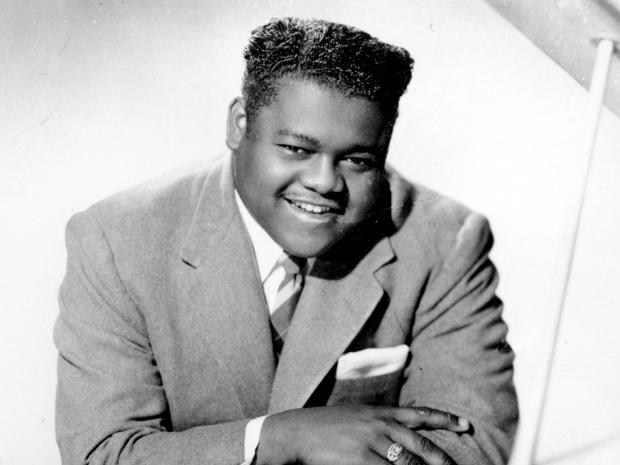 Antoine Dominique “Fats” Domino, one of the last surviving “Founding Fathers” of Rock n’ Roll, has died at the age of 89. According to the Jefferson Parish Medical Examiner’s office, Domino died of natural causes. A life-long resident of the New Orleans area, he gave the city a rock music vibe to complement its status as the birthplace of jazz. Young and old alike easily recognize his signature vocalization of the famous lyrics “I’ve found my thrill…on Blueberry Hill…”, a recording 61 years young.
Domino helped usher in rock n’ roll with his boogie-woogie piano played in his signature style, and did so thoroughly. Not only did he have hits at the dawn of rock’s explosion (1955) and for the rest of that decade, but he had R&B hits that helped firmly plant rock’s roots prior to then.
From the start of the 1950s through the early ‘60s, we sold 65 million singles and had 23 gold records, making him second only to Elvis as the strongest commercial force at the dawn of the genre.
To add depth to the legend, his image and persona were unforgettable. He stood at 5 feet, 5 inches tall (joking that he was as rotund as he was tall), and sported a big, infectious grin. During performances, he exhibited a fondness for the bling in the form of jewel-encrusted rings that he wore on most of his fingers – again, he wore these while playing the piano. His easy-going demeanor surely helped his public persona as well.
As each of Rock’s founding fathers contributed their own style to the genre, Domino was no exception, he having brought New Orleans parade rhythms to the proverbial party.
Domino was born on Feb. 26, 1928, the youngest of nine children. He grew up in New Orleans’ Ninth Ward, and spent most of his life there. His life changed forever when his family inherited a piano when he was ten. His brother-in-law was a jazz musician who wrote down the notes for young Antoine, and taught the boy some basic chords.
He threw himself fully into learning to play the piano, becoming almost entirely self-taught. Part of the self-teaching included playing records from noted boogie-woogie artists, including Amos Milburn, who would later have a slew of R&B hits in the late 1940s and early 1950s.
At this same time, he dropped out of the fourth grade so he could take a job as an iceman’s helper. He supplemented his piano practicing by playing pianos for customers in their homes while making deliveries. Later in his teens, he started working at a club called The Hideaway with a band led by a bassist named Billy Diamond, who first dubbed him “Fats”. It did not take long for Domino to become the face of the band and a huge local draw.
A songwriter, arranger, and producer named David Bartholomew took notice of this strong, local draw, and realized he found a special artist in Domino. By 1949, Bartholomew brought over the owner of Imperial Records, Lew Chudd, to The Hideaway in New Orleans to see Fats Domino in person and the amazing effects he had on the club’s patrons. As he told the Cleveland Plain Dealer in a 2010 interview, “Everyone was having a good time. When you saw Fats Domino, it was ‘Let’s have a party!’ ”
Together with Mr. Bartholomew, Fats Domino established his boogie-woogie style of piano playing early on with his first record, “The Fat Man,” an instant R&B hit when it charted in 1950 on the Imperial label. The song title would give him a stage persona for the rest of his career, and he would stay with that label for over a decade, churning out hits that helped define the 1950s. Another trait he established with his first record was his mastery of the non-word lyrics, namely the “wah-wah” sound that soon evolved into “woo-woo”.
Indeed, those very sounds added much to the character of another early 1950s R&B hit from 1953, “Please Don’t Leave Me”. A close listen indicates that, from the opening bars of that record, he already had honed his signature style of rapid piano triplets.
His most solid contribution to someone else’s record came in 1952, when he just so happned to visit a New Orleans studio. He was asked to help a nervous teenaged singer named Lloyd Price. Domino not only obliged, but came up with another memorable piano riff at the beginning of the track that set the tone for the entire song, “Lawdy Miss Clawdy”. The R&B record proceeded to become one of the first to cross over to the pop audience.
His style continued to gradually evolve to the right point at the right time when he had a hit that helped trigger the Rock n’ Roll explosion of 1955 with “Ain’t That A Shame”. But that was only a warm-up for what he was to record for the following year. People of all ages to this day can easily recognize his version of “Blueberry Hill” from its semi-staccato piano opening.
As a preschooler, it was within a handful of the first of popular tunes I recall hearing. At that time, the recording was not even 30 years old. The almost plaintive-sounding response/reactions of the horn section to Domino’s vocals are unlike anything recorded before or since, and undoubtedly contributed to the legendary status of the record. Those strains have certainly remained with me all these years.
The irony of “Blueberry Hill” is that, unlike, say, “The Fat Man”, it was not a Domino original, but a long-standing cover. The song originated in Big Band Era, with Gene Autry actually cutting the first know version in 1940. Glenn Miller followed suit on May 13 the same year (with Ray Eberle on vocals). Other bands and notable singers contributed their own “take” on it in the early half of the 1940s, including Kay Kyser, Russ Morgan, Jimmy Dorsey, Gene Krupa, and Connie Boswell. Glenn Miller’s version actually made it to No. 1 on the pop charts in 1940. Louis Armstrong would later cut a version with Gordon Jenkins’ band in 1949. But 16 years after the song’s introduction, Fats Domino truly made it into his own, so much so that it now comes as a surprise to many that earlier versions of it by other artists even exist.
Although Domino already had such a legendary record to his credit by 1956, he did not cease to cut great, memorable tunes. That same year, he produced some other notable tunes such as his version of “My Blue Heaven” and “When My Dreamboat Comes Home” (also holdovers from the Big Band Era). With both, Domino offered refreshing takes, particularly the latter. Also in Domino’s 1956 vintage is “I’m In Love Again”.
At the end of 1956, he churned yet another of his most memorable tunes, “Blue Monday”. Who can forget the quasi-chorus “Saturday mornin’…..Oh, Saturday morning…..all my tiredness have gone away….”? Clearly grammar was not the Fat Man’s strong point – no doubt a product of his aforementioned truncated education — but the tune was great anyhow, bluesy yet upbeat at the same time. As kid in junior high, I learned how to play the brief sax solo in the middle of the record in question.
His most notable track from 1957 was “I’m Walkin’”, another uptempo tune that has found its way into movie soundtracks and commercials over the years. Who can forget the sequence in “Blues Brothers” (1980) when the protagonist duo trapse all over Chicagoland announcing the Blues Brothers Showband and Revue?
“Whole Lotta Loving” is the stand-out tune in Domino’s discography from 1958, and he closed out the Fifties strongly with “I’m Ready”, “I Want to Walk You Home” and “Be My Guest” in 1959, all having different tempos. The first of the aforementioned three is particularly catchy. Its energy would make one think as though it was recorded closer to the rock explosion period of 1955-’57.
Even the early 1960s were a rather fecund period for Domino, having a hit in 1960 with “Walking to New Orleans”, a track played ad nauseam on the SiriusXM 50s on 5 channel. Other tracks from this period included Hank Williams covers (“Jambalaya”, “You Win Again”), originals such as “Let the Four Winds Blow”, and other covers such as “I Hear You Knocking” (Smiley Lewis’ hit from 1954) and “You Always Hurt the One You Love” (A Mills Brothers hit from 1944).
By 1963, his record sales were lagging considerably, and a switch to ABC-Paramount did little to revive them. But he remained a popular live act throughout the 1960s, touring Europe for the first time in 1962, and met the Beatles in Liverpool during that tour – before they became huge stars. By the mid-1960s, he appeared in Las Vegas for 10 months a year making live performances.
He quit touring for good in the 1980s, and settled back down in his hometown of New Orleans. Part of the reason for staying in his native city was that, according to him, it was the only place where he liked the food. Lucky for those in attendance, he was a regular performer at the annual New Orleans Jazz and Heritage Festival.
Still alive and well when Hurricane Katrina hit his native city on Aug. 29, 2005, he refused to leave his home in the Lower Ninth Ward even as it was flooding. Eventually he was rescued by helicopter on Sept. 1, and evacuated to Baton Rouge, La., where for a couple of days he stayed in then-LSU quarterback JaMarcus Russell’s apartment until taking up shelter elsewhere pending the receding of the floodwaters. The flood in the hurricane’s wake caused major damage to his home, having risen up 20 feet on the house, but it was fully rebuilt by 2007.
The timelessness of Domino’s music was discerned by some even when it was new. Jerry Wexler, the legendary producer at Atlantic Records, made a prediction as early as 1953, stating “Can’t you envision a collector in 1993 discovering a Fats Domino record in a Salvation Army depot and rushing home to put it on the turntable?” he wrote. “We can. It’s good blues, it’s good jazz, and it’s the kind of good that never wears out.” The fact that “Blueberry Hill” and other riffs from his other records remain recognizable today prove just how thoroughly that prognostication has come to pass.
 intellectualgridiron