Chuck Berry, Rock ‘n’ Roll’s Founding Father-Poet, Dies at 90 March 26, 2017
Posted by intellectualgridiron in History, Pop Culture.Tags: 1955, 1958, Beach Boys, big band, Bill Haley, Bob Wills, Buddy Holly, Carl Perkins, Chess, Chuck Berry, Country, Eddie Cochran, Elvis, Fats Domino, Founding Fathers, Gene Vincent, Glenn Miller, Jerry Lee Lewis, Johnnie B. Goode, Johnny B. Goode, Leonard, Little Richard, Maybelling, Moonglows, music, Nat "King" Cole, record, rock, Rock n Roll, Sam Phillips, Sun, Swing, T-Bone Walker, Tommy Dorsey, Voyager, western
add a comment
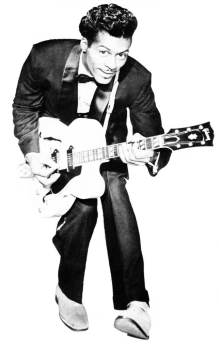
Chuck Berry in his most iconic publicity photo. Notice the traditional, shawl-lapel tuxedo, which was an implicit appeal to mainstream audiences.
Chuck Berry died at his home in St. Louis on March 18, 2017. He was 90 years old. Given that the musical genre of Rock ‘n’ Roll is over 60 years old by now, it comes as little surprise that most of its “founding fathers” are now dead. Some died when the music was still young (e.g., Buddy Holly, Eddie Cochran, etc.), others later on from old age (Berry), or any types of cancers or other ailments (Gene Vincent, Bill Haley, Carl Perkins), or drugs/pills (Elvis).
Only a few notable rock founders remain; Little Richard (84), Fats Domino (89), and, inexplicably, Jerry Lee Lewis (81).
But Chuck Berry’s passing is particularly notable since his musical legacy is arguably, outside of Elvis, the farthest-reaching of any of Rock’s Founders, both literally as well as figuratively.
Take the obvious example of “Johnny B. Goode”. As we speak, it hurtles through the cosmos, cut into golden records affixed to both the Voyagers I and II spacecraft. Should some intelligent, extraterrestrial beings find these probes thousands of years from now, they shall hear it as a prime example of music produced by the people of Earth. Let that sink in for a moment.
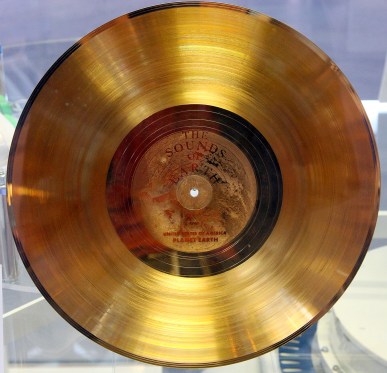
An authentic duplicate of the gold-plated records that were launched along with the two Voyager spacecraft in 1977 and continue to silently sail beyond our solar system. Among the diversity of music on this disc is Chuck Berry’s “Johnny B. Goode”. (C) photo by author at the Udvar-Hazy Center in Chantilly, Va., Nov., 2014.
But back down to Earth, the song’s energy and mood take on a spirit of their own. It has been used in countless movie soundtracks for one. Its opening guitar riff is one of the most famous in the history of the electric guitar, and grabs the listener with its first few opening notes on Berry’s Gibson ES-350T, never to let go. Though recorded in 1958, even almost 60 years later, it still has the incredible ability to both raise the energy and lighten the mood of a room, no matter how lively the scene may currently be. Personal experience has demonstrated this on a number of occasions. Feeling lethargic during the morning commute to work? Call up Johnny B. Goode on your mp3 library in your car: that record will rev you up to take on the day without fail.
Guitarists both professional and amateur the world over have picked up their cherished instrument out of inspiration for that record’s famous opening riff, many having spent months trying to learn to imitate it. But if all that does not demonstrate the distance and depth Chuck Berry’s musical legacy, consider the aforementioned space travel note.
Like many artists, Berry himself was not example well-adjusted, either during his youth or adult life. Despite growing up in a middle-class family in St. Louis, he had a serious run-in with the law before graduating from high school. During his Senior year, he was arrested and for armed robbery and for stealing a car at gunpoint, and sent to reformatory near Jefferson City, Mo., in 1944, and was released on his 21st birthday in 1947.
He married in 1948 and worked jobs ranging from janitor of the apartment where he resided to factory worker at auto plants in St. Louis in order to support his wife and young family. At one point, he even trained as a beautician, which might explain his distinctive hairstyle on stage and in publicity photos.
Speaking of the stage, however, he did have a life-long interest in music, and even gave his first public performance as a high school student in 1941. By the early 1950s, he started working with local bands to supplement his income, formulating his own style by borrowing heavily from the riffs of T-Bone Walker, further honed by guitar lessons from his friend Ira Harris. By early 1953, he was performing with Johnnie Johnson’s trio. That collaboration would prove fruitful for both, for it was Johnson who would be the reliable pianist behind Berry’s many legendary tracks after his own band became yesterday’s news. Indeed, his piano playing seemed to perfectly complement Berry’s guitar on “Johnny B. Goode”.
The irony in Berry’s successful formula is that it took an opposite approach to the one Elvis Presley used for his own success. Sam Phillips, the founder and owner of legendary Sun Records, realized that Elvis had the potential for huge commercial success by being a white person who could imitate the singing mannerisms of black artists. Berry came up with a different recipe. He covered Country-Western songs – along with the requisite R&B tunes – to the vocal stylings of Nat King Cole, backed up with the musical stylings of Muddy Waters. Translation: instead of a white guy covering R&B tunes, he was a black guy covering [white] Country-Western tunes, with mainstream vocal styling and enough R&B musical backing to give the music an edge, and in so doing brought in a much wider, more affluent audience than he would have by simply sticking to the blues. His calculated showmanship was also a key ingredient in his success, as he frequently wore a tuxedo during live performances in order to appeal to the aforementioned mainstream audiences.
Perhaps the best example of Berry’s use of Country-Western came about after he actually first met Waters when he traveled to Chicago in May of 1955. At Waters’ behest, Berry contacted Leonard Chess (founder and owner of Chess Records), demonstrating to the rising executive what he could produce for him. What grabbed Chess’ attention was Berry’s adaptation of a fiddle tune called “Ida Red”, which was recorded by Country Swing bandleader Bob Wills* in 1938. Berry recorded this Rock adaptation of Ida Red under a new title, “Maybelline” on May 21, 1955. The song soon sold over a million copies, and became one of the key records that gave fuel to the explosion of Rock n’ Roll that very same year.
The same year (’55) yielded other great records by Chuck Berry, including “Thirty Days”. In both cases, one thing that stands out is his guitar. His Gibson ES-350 model was his signature instrument in the same way that Buddy Holly would come to “own” the Fender Stratocaster. The ES-350 (“E.S.” standing for “electro-Spanish”, incidentally) had the sublime combination of the traditional, mellow tones of a hollow-body archtop guitar, but with a hard edge to make things very interesting. Berry quickly learned to use this potent combo to amazing effect, as his first hits alone clearly show.
The following year (1956) would prove just as fruitful, especially with his hard-charging hit “Roll Over Beethoven”. Also added to that year’s successful mix was “Too Much Monkey Business” and “You Can’t Catch Me,” the latter of which he also performed in the movie “Rock, Rock, Rock” that same year.
The very soundtrack from 1957 cannot be complete without both “Rock and Roll Music” and “School Days,” while 1958 proved, arguably, to be Berry’s most fecund vintage. Not only did ’58 produce the legendary “Johnny B. Goode,” but also “Sweet Little Sixteen” – the song that became the inspiration for the Beach Boys’ huge hit “Surfin’ USA” the following decade – but also “Carol”, “Reelin’ and Rockin’”, “Around and Around”, “Sweet Little Rock and Roller”, and “Run, Rudolph, Run”. One can easily be forgiven for mistaking the last number with “Little Queenie,” which charted the following year: both of which share an identical melody.
The year 1959 proved just as energetic, though, as he recorded “Little Queenie (as already mentioned),” “Memphis,” “Let It Rock” “Almost Grown,” and “Back in the USA”, the latter two having been augmented by the vocal backup of The Moonglows, who were Chess Records stablemates.
“Let It Rock”, although a brief track at 1:47, also merits special notice as he successfully emulates the sound of a train with his guitar. Little Richard proved that the Holy Grail of Rock was the “freight-train” effect in music. Richard achieved this with the combination of percussion and piano syncopations, sometimes with saxophones mixed in, too. Berry’s unique contribution was, as already mentioned, via guitar.
Even by 1960, when the genre had already evolved itself into something less energetic, Berry was still producing songs of comparatively exceptional energy such as “Bye, Bye Johnny” (an obvious follow-up to Johnny B. Goode).
Only in 1961 did his career take a temporary turn for the worse when his mal-adjustments caught up with him yet again. This time he was arrested and eventually convicted for violating the Mann Act (transportation of underage women across state lines for immoral purposes).
Released after serving a year and a half in prison, he immediately returned to recording and quickly produced more hits, including “Nadine” and “No Particular Place To Go,” (the melody borrows heavily from “School Days”) and “You Never Can Tell”, all of which clearly the recalled the energy and excitement of the previous decade when rock was fresh. This, at a time, when what passed for “rock” had become comparatively boring and listless. Even in the early 1960s, both Chuck Berry and Little Richard were keeping the flame alive long after their still-active contemporaries had sold out. The only thing about him that did seem to evolve was his choice of guitar. Instead of his blond-finished ES-350, he seemed to increasingly favor a red ES-335 instead.
Perhaps the grandest irony of Chuck Berry’s career was that he did not have a “Number One” hit on the Pop charts (though several topped the charts, or came close to doing so on the R&B charts). Johnny B. Goode peaked on the Pop charts at No. 8; Sweet Little Sixteen actually surpassed it, peaking at No. 2. Not until 1972 did Berry finally have a record that achieved Number One status on the Pop charts with the rude novelty song “My Ding-a-Ling,” the lyrics of which would put Sterling Archer’s famed reaction-expression of “phrasing” into overdrive!
Berry’s music from the ’50s and early ‘60s also causes us to reconsider Rock music’s ancestral origins. Many historians quickly point out Rock’s base ingredients of both R&B (sometimes outright Blues itself) and Country-Western, and those key ingredients are clearly evident across the board. But the third key ingredient of Big Band-Swing is often overlooked entirely. A careful study of Chuck Berry’s own interviews verifies this as a key ingredient to the genre he helped, ironically, create.
A 1987 LA Times article revealed Berry in that year reminiscing not of his early hits or those of his contemporaries, but of Tommy Dorsey’s “Boogie Woogie” (1938) and Glenn Miller’s “In the Mood” (1939). “The Big Band Era was my era,” he candidly clarified. “People say, where did you get your style from. I did the Big Band Era on guitar. That’s the best way I could explain it.” He even continued, “”Rock ‘n’ roll accepted me and paid me, even though I loved the big bands . . . I went that way because I wanted a home of my own. I had a family. I had to raise them. Let’s don’t leave out the economics. No way.” Indeed, in that same interview, he was even more candidly frank in saying that he would have been even happier crooning Nat King Cole-style songs instead of rock. Let us take a moment to pause and consider that as our collective jaw drops to the floor in amazement.
But perhaps we ought not to be so surprised. In his ‘Rockumentary’ film “Hail! Hail! Rock ‘n’ Roll”, also from 1987, he attempted to croon, during a rehearsal session in his home, to traditional American Pop Standards “I’m Through With Love” and “A Cottage For Sale.”
Yet another clue, though, shows up in a live gig he did at the Newport Jazz Festival in 1958.
Notice the jazzy approach he takes toward the live rendition of this hit record from the previous year.
To put things in yet another perspective, one could make the case that Berry did not sing Rock music insomuch as he sang folk music set to Rock ‘n’ Roll. Johnny B. Goode, for example, became a hero of legend as the protagonist in Berry’s immortal record. In the case of “No Money Down,” the lyrics describe the dream of every new car buyer to this day. “School Days” articulate the day-to-day experience of kids in junior high and high school like no other song ever, and they still ring just as truly today, 60 years later. “Too Much Monkey Business” describes/pokes fun at the struggles of most 20-something men as they make adjustments to adulthood and the responsibilities thereof. “Back in the USA” speaks the heart of every patriotic American who is grateful to return to their beloved native land after travelling abroad. Even “You Never Can Tell” speaks to the hopes and the potential of young newlyweds as they just start off on their own.
Chuck Berry’s music packed a punch still that resonates strongly today, more than sixty years after this first recording sessions were put to tape. His guitar riffs are the stuff of legend, and everybody guitar player, professional and amateur alike, owes some degree of debt to him for their own inspiration. But ironically, Chuck Berry’s greatest staying power might be on account of his own lyrics, which made him the poet of Rock’s Founding Fathers, and who has now joined most of his fellow contemporaries in a higher plane of existence.
*According to the late Waylon Jennings, “Bob Wills is still the king (of country)!”
On NASA “Boilerplates” March 16, 2017
Posted by intellectualgridiron in Science.Tags: 13, Apollo, astronaut, boilerplate, command, Cosmosphere, Fred Haise, Jack Swigert, Jim Lovell, Louisville, lunar, module, museum, NASA, Odyssey, Udvar-Hazy
add a comment
Usually when you think of the word “boilerplate”, you might think of some sort of insincere, hackneyed statement from a public relations person or a politician. But when it comes to the history of space exploration, the term takes on a much more important meaning.
Boilerplate spacecraft are simulations of the real spacecraft, having the size and shape of the real thing on the outside, but are not actual flight articles. Their use is for simulation and testing without putting an actual, flight-ready spacecraft at risk to damage, etc. The video above offers a more thorough explanation with some excellent examples of how such mock-ups were utilized.
I have had the privilege of encountering lots of genuine NASA spacecraft over the years, but I’ve encountered a few interesting “boilerplates” as well. Indeed, by interest in space was kindled by frequent encounters with a boilerplate. As a Louisville, Ky., native who lived the first 6 and a half years of his life in that city, my parents often took us to what is today called the Kentucky Science Center (back then it was the Louisville Museum of Natural History and Science). From about 1980 (the year I was born) to about 1996, they had an impressive space gallery on the first floor, with all sorts of cool space artifacts.
I can still see them all as a kid, walking along and viewing the amazing vestiges of “vintage space”. There was a test pilot’s helmet from the 1950s; various astronaut gloves, an astronaut suit (whose specifically I cannot recall); a 1:4 scale model of an Apollo Lunar Module; an old Gemini simulator that you could actually sit down inside; part of an old rocket engine; 1960s-era NASA mainframe computer panels (no joke – these made up a mini-corridor all their own); a scaled down model of an Apollo Command Module, pre-launch, hence its white exterior (about 1:8 scale, give or take).
But the obvious crown jewel of the exhibit was Apollo BP-1102A, a water egress-training module. After Apollo 13’s “successful failure,” NASA removed the interior of that used spacecraft and moved it into this particular boilerplate for investigation purposes. The shell of the Command Module Odyssey was eventually put on display at the Air and Space Museum in Paris (yes, France), while Odyssey’s interior and newly wed BP-1102A somehow found their way to the museum in Louisville. In that same room, there was a photo of all three astronauts from that mission on hand for an exhibit inauguration ceremony in front of the museum’s façade along Main Street in downtown. Since this was around the time I was born, it was a fortunate thing that all three astronauts — Jim Lovell, Jack Swigert, and Fred Haise — were able to be together again, as Swigert died of cancer roughly two years later, ironically just after getting elected to Congress.
As a very young boy, I did not know about “Boilerplates”: all I understood was that the Apollo 13 was in my hometown. As I got older, it gradually dawned on me that the authentic part of the display was the capsule’s interior, while the exterior shell was a mock-up. The copper-colored paint job was to make the boilerplate look like the Block II Apollo Command Modules during splashdown, after they burned to a golden-brown color during re-entry on account of the massive fraction of Earth’s atmosphere.
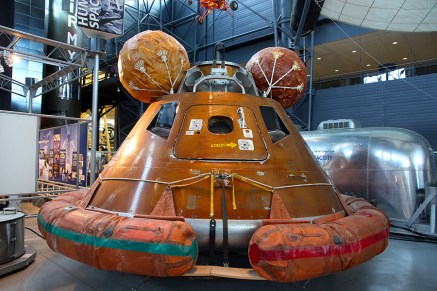
As a Louisville native who visited the Kentucky Science Center as often as I could growing up, encountering this distinctive Apollo boilerplate at the Udvar-Hazy Center was like seeing an old friend. (C) photo by the author; Nov., 2014.
But all good things come to an end, sooner or later. By the latter half of the 1990s, the whole spacecraft was gone. The popular 1995 film Apollo 13 with Tom Hanks, Kevin Bacon, and the late Bill Paxton had apparently made the local spacecraft landmark too valuable a commodity to be tucked away in Louisville. What I heard at the time was they reunited the interior with the exterior shell, but the “restored” spacecraft’s whereabouts were unclear to me, until I later found it that it was on new display at the increasingly famous Cosmosphere in Hutchinson, Ks. (Of all bloody places!) Moreover, the space hall was moved up to the second floor of the museum, and by that time, it was already a shell of its former self. Presently, the whole exhibit has been phased out, sadly, but the Gemini simulator is still on display there, thankfully, ever inviting guests to sit down inside and experience a hint of “vintage space” for themselves.
But one thing I did wonder for the longest time was, whatever happened to BP-1102A? Only in recent years did I learn of NASA spacecraft boilerplates, and that is when I “put two and two together” and realized that I had many a hands-on encounter with such a test model while growing up and did not even realize it at the time. Convinced I would never see it again, I was eventually proven mistaken.
A past job fortuitously took me out to the East Coast for a month in November of 2014. While there, I seized the opportunity to visit the Udvar-Hazy Center (a remote annex to the Smithsonian Air & Space Museum) near Dulles International Airport. While there, I came upon a boilerplate that looked eerily similar to the one I always ran to the old space hall in Louisville as a young boy. Further research afterwards indicated that I had indeed seen an old “friend” for the first time in almost 20 years. In addition to being given a much more prominent venue for display (it does not get any bigger or higher-profile than the Smithsonian), it has also been fitted with the flotation collar and balloons from the Apollo 11 – talk about an upgrade!
Not too long after this reunion of sorts, I came across another Apollo boilerplate (29A), this time at the immense Meteor Crater near Winslow, Ariz. Obviously, it is but a small side-show to the main attraction, but it is intriguing to encounter nonetheless. Much like BP 1102A, the purpose of Boilerplate 29A was to test the systems that helped the Apollo capsules stay afloat during splashdown in the ocean.
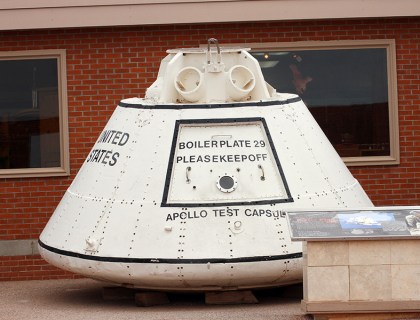
Another Apollo Boilerplate (29A) that I encountered while visiting the massive Meteor Crater near Winslow, Ariz. (C) photo by author; May, 2015.
The lesson of this story – such as there is one at all – is to keep your eyes peeled for these interesting space artifacts during your sojourns, as you never know when you might encounter them. After all, as the video at the top of the article reminds us, they have their own special place in the history of space travel and the development thereof.
Time to Re-think “6 AM’s” March 1, 2017
Posted by intellectualgridiron in Sports.Tags: 6 AM, college, conditioning, football, Iowa, NCAA, Oregon, Rhabdomyolysis, winter, workout
add a comment
There is an oft-overlooked part to college football that has gotten out of control. As a former Big Ten football team staff member, I had to endure what are, in the industry, known as “6 AM’s”. The simple definition/description is that they are winter conditioning sessions for college football players, usually starting in late January and lasting until Spring Practices begin.
They are also a royal pain in the backside. College kids have a hard time getting enough sleep as it is. Now imagine having to get up no later than 5 in the morning and trudge yourself into the football facilities. Show up for work all dressed in normal practice garb no later than 5:30 in the morning so you can set up the equipment for these early morning conditioning sessions.
At least we did not have to run through all those grueling drills: that was for the players to do. Good luck being able to maintain consciousness in your classrooms for the rest of the day. If you miss class because you are too tired, coaches typically cook up special penalties, such as more running. At Purdue during the Joe Tiller era, the penalty was for players who missed class to start running at 5:30 – meaning we would have to get things set up prior to that time – after which they had to join the rest of their teammates for the 6 AM B.S.
As bad as they have been, coaches have gone too far with these “6 AM’s”. One recent example is of several Oregon football players needing hospitalization during such a session, which included an hour of push-ups and “up-downs.” An hour, seriously? Some of these hospitalized players were diagnosed with Rhabdomyolysis, which basically involves the soft muscle tissue breaking down, then leaking into your blood stream.
But that was just earlier this year. Back in 2011, 13 Iowa football players were hospitalized for the same problems following one of their winter conditioning sessions.
It is perfectly reasonable for coaches needing their players to be in shape. Moreover, it make sense that they already be in shape for spring practices, so that the coaches can properly ascertain what sort of talent they have to work with for the upcoming fall season that year. But treating these winter conditioning session as “gut checks” is horribly antiquated, and arguably abusive.
The problem is that coaches too often use these “6 AM” drills (some coaches smartly schedule them in the afternoon, but not enough of them do) as a symbolic gesture to remind players that they are under said coaches’ thumbs, so to speak. Coaches also too often use these drills as an excuse to put them through “gut-checks”, testing their manhood so as to earn the coaches’ respect and earn their right to stay on the team. Again, this is not always the case, but incidents like those mentioned above give that impression.
By all means, have conditioning sessions, but coaches, be both sensible and reasonable and have them in the afternoon…like sane people. There is nothing holding coaches back from implementing these sensible solutions: only ego and antiquated thinking. It’s just a matter of coaches having the good sense to be practical and realize that they can get their players in good enough shape without sleep-depriving them, ruining their entire days of class, and fatiguing them to the point of needing hospitalization. This is not the Marines, let alone the French Foreign Legion.
Give the players a break, schedule the conditioning sessions in the afternoon, and focus on getting them in shape without having to put them through daily gut-checks. After all, they should have earned your respect by their willingness to show up in the winter to go through such hell before even putting on helmets and pads later in the springtime. For those coaches who already honor this ethic, kudos.
 intellectualgridiron